


Chernobyl at 40: As the world bets on nuclear again, has it learned the lessons?
Forty years ago, a reactor taught the world what arrogance and opacity can do to atoms under pressure. Forty years on, the world is turning back to nuclear power again — whether that proves wise or hubristic depends on remembering the past and not repeating it

On the night of April 26, 1986, at twenty-three minutes past one in the early hours, Reactor Number 4 of the Lenin Nuclear Power Plant near the Ukrainian town of Pripyat in the then USSR exploded during a botched safety test. The reactor hall roof was blown apart, a graphite fire raged for ten days, and a radioactive plume drifted across Belarus, Russia, Scandinavia, and much of Europe.
Forty years later, the world, with more than 400 operational reactors and more than 70 under construction, is more dependent on nuclear energy. This is the paradox our generation must reckon with, though we will return to it a bit later.
The Night the Atom Slipped its Leash
As the BBC and AP’s fortieth-anniversary dispatch, carried by PBS NewsHour and The Washington Post, all recount, the disaster began with a poorly designed experiment. Operators shut down the reactor’s power-regulating system and emergency safety systems, removed control rods, and allowed the unit to run at 7 per cent power. Within seconds, output rose to 50 per cent; fuel elements burst; superheated particles flashed cooling water to steam; explosions blew off the reactor lid and the building’s roof. The graphite core caught fire. According to the World Nuclear Association, this remains the largest release of radioactive material ever from a civilian nuclear plant.
 More from Opinion
Two workers died that night. Of 237 hospitalised, 134 developed acute radiation syndrome, and 28 died within three months. Around 600,000–800,000 "liquidators" — soldiers, miners, plant workers, and firefighters — were sent in to seal the wound; over 300,000 residents were permanently resettled. An exclusion zone of 1,838 square miles, the size of Rhode Island, was abandoned across Ukraine and Belarus. PBS NewsHour’s Simon Ostrovsky, reporting from inside the zone in April 2026, found a skeleton crew of about 600 still managing radioactive debris — a clean-up now slated to continue until 2064.
Consequences: A Generation in the Shadow
The United Nations and the World Health Organisation eventually attributed around 4,000 long-term cancer deaths to Chernobyl, though independent reviews cited by The Guardian and The New York Times have placed the figure as high as 16,000 across Europe. The most significant, clearly established health effect was a dramatic increase in thyroid cancer among children and adolescents exposed to iodine-131, with over 6,000 cases documented by 2005. The mental health toll — chronic anxiety, alcoholism, displacement trauma — is now considered by the WHO to be the single largest public health consequence.
The political consequences proved as radioactive as the physical ones. In an article written for the 20th anniversary of the disaster in April 2006, Mikhail Gorbachev stated: "The nuclear meltdown at Chernobyl... even more than my launch of perestroika, was perhaps the real cause of the collapse of the Soviet Union five years later." PBS NewsHour’s archival footage from April 1986 shows how a TASS bulletin tried to bury the catastrophe. Italy shut its plants by referendum in 1987. Austria abandoned an already-built reactor. Germany set out on the long road to its 2023 phase-out. Three Mile Island in 1979 and Chernobyl in 1986 ended new American reactor construction for nearly three decades. Then came Fukushima Daiichi in March 2011. By the mid-2010s, the obituary for nuclear power was being widely written.
The Nuclear Power Renaissance
And yet, the obituaries were premature. The latest tally shows over 400 nuclear reactors operational in 31 countries, with about 70 more under construction — producing roughly 10% of the world’s electricity and a quarter of all low-carbon power.
International Energy Agency (IEA) Executive Director Fatih Birol adds that the revival was visible “years ago” and is now accelerating. The IEA reported in April 2026 that some 78 GW of capacity is under construction across 15 countries — the highest levels in three decades. The table below provides a bird's-eye view:
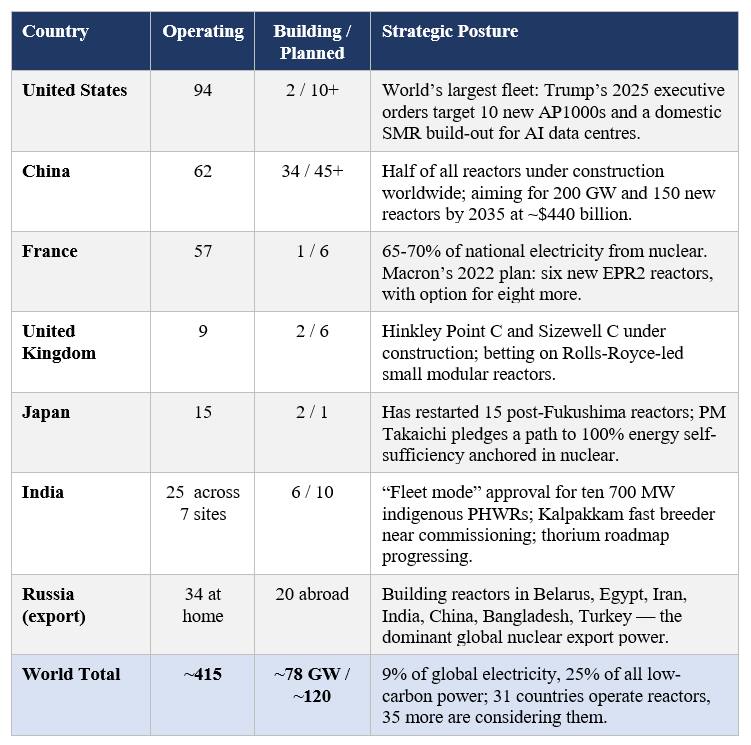
The picture is unmistakable. The United States leads but has built almost nothing new for thirty years. China is building reactors fastest, with 40 under construction and a goal to surpass the U.S. and become the global leader in nuclear capacity. France, with 57 reactors, remains European — Macron announced in 2022 six new EPR2 reactors. The AP-PBS report quotes Paris-based consultant Nicolas Goldberg observing that Covid and the Ukraine gas crunch “revealed the limits of deploying renewable electricity and Europe’s dependence on gas,” reinforcing France’s strategy of extending its existing fleet. The United Kingdom is mid-build at Hinkley Point C and Sizewell C, betting on Rolls-Royce SMRs. Japan, fifteen years after Fukushima, has restarted 15 reactors with 10 more under restart review. India operates 25 reactors, has six under construction, and ten 700 MW indigenous PHWRs cleared in “fleet mode.”
Beyond these six lies a quiet but consequential story: Russia operates 34 reactors at home — including eight modernised Chernobyl-type RBMKs — and is building 20 reactors abroad. Rosatom is the dominant export power in atomic energy today. Ukraine still relies heavily on nuclear plants to generate about half of its electricity. Africa remains thinly nuclearised: South Africa’s Koeberg is the continent’s only operating plant, but Russia is building Egypt’s El Dabaa, and Ghana, Kenya, Morocco, and Nigeria are at various planning stages.
US Undersecretary of State Thomas DiNanno said last month, "The world cannot power its industries, meet the demands of artificial intelligence, or secure its energy future without nuclear power," and European Commission Chief Ursula von der Leyen has acknowledged that it was Europe’s "strategic mistake" to cut nuclear energy. The European Commission has categorically shifted its perception of nuclear energy and now views it as part of clean energy, alongside wind and solar power, to achieve climate goals.
Rafael Grossi, the Director General of the International Atomic Energy Agency, said recently, "The momentum we are seeing today is the result of a growing recognition that reliable, low-carbon electricity will be essential to meet the world’s rising energy demand."
The world is unmistakably returning to the era of increasingly nuclear energy.
Germany remains the sole exception. It has zero operational nuclear power reactors following the shutdown of its final three plants (Emsland, Isar 2, and Neckarwestheim II) and is not building any new reactors, having completed a long-term phase-out policy, and is instead focusing on renewable energy.
Why the World is Returning to the Atom
Why, four decades after Chernobyl, are governments racing back? Consensus reports converge on five overlapping forces.
Climate imperatives: Twenty-two nations, led by the US, France, the UK, and Japan, pledged at COP28 to triple nuclear capacity by 2050; that coalition expanded to 38 countries at the 2026 Paris Nuclear Energy Summit.
Artificial intelligence and data centres: Hyperscalers need round-the-clock, dispatchable, carbon-free power. Microsoft has signed a deal to restart Three Mile Island Unit 1; Amazon has committed to 5 GW with X-energy; Google is partnering with Kairos Power for 500 MW; Meta is pursuing 4 GW. CNBC and the Wall Street Journal describe this as the single most important demand-side shift in the industry’s history.
Energy security after Ukraine: As The Guardian and PBS observe, Russia’s 2022 invasion of Ukraine — and Europe’s painful divorce from Russian gas — made baseload electricity a strategic asset again. Poland is building its first reactors; Sweden and Belgium have reversed phase-out plans; Italy is debating the reversal of its 1987 ban.
New technology and lower expected costs: Small Modular Reactors of 50–300 MW promise factory-built, standardised, passively-safe designs. The US Nuclear Regulatory Commission certified NuScale’s SMR design in January 2023, and on 4 March 2026, approved the construction permit for TerraPower’s Natrium reactor. The Natrium permit is particularly historic as the first for a non-light water reactor in over 40 years. China’s HTR-PM (High-Temperature Gas-Cooled Reactor - Pebble-bed Module) at Shidaowan in Shandong province began commercial operation on 6 December 2023, following a successful 168-hour demonstration run. It is widely recognised as the world’s first commercial-size Generation IV modular nuclear power plant.
Demographic and developmental pressure: Asia and Africa cannot decarbonise without firm power. India’s per-capita electricity consumption is still less than a third of China’s; that gap will be closed largely through new generation.
The Middle East War: And the Shift to Atomic Power
The 2026 US-Israel-Iran war (the first twelve-day war and later full-scale warfare spreading in impact and damage to the Middle East), its impact on Middle Eastern oil and gas production, dispatch, and prices, and the closure of the Strait of Hormuz, has been the single sharpest accelerant. The AP-PBS report opens with the explicit observation that the nuclear revival has been “given a big boost by war in the Middle East.” Reuters describes oil and LNG markets convulsing, petrol queues in Vietnam, LNG cargoes rerouted at sea, and spot power prices doubling across Asia.
Japan has accelerated reactor restarts. South Korea reversed its phase-out. Vietnam revived its dormant programme. The Philippines is reactivating the mothballed Bataan plant. The UAE’s four-unit Barakah complex is now fully operational; Saudi Arabia has announced sixteen reactors by 2040; Egypt’s El Dabaa is rising on the Mediterranean coast; Turkey’s Akkuyu is being commissioned. The World Economic Forum calls the period since June 2025 a “structural break.” Where the Yom Kippur War of 1973 birthed the first nuclear build-out in France and Japan, the Iran war of 2026 is birthing the second.
The Cautions: What Forty Years Should Have Taught Us
None of this absolves the technology of its real risks, and a thoughtful world must hold both truths at once.
Safety and human factors: Chernobyl was a catastrophe of design — a flawed RBMK reactor — compounded by hubris and Soviet secrecy. Fukushima was a failure of imagination about tsunami height. Modern reactors are far safer, but engineering cannot eliminate the human factor.
Nuclear waste: Finland’s Onkalo is the world’s first operating deep geological repository, but the rest of the world is decades behind. Most spent fuel pools were never designed for indefinite storage.
Cost and time overruns: The U.S. Vogtle 3 and 4 came in at twice projected cost; France’s Flamanville 3 took seventeen years; the UK’s Hinkley Point C is well over budget. NuScale cancelled its flagship Idaho SMR in 2023 when costs jumped from $5 billion to $9.3 billion.
Proliferation: Every civilian programme creates dual-use knowledge. Iran’s enrichment programme, exposed by International Atomic Energy Agency (IAEA) reports cited in The New York Times, must temper any uncritical embrace of nuclear export diplomacy.
War and reactors: PBS NewsHour’s 2026 dispatch from inside Chernobyl is itself a warning: Russian troops occupied the site in 2022 and, plant manager Nikolai Pobedin told PBS, “used us like a shield to store their weapons and equipment. After all, no one would attack a nuclear power plant.” Drone strikes on Chernobyl’s containment shelter, shelling around Zaporizhzhia, and damage near Iran’s Bushehr plant during the 2026 strikes have prompted IAEA Director General Rafael Grossi to warn of “the most serious threat to nuclear safety since 1986.”
End Note: The Way Forward
The lesson of the forty years between Chernobyl’s plume and the Hormuz blockade is not that nuclear power is safe, nor that it is dangerous — it is that nuclear power is consequential. It is the only proven, scalable, dispatchable, near-zero-carbon energy source humanity has invented, and the only one that can fail catastrophically across borders and generations. To pretend otherwise, in either direction, is dishonest.
The way forward is therefore neither a romantic dash for atomic abundance nor its reflexive rejection. The future needs disciplined, transparent, internationally governed expansion. The world should demand five things of every new programme:
- Standardised designs and serial construction to control costs.
- Independent regulators insulated from political and commercial pressure.
- Mandatory deep geological waste repositories before new builds expand.
- Internationally enforced no-strike norms for civilian reactors in any future conflict; and
- Binding limits on enrichment and reprocessing for new entrants under IAEA Additional Protocols.
Nikolai Pobedin, the Chernobyl manager who stayed at his post for nearly four decades, said that nuclear power is “the energy of the future”. He may be right — but his lifetime of vigilance is proof that the future must be earned, not assumed. Forty years ago, a reactor in Pripyat taught the world what arrogance and opacity can do to atoms under pressure. Forty years on, the world is choosing to trust the atom again. Whether that choice is wisdom or hubris will depend not on the technology itself, but on whether this generation has the humility to remember Pripyat — and the discipline never to repeat it.
(The author is a multidisciplinary thought leader with a strong action bias and an India-based impact consultant. He is a keen watcher of changing national and international scenario. The views expressed are personal and do not necessarily reflect the views of Firstpost.)

Could India have done more to prevent the Iran war?
The Russia-Ukraine war: Why peace remains so elusive
Head-on | Why President Trump is targeting India
When Manila and Tokyo draw a line, Beijing draws a red line
Bangladesh gets a new envoy to reset its India ties