Every single Indian festival has its own speciality and importance wherein it gets related to that seasonal food and behaviour
Hinduism is the only culture where women are worshipped. Every single Indian festival has its own speciality and importance wherein it gets related to that seasonal food and behaviour. Some festivals are related to harvest. So, our forefathers revolved these festivals around the above things to express our gratitude to
Devtas and to express our joy.
Diwali and
Holi have their own hues and celebrations. Ganapati, at one time, was a regional celebration but now has become a national favorite. Although Ganesh
Chaturthi is the longest celebration of 10-11 days,
Navratri is outstanding among them.As per
Skanda Puran (Uttarardha 72.85-89). During the
Navratri every year, pilgrimages should perform festivals towards Bhagwati by the devotees along with the members of their families, seeking blessings and favor. If anyone of evil intellect fails to perform the annual religious festival of
Durga Mata, there shall be thousands of obstacles at every step for him or her.This denotes that this festival attaches importance to gaiety and joy, with pilgrimage being an integral part of the celebration. South India has its own
Golu. So this universal festival expresses its joy in various forms. Some people sing and chant devotional songs. Some observe a nine-day fast, especially the people of the north.So also, people of the Western region celebrate this festival by playing
Garba and
Dandiya, particularly in Gujarat. As per Shri Kanti Patel (Renowned Gujarati Author and Critic), Poet Dayaram and Vallabh Bhatt had written
Garba and
Garbi in the worship of
Amba, both narrating the importance of
Pawagarh or Ambaji. Garba is the song sung during
Ashwin Navratri praising
Maa Durga. The peasants are in the end stage of the harvesting festival, so it is thanksgiving to
Maa Bhagwati for taking care of her children. Some fast some feast in this festival. Eastern India feasts and rejoices as a mark of respect to
Maa Durga in the form of
Durga Puja. This dance origin comes from
Dwapar Yuga; as
per Bhagwat Puran 10.29.1, it was during the Autumn season this dance was performed by Krishna and
Gopis, Many Traditional Sages believe this dance as
Atama meeting
Parmatma, and hence entire Gujarat celebrates it with great joy. Also, it is mentioned, as per
Skanda Puran Uttara 72.85- 89, A hint of joy and festivity during this celebration is indicated for these 9 days. As per
Shiv Puran chapter 51.73 - 82, the following narrative proves how ancient this festival is.Bengal has a great significance in
Durga Puja, as to the Tourism department of West Bengal 2018; as per recorded history in Bengal, the 1
st Durga Puja celebration was done in the 15
th Century; Dinajpur and Malda started the first Durga Puja celebration in Bengal. Many local people believe that Raja Kangshanarayan of Taherpur or Bhabananda Mazumdar of Nadiya held the
Ashwin Durga Puja in Bengal in the year 1606. Even it is said that The
Baroyari started
Durga Puja with 12 friends of Guptipara in Hoogly, West Bengal, who started the first community puja, which was known as
Baroyari Puja(
Baro means 12& Yari means Friends) in 1790. This
Puja entered Kolkata in 1832 by Raja Harinath of Cossimbazar, who performed the
Durga Puja.As per
Shiv Puran Uma Samhita Chapter 51.73-82, It says the devotee shall observe the holy rites of
Navratri in the
Shukla Paksha of
Ashwin and fulfill his desires. None of the
Devtas, neither Brahma nor Shiva nor Karttikeya nor anyone else, can describe the importance of the rites of Navratri. By performing the Navratri rituals, King Suratha, son of Virata, regained his lost kingdom. The intelligent king of Ayodhya, Sudarshana, son of Dhruvasandhi, secured the lost kingdom. Performing this great rite and propitiating the goddess. Makes you free from worldly bondage for attaining Moksha. Shiva fulfills all the mental desires when
Ashwin Navratri performs.This all comes under
Śhākta culture, which is one of the oldest cultures as our oldest book of
Sanatan Dharma, i.e.,
Rig Ved, where
Sayan Bhasya of Rig Ved 7.103.5 mentions
Śhākta/ शाक्त(शाक्तस्येव शक्तिमतः). Even Arjun performed
Durga Puja as per
Mahabharat Bhishma Parva Chapter 23. Even we have
Devi Suktam in
Rig Ved 10.125.1-8. Hence this concludes that
Śhākta and its traditions have been followed since the Vedic era.
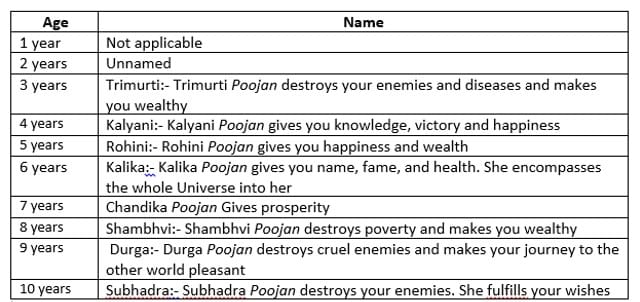
Navratri and Kanya Pujan as per Devi Puran/em>: Twice a year in the season of Sharad and Vasant, in the months of Ashwin and Chaitra, Maa Bhagwati visits our home for nine days. The Navratri days are the most sacred days as even Devtas worship Durga Bhagwati on these days. Her blessings are more important since this time of the year brings diseases due to weather changes. The following Puja of Navratri is mentioned in Devi Puran. King Sudarshan, a descendant of Shri Ram, had done this Puja at Kashi to honor the Aadi Shakti who had destroyed the evil Shatrujit at Kashi, followed by King Subahu.As per Devi Bhagwat (30.18 Tritiya Khand), Shri Ram had also performed Devi Puja at Kishkindha when he went in search of Sita as instructed by Narad. As mentioned by Narad in the same chapter(21), this Yagya was performed by Brahma, Vishnu Mahesh, and other Devtas in Swarga. Worshipping the Paramba Shakti was done from the beginning. The nine-day puja should be done as per the Scriptures. It is better to arrange the required materials a day prior to Navratri. First, select a clean spot for the creation of a Vedi or platform. Ideally, the floor should be applied with a paste of cow dung and white mud along with pillars decorated with Dhwaja (Flag) and streamers. Cover this erected Vedi with a silken cloth. Place the Devi statue in the center and a Kalash next to it. The Kalash should be filled with the sacred water of Rivers. On top of the Kalash, insert five leaves (Betel, Mango, etc.). You can also put a Navarna Yantra instead of a statue. The ideal Muhurat for this Ghat Sthapana is Nanda Tithi in Hasta Nakshatra.Make the offerings of Chandan, Agar, Camphor, Flowers of Mandaar, Champa, and Bilwa leaves along with Dhoop and Deep; for Havan, prepare a triangular Kund with a separate Vedi or Platform. Thrice a day puja is ideal. The Yajman has to sleep on the floor all nine days. If you cannot fast all nine days, the last three days of Saptami, Ashtami, and Navmi also give you the desired results. Remember all the Devtas, too, who are busy worshipping the Aadi Shakti.Kumari Pujan: Actually, you have to start Kumari Puja by worshipping one Kumari on the first day, two on the second, and likewise go on increasing the numbers per day. So, on the last day, you worship nine Kumarikas. The offering should be of food, clothing, and Jewellery. If you are unable to do Kumari Puja each day, then you can perform this on Ashtami since Bhadrakali had appeared on that day to destroy the Havan Kund of Daksha. Give the things as per your ability. The minimum age for a Kumari should be two years of age and above, and the maximum age should not exceed ten years. Following is the table indicating the name and age of Kumarika.![]()
We worship Nine Devis on each day as per Durga Shaptashati:-प्रथमं शैलपुत्री च द्वितीयं ब्रह्मचारिणी । तृतीयं चन्द्रघण्टेति कूष्माण्डेति चतुर्थकम् ॥ ३ ॥ पञ्चमं स्कन्दमातेति षष्ठं कात्यायनीति च। सप्तमं कालरात्रीति महागौरीति चाष्टमम् ॥ ४ ॥Day 1) Shailputri: - Although she is the one who rules over us, She is Parvati, the daughter of Giriraj. She took birth as she was satisfied by his daughter because of deep meditation and Tapasya. This has its evidence in Puranas.Day 2) Brahmacharini:- ब्रह्म चारयितुम शीलं यस्या:सा ब्रह्मचारिणी मीनिंग that whose nature is to provide Brahma Swarup, is BrahmchariniDay 3) Chandraghanta: - चंद्रघंटे यस्या: सा meaning that the happiness provider moon resides in whose bell, is known as Chandraghanta.Day 4) Kushmanda:- कुत्सित ऊष्मा कृष्मा त्रिविधतापसे युक्त meaning the three types of Taap or difficulties lies in her stomach, she is known as Kushmanda.Day 5) Skanda Mata:- Skanda is the name of Kartikeyan; hence mother of Skanda is Skanda Mata, Also As per Chhandogya Shruti (छान्दोग्यश्रुतिके) when Sanat Kumars originated from the stomach of Bhagwati's Shakti, they were known as Skanda. Because she is their Mata, she is known as Skanda Mata.Day 6) Katyayani:- She is known as Katyayani as she originated in the Ashram of Sage Katyayan as his daughter to fulfill the work of Devtas.Day 7) Kaalratri:- She is known as Kaalratri or the destroyer, as she destroys evil.Day 8) Mahagauri:- She is known as Mahagauri as she attained fairness through Tapasya.Day 9) Sidhhidaatri :- She provides Moksha or Siddhi, so she is Known as Sidhhidaatri.The author is a freelance columnist. Views are personal. He tweet @AnshulspiritualRead all the Latest News, Trending News, Cricket News, Bollywood News,India News and Entertainment News here. Follow us on Facebook, Twitter and Instagram.