
Advertisement


Sections
Why India's juvenile justice system is fractured
The Juvenile Justice Act, 2015 is now a reality. But now, there is a need to take a hard look at the law, in a way which goes beyond the 16 December 2012 Delhi gangrape.

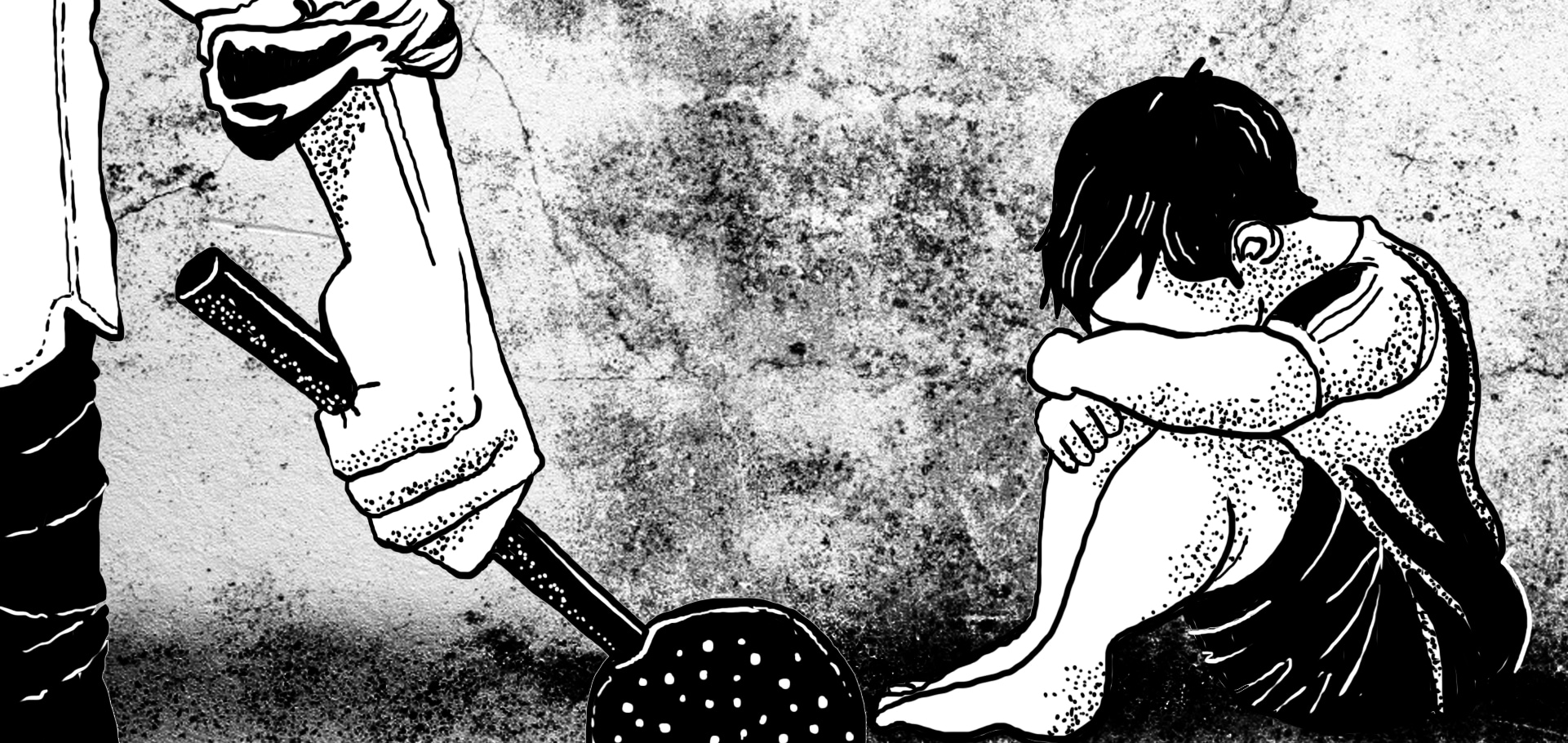
From the first day that ‘M’* came to the children’s home with his mother, it was clear that he had witnessed a lot of violence and trauma. The 10-year-old boy was attention-seeking and belligerent, and he often picked up fights with other kids. Often, in the middle of a conversation, he would abruptly say, “Mujhe paagalkhaane bhej do; mujhe marna hai.” (Send me to an asylum; I want to die.) His story, and that of his family, unfolded over the next month.The boy’s mother had lived at the children’s home for girls a decade ago. In September, she now returned to Prayas JAC Society’s office as an adult, seeking shelter and support. She had suffered vicious abuse at the hands of her husband, and so did her three children. On one occasion, M’s father scalded him with a hot steel utensil so severely that he could not walk for months. On several occasions, the father got him to steal from other people’s houses. It was under these circumstances that M had been arrested for a brief while by the police, at an age when he could barely understand the consequences of his actions.Luckily for the young boy, he was let off.![juvenile-justice1]() But his case points to a larger reality of the juvenile justice system, one that rarely figures in acrimonious prime time debates. Since 1986, successive legislations dealing with juvenile justice have dealt with two broad categories of children. They have been referred to by different terms over time, and are presently understood as children in need of care and protection and children in conflict with the law. But as several cases indicate, these are not watertight categories, and the line between children involved in crime and children who face neglect or exploitation is often blurred.Data from the National Crime Records Bureau tells a similar story. For instance, only 3.4 percent of the juveniles apprehended in 2015 come from families with an annual income of more than Rs 2 lakh — which is largely the economic background of people who read and write articles such as this one. The overwhelming majority of cases — 70.6 percent to be precise— are from families with an annual income of less than Rs 50,000.
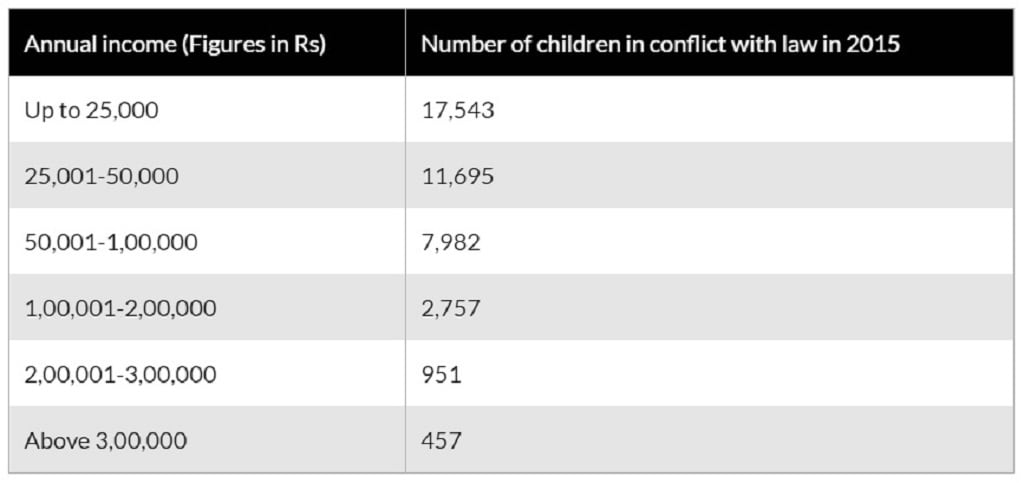
But his case points to a larger reality of the juvenile justice system, one that rarely figures in acrimonious prime time debates. Since 1986, successive legislations dealing with juvenile justice have dealt with two broad categories of children. They have been referred to by different terms over time, and are presently understood as children in need of care and protection and children in conflict with the law. But as several cases indicate, these are not watertight categories, and the line between children involved in crime and children who face neglect or exploitation is often blurred.Data from the National Crime Records Bureau tells a similar story. For instance, only 3.4 percent of the juveniles apprehended in 2015 come from families with an annual income of more than Rs 2 lakh — which is largely the economic background of people who read and write articles such as this one. The overwhelming majority of cases — 70.6 percent to be precise— are from families with an annual income of less than Rs 50,000.![table juvenile]() The Union government does seem to have taken note of some of these aspects while framing the model Juvenile Justice Rules, 2016, which have been put in the public domain. For instance, the social investigation report now specifically includes questions on whether the child was the victim of any offence, what his/her exact role in the offence was, the reasons for leaving school (in cases of dropouts). These points were not included in the earlier rules from the year 2007. The report is also expected to include details on the educational background and economic status of the child’s family. But to a large extent, how good or bad the law turns out to be depends on the people who implement it.The narrative around juvenile offenders has been either overstating the threat or claiming that poverty and deprivation are overwhelmingly the reasons for such crimes. But there is a need to go beyond broad generalisations.
The Union government does seem to have taken note of some of these aspects while framing the model Juvenile Justice Rules, 2016, which have been put in the public domain. For instance, the social investigation report now specifically includes questions on whether the child was the victim of any offence, what his/her exact role in the offence was, the reasons for leaving school (in cases of dropouts). These points were not included in the earlier rules from the year 2007. The report is also expected to include details on the educational background and economic status of the child’s family. But to a large extent, how good or bad the law turns out to be depends on the people who implement it.The narrative around juvenile offenders has been either overstating the threat or claiming that poverty and deprivation are overwhelmingly the reasons for such crimes. But there is a need to go beyond broad generalisations.![JJ1_Strip_2]() These are cases where one cannot come to easy conclusions — whether by way of condemning the ‘criminal tendency’ of the child, or by way of attributing the crime to ‘circumstances’.Around a year ago, the country was preparing for a stormy Winter Session of Parliament in which, among other things, the proposed law on juvenile justice was passed. The Juvenile Justice Act, 2015 is now a reality. But now, there is a need to take a hard look at the law, in a way which goes beyond the 16 December 2012 Delhi gangrape.*Names have been changed to protect identityThe author works with Prayas JAC Society, an organisation headquartered in New Delhi, that works on child rights
These are cases where one cannot come to easy conclusions — whether by way of condemning the ‘criminal tendency’ of the child, or by way of attributing the crime to ‘circumstances’.Around a year ago, the country was preparing for a stormy Winter Session of Parliament in which, among other things, the proposed law on juvenile justice was passed. The Juvenile Justice Act, 2015 is now a reality. But now, there is a need to take a hard look at the law, in a way which goes beyond the 16 December 2012 Delhi gangrape.*Names have been changed to protect identityThe author works with Prayas JAC Society, an organisation headquartered in New Delhi, that works on child rights
 But his case points to a larger reality of the juvenile justice system, one that rarely figures in acrimonious prime time debates. Since 1986, successive legislations dealing with juvenile justice have dealt with two broad categories of children. They have been referred to by different terms over time, and are presently understood as children in need of care and protection and children in conflict with the law. But as several cases indicate, these are not watertight categories, and the line between children involved in crime and children who face neglect or exploitation is often blurred.Data from the National Crime Records Bureau tells a similar story. For instance, only 3.4 percent of the juveniles apprehended in 2015 come from families with an annual income of more than Rs 2 lakh — which is largely the economic background of people who read and write articles such as this one. The overwhelming majority of cases — 70.6 percent to be precise— are from families with an annual income of less than Rs 50,000.
 The Union government does seem to have taken note of some of these aspects while framing the model Juvenile Justice Rules, 2016, which have been put in the public domain. For instance, the social investigation report now specifically includes questions on whether the child was the victim of any offence, what his/her exact role in the offence was, the reasons for leaving school (in cases of dropouts). These points were not included in the earlier rules from the year 2007. The report is also expected to include details on the educational background and economic status of the child’s family. But to a large extent, how good or bad the law turns out to be depends on the people who implement it.The narrative around juvenile offenders has been either overstating the threat or claiming that poverty and deprivation are overwhelmingly the reasons for such crimes. But there is a need to go beyond broad generalisations.
The narrative around juvenile offenders has been overstating that poverty and deprivation are the reasons for such crimes.For instance, S* — a 16-year-old boy from a relatively affluent family — got involved in a murder case after his family got into an argument with another family with whom they had a business partnership.In another instance, X* — a 15-year-old boy — was involved in a case of kidnapping and murder after a fight with another schoolboy turned ugly. Earlier, X had been beaten up severely by the same boy, due to which he suffered multiple fractures and was hospitalised for 2-3 months. He later took his revenge by stabbing the boy to death, after which he came into the clutches of the law.
 These are cases where one cannot come to easy conclusions — whether by way of condemning the ‘criminal tendency’ of the child, or by way of attributing the crime to ‘circumstances’.Around a year ago, the country was preparing for a stormy Winter Session of Parliament in which, among other things, the proposed law on juvenile justice was passed. The Juvenile Justice Act, 2015 is now a reality. But now, there is a need to take a hard look at the law, in a way which goes beyond the 16 December 2012 Delhi gangrape.*Names have been changed to protect identityThe author works with Prayas JAC Society, an organisation headquartered in New Delhi, that works on child rights
First Published:Nov 17, 2016, 08:15:32 IST
Advertisement
Advertisement

Off-centre | Vande Mataram: The mother that we adore
A meditation on the meaning of India as the country celebrates 77th independence Day
Of nature, culture and alcohol: A glimpse into Sikkim’s age-old brewing traditions
Most rural households across Sikkim have their own breweries, which are an integral part of the local culture.
Revisiting the Bollywood dream sequence: A tour of the world, and within
The Bollywood dream sequence helped stretch my imagination in a way that I believed the whole world was within me. This self-sufficiency helped me get through the physical setting I was in, from awkward social gatherings to the confines of my home during the pandemic.
Trams, part of Kolkata heritage, are little more than a nostalgia ride today
In recent years, hit by natural disasters and official neglect, the city’s tram system has become little more than a nostalgia ride, its passengers more often looking for a lark than an efficient trip home.
Online exhibition archives oral histories of the Kolis, degradation of Mumbai's coastal ecology
The online exhibition Through the Eyes of the Kolis uses their photos to highlights how Mumbai's ecology has been disturbed and how the fishermen community are adapting.
Advertisement
Advertisement