
Advertisement


Sections
Kashmir: Mining expands on rivers despite dire warnings, threatening local livelihoods
Despite warnings from research commissioned by itself, the government has thrown open mining auctions in Kashmir, threatening the stability of the riverbed, flood control mechanisms, and local livelihoods

By Athar ParvaizThe Indian government is in the process of auctioning out approximately 200 blocks in Jhelum river and its tributaries for mining of sand and other minerals. This is despite a recent study warning against large-scale mining operation in the Jhelum, and the advice of an environmental committee against haphazard mining in water bodies.In 2018, the department of Irrigation and Flood Control (IFC) had asked the Central Water and Power Research Station (CWPRS) to do a detailed technical report covering a host of issues. This was also cited by a World Bank supported study for the Jhelum and Tawi Flood Recovery Project.“The dredging de-silting/sand mining of the main channel of Jhelum from upstream to Asham is not advisable and may cause difficulties for the flood management. Re-sectioning by increasing the waterway width may possibly be taken up at few places only as recommended in the tour report of CWPRS officers,” the technical report concluded.The report, CWPRS said, is based on the morphological analysis, site visits and analysis of unsteady flow conditions using 1-D unsteady mathematical model with the data provided by the state engineers including the hydrographs, their lag time of flood initiation and capacity curve for the various lakes.The World Bank supported study also noted:“In addition to the works to be included in the interim scheme, CWPRS also recommended that further consideration be given to:![A man standing on the bank of a tributary of Jhelum in south Kashmir, Vishu. In autumn and winters, Jhelum’s tributaries have extremely low flows. Photo credit: Athar Parvaiz.]() Earlier, these rights were only with local residents. Most of the mineral blocks auctioned so far, have been bought by companies from outside Kashmir.[/caption][/rq]All the 10 sand blocks in Srinagar (on the Jhelum), have been bought by the companies from outside Kashmir for five years against a bidding amount of INR 50 million (USD 0.7 million). In Pulwama, local contractors have successfully bid for 40 percent of the 36 blocks in the district, the rest going to companies from outside Kashmir with total bidding amount of INR 480 million (USD 6.7 million).In Baramullah, out of the 35 blocks, 28 blocks have been auctioned by 10 February. 19 of the 28 auctioned have been bought by companies from outside Kashmir against a bidding amount of INR 190 million (USD 2.66 million).Local contractors allege that it is a “huge injustice” to them that natural resources, which provide employment to thousands of households in Kashmir, are now “open for sale” for anybody. “We are not in a position to compete with companies from outside. How can our resources match theirs? Obviously, they manage to buy most of the mineral blocks,” said Bilal Ahmad, a local contractor. Ahmad’s concerns apart, the large-scale auctioning also raises concerns that illegal mineral mining of sand, boulders and gravel that has happened earlier, may now become beyond control.Engineers in Kashmir’s Flood Control Department are aware of the consequences they are going to face in coming years because of large-scale mining in Kashmir’s rivers. “When you mine intensively in Jhelum and its tributaries, it is certainly going to leave an impact on local ecology as also on flood management in Kashmir,” said an engineer in Irrigation and Flood Control Department requesting anonymity. “For example, when massive exploitation of minerals is done in tributaries of Jhelum, it will increase the velocity of river flow, which, in turn, can result in instant flooding and over siltation in our water bodies such as Wular,” he said.In recent years, Kashmir has faced many floods notably the devastating floods in 2014 which killed hundreds of people in parts of Kashmir controlled by India and Pakistan and caused losses worth billions of rupees.Banner image: A view of the Jhelum in Srinagar. Photo credit: Athar Parvaiz.***The Third Pole is a multilingual platform dedicated to promoting information and discussion about the Himalayan watershed and the rivers that originate there. This report was originally published on thethirdpole.net and has been reproduced here with permission.
Earlier, these rights were only with local residents. Most of the mineral blocks auctioned so far, have been bought by companies from outside Kashmir.[/caption][/rq]All the 10 sand blocks in Srinagar (on the Jhelum), have been bought by the companies from outside Kashmir for five years against a bidding amount of INR 50 million (USD 0.7 million). In Pulwama, local contractors have successfully bid for 40 percent of the 36 blocks in the district, the rest going to companies from outside Kashmir with total bidding amount of INR 480 million (USD 6.7 million).In Baramullah, out of the 35 blocks, 28 blocks have been auctioned by 10 February. 19 of the 28 auctioned have been bought by companies from outside Kashmir against a bidding amount of INR 190 million (USD 2.66 million).Local contractors allege that it is a “huge injustice” to them that natural resources, which provide employment to thousands of households in Kashmir, are now “open for sale” for anybody. “We are not in a position to compete with companies from outside. How can our resources match theirs? Obviously, they manage to buy most of the mineral blocks,” said Bilal Ahmad, a local contractor. Ahmad’s concerns apart, the large-scale auctioning also raises concerns that illegal mineral mining of sand, boulders and gravel that has happened earlier, may now become beyond control.Engineers in Kashmir’s Flood Control Department are aware of the consequences they are going to face in coming years because of large-scale mining in Kashmir’s rivers. “When you mine intensively in Jhelum and its tributaries, it is certainly going to leave an impact on local ecology as also on flood management in Kashmir,” said an engineer in Irrigation and Flood Control Department requesting anonymity. “For example, when massive exploitation of minerals is done in tributaries of Jhelum, it will increase the velocity of river flow, which, in turn, can result in instant flooding and over siltation in our water bodies such as Wular,” he said.In recent years, Kashmir has faced many floods notably the devastating floods in 2014 which killed hundreds of people in parts of Kashmir controlled by India and Pakistan and caused losses worth billions of rupees.Banner image: A view of the Jhelum in Srinagar. Photo credit: Athar Parvaiz.***The Third Pole is a multilingual platform dedicated to promoting information and discussion about the Himalayan watershed and the rivers that originate there. This report was originally published on thethirdpole.net and has been reproduced here with permission.
- Cessation of dredging of Jhelum River between Sangam and Asham;
- Dedication of low lying areas on the left bank of the Jhelum River near the start of the Flood Spill Channel to form detention basins of 49km2 and 44km2) – uncontrolled development in these areas will preclude their utility for flood retention in the future”
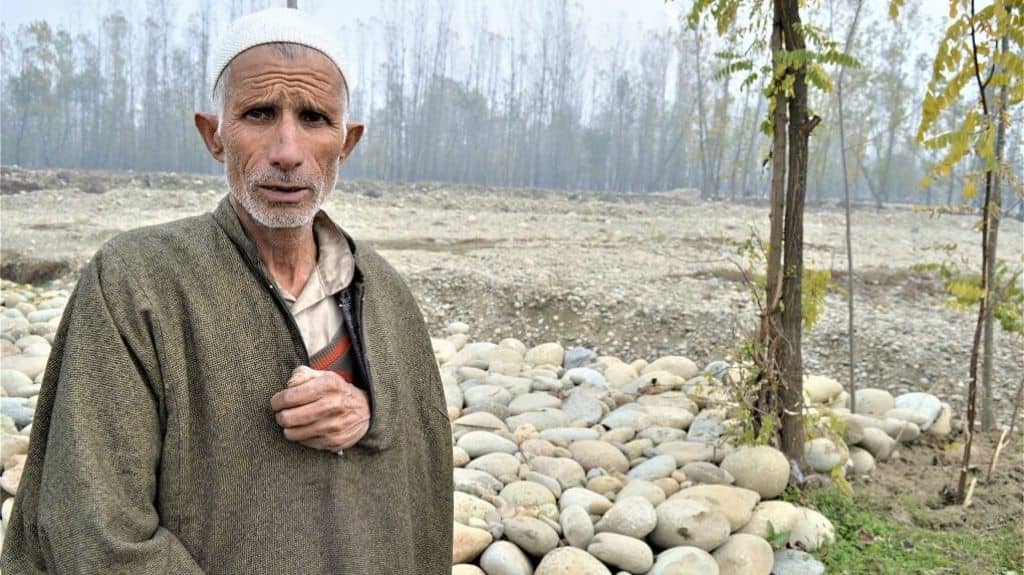 Earlier, these rights were only with local residents. Most of the mineral blocks auctioned so far, have been bought by companies from outside Kashmir.[/caption][/rq]All the 10 sand blocks in Srinagar (on the Jhelum), have been bought by the companies from outside Kashmir for five years against a bidding amount of INR 50 million (USD 0.7 million). In Pulwama, local contractors have successfully bid for 40 percent of the 36 blocks in the district, the rest going to companies from outside Kashmir with total bidding amount of INR 480 million (USD 6.7 million).In Baramullah, out of the 35 blocks, 28 blocks have been auctioned by 10 February. 19 of the 28 auctioned have been bought by companies from outside Kashmir against a bidding amount of INR 190 million (USD 2.66 million).Local contractors allege that it is a “huge injustice” to them that natural resources, which provide employment to thousands of households in Kashmir, are now “open for sale” for anybody. “We are not in a position to compete with companies from outside. How can our resources match theirs? Obviously, they manage to buy most of the mineral blocks,” said Bilal Ahmad, a local contractor. Ahmad’s concerns apart, the large-scale auctioning also raises concerns that illegal mineral mining of sand, boulders and gravel that has happened earlier, may now become beyond control.Engineers in Kashmir’s Flood Control Department are aware of the consequences they are going to face in coming years because of large-scale mining in Kashmir’s rivers. “When you mine intensively in Jhelum and its tributaries, it is certainly going to leave an impact on local ecology as also on flood management in Kashmir,” said an engineer in Irrigation and Flood Control Department requesting anonymity. “For example, when massive exploitation of minerals is done in tributaries of Jhelum, it will increase the velocity of river flow, which, in turn, can result in instant flooding and over siltation in our water bodies such as Wular,” he said.In recent years, Kashmir has faced many floods notably the devastating floods in 2014 which killed hundreds of people in parts of Kashmir controlled by India and Pakistan and caused losses worth billions of rupees.Banner image: A view of the Jhelum in Srinagar. Photo credit: Athar Parvaiz.***The Third Pole is a multilingual platform dedicated to promoting information and discussion about the Himalayan watershed and the rivers that originate there. This report was originally published on thethirdpole.net and has been reproduced here with permission.
First Published:Feb 18, 2020, 09:32:08 IST
Advertisement
Advertisement

Off-centre | Vande Mataram: The mother that we adore
A meditation on the meaning of India as the country celebrates 77th independence Day
Of nature, culture and alcohol: A glimpse into Sikkim’s age-old brewing traditions
Most rural households across Sikkim have their own breweries, which are an integral part of the local culture.
Revisiting the Bollywood dream sequence: A tour of the world, and within
The Bollywood dream sequence helped stretch my imagination in a way that I believed the whole world was within me. This self-sufficiency helped me get through the physical setting I was in, from awkward social gatherings to the confines of my home during the pandemic.
Trams, part of Kolkata heritage, are little more than a nostalgia ride today
In recent years, hit by natural disasters and official neglect, the city’s tram system has become little more than a nostalgia ride, its passengers more often looking for a lark than an efficient trip home.
Online exhibition archives oral histories of the Kolis, degradation of Mumbai's coastal ecology
The online exhibition Through the Eyes of the Kolis uses their photos to highlights how Mumbai's ecology has been disturbed and how the fishermen community are adapting.
Advertisement
Advertisement