


Dalit shahirs of Maharashtra: Wamandada Kardak's anti-caste metaphors
Wamandada Kardak's work as a Dalit shahir was a breakthrough in terms of defining ‘culture’ in a Hindu Brahminical society

An introduction: Maharashtra’s tradition of ‘shahiri’ is several centuries old. In the last few decades of the 18th century, under the influence of Mahatma Phule’s Satyashodhak Samaj, it was transformed into a musical weapon of the masses, against the caste system. By the 1930s, the ‘Satyashodhaki jalsa’ was in decline, but a powerful new force had emerged in its place: ‘Ambedkari jalsa’. Ambedkari jalsa represented the teachings and philosophy of Dr BR Ambedkar in oral form, accompanied by songs. Over a journey that is close to completing a century, many Ambedkarite shahirs have helped hone shahiri as an anti-caste tool. This series on Maharashtra’s shahirs explores the lives and work of 15 greats.
This is part three of the series.
— Art by Satwick Gade
But in the pursuit of this level of mastery, Wamandada never kept himself away from the people. He visited hundreds of villages and wrote thousands of songs and poems during his halts, thereby leaving behind his literature for the people he spent time with.A considerable amount of his writing, as some scholars estimate, is still left unpublished. But if one were to look at those songs and poems which are available today and study them through the lens of literary theories and frameworks, one will be forced to confess that translating his literature into a foreign language — in this case English — is much too difficult. He created many images and metaphors which were hitherto unheard of in the domain of literature, and of course, in music.How did Wamandada Kardak, who was barely educated in the academic sense, manage to create such a rich and impactful body of work? He seems to offer an answer to this question:“Bhimvani padali majhya kaani
Tich tharali majhi gaani”“(The voice of Bhima Dr Babasaheb Ambedkar echoed in my ears
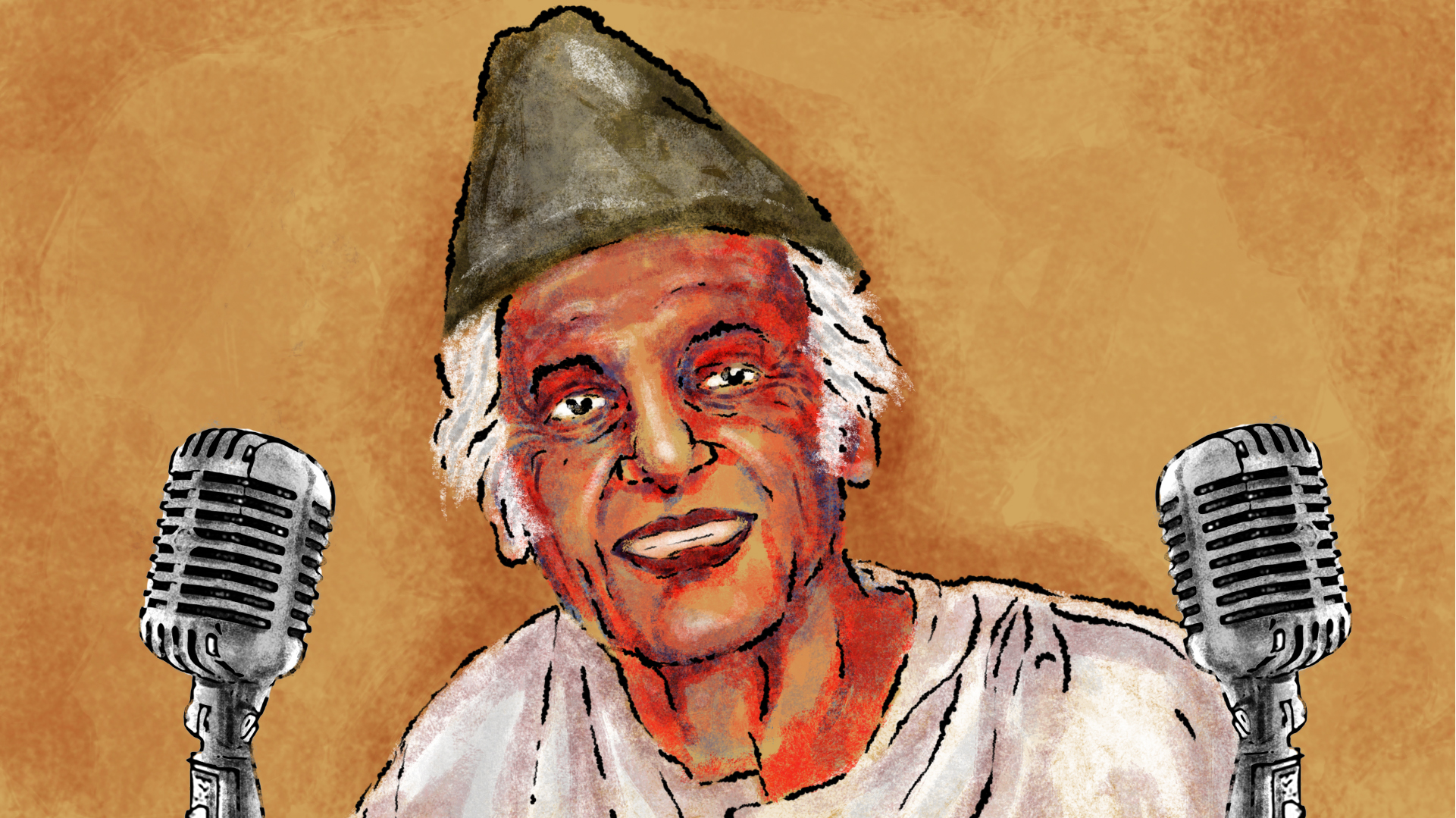 [/imgcenter]The definition of ‘culture’ is always moulded by the upper classes, elites (read: Brahminical castes, classes) which undermines and distorts the very importance of culture shaped by the labour and intelligence of Dalits-Bahujans. Wamandada Kardak's work came as a breakthrough in terms of defining ‘culture’. Through his songs and jalsas, he contributed immensely to the process of 'cultural transfer' by putting into words the vision for an egalitarian and democratic society — a vision which almost impossible to conceive in the castiest reality of a Hindu (Brahminical) society.“Wamandada’s poetry falls under modern shahiri. In this sense, Wamandada is a modern Bhim-Shahir. In a sense, he was the modern Kabir,” writes Professor Vitthal Shinde. He paved the way for a visual ‘art’ form to be rational, educative, and of course, influential in terms of the growth of an anti-caste consciousness. His music was rich with aesthetic values and highly effective in terms of its approach towards listeners. If one reviews his body of work — including his jalsas and shahiri performances — which was built over 55 years, he emerges as the undisputed pioneer of Cultural Transfer in the context of the anti-caste movement.*Translated by Yogesh Maitreya for the purpose of this article***Note from the writer: The song presented with this article was originally written and performed by Wamandada Kardak. Since this song isn't available in the audio format, it has been composed and performed by Charan Jadhav for the purpose of this series. This is an acknowledgment of his contribution.Read part one, two, four and five of the series.Yogesh Maitreya is a poet, translator and founder of Panther's Paw Publication, an anti-caste publishing house. He is pursuing a PhD at the Tata Institute of Social Sciences, Mumbai.
Off-centre | Vande Mataram: The mother that we adore
Of nature, culture and alcohol: A glimpse into Sikkim’s age-old brewing traditions
Revisiting the Bollywood dream sequence: A tour of the world, and within
Trams, part of Kolkata heritage, are little more than a nostalgia ride today
Online exhibition archives oral histories of the Kolis, degradation of Mumbai's coastal ecology