
Advertisement


Sections
Abhishek Hazra on How to Hide Your Hegel
In the aftermath of the recent arrests of activists and writers, the Almora chapter of the Kankurgachi Hegel Club, an amateur group of Hegel enthusiasts, is worried and can’t help wonder if it is safe to keep Hegel on their bookshelves. They have initiated a three-pronged—that is, by heart, by scroll and by marginalia—project to hide Hegel

Fragment 1: A record (and a partial reconstruction) of the Almora Hegelians, memorising the Phenomenology by the flickering light of the old TV in their modest clubhouseOne: In order to clear their bookshelves of any and all signs of Hegel, the Almora Hegelian initiate a project to memorise Hegel by heart. Beginning with the classic Phenomenology of Spirit, 1807, which Hegel described as an “exposition of the coming to be of knowledge”.
Fragment 2: Having handwritten Hegel on a scroll, the Almora Hegelians try to read him backwards, while rehearsing with Sombhu Mitra’s OedipusTwo: Given the obvious demands on memory such a project entails, Almora Hegelian are also exploring other options. Some of them still want to have access to the written Hegel, but prefer the ancient scroll, over the books currently in circulation.[imgcenter]
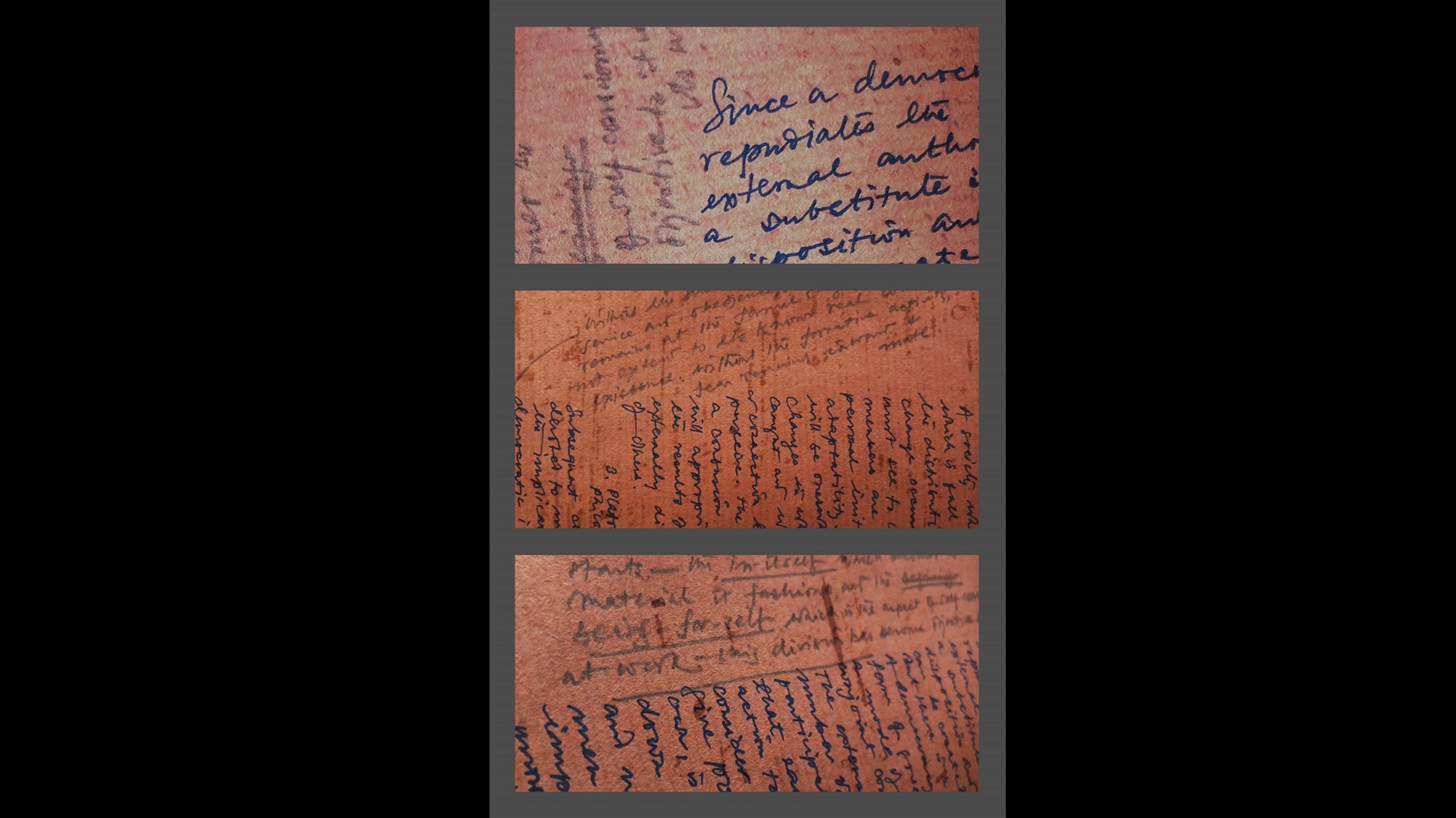 [/imgcenter]Fragment 3: Can the Almora Hegelians hide Hegel by scattering his texts into marginalia scribbled onto other books?Three: A few of the Almora Hegelians retreat to Marginalia and begin filling up the margins of John Dewey’s Democracy and Education, 1916 with Phenomenology of Spirit. While copying down Hegel’s discussion of Oedipus and Greek tragedy, they channel Sombhu Mitra’s dramatic rendition of Sophocles in their own voices.The Kankurgachi Hegel Club really existed; Kankurgachi being a north-eastern suburb in Kolkata.“From what I have gathered from tertiary and quaternary sources, Kankurgachi Hegel Club seems to have existed in the late 80s or early 90s. Many of the scholars broadly associated with the Subaltern Studies project were part of the club, where they were engaged in serious study of Hegel. I have for long been fascinated by this club. To give you a sense of what is conjured up by a phrase like 'Kankurgachi Hegel Club', imagine chancing upon something like the ‘Borivali Deleuze Club’,” Hazra chuckles and adds, “Is it too romantic or deluded to consider this Hegel club as a classic case of the ‘provincial peripheral figure’ engaging with the ‘theoretical discourse of the centre or the metropole’?” “However,” Hazra hastens to clarify, “you should remember that unlike the sharp scholars who debated at Kankurgachi, the Almora Hegelians are a more humble lot who often muddle up the metaphysical Hegel with the logical one.”Hazra has often tried to reconstruct the discussions that would have happened at Kankurgachi. He wonders if these scholars with their shared social habits and intellectual genealogy, dismissed Hegel’s extensive writings on India as so much Orientalist prejudice. Confronted with Hegel’s pronouncements on the ‘unfreedom’ of Indian thought, did the Kankurgachi scholars ever think of turning to that visionary Indian student of John Dewey?Through his elaborate story of Almora Hegelians and the Kankurgachi Hegel Club, Hazra is not just telling us a story, he is becoming the story. The coded character of the story about a story about a story is not the only parallel to be drawn between the artist and the narrative he has set before us. The sheer idiosyncrasy of the methods adopted by the Almora Hegelians also reflects on the familiar questions of ends and means or the contrast between honest intent and failed action.It’s not hard to imagine Hazra as a peripheral figure who carefully reads and watches and draws connections between seemingly disparate histories and ideas. The Almora Hegelians share initials with Abhishek Hazra. Coincidence? Maybe. But, maybe not.***Artist in focus:Abhishek Hazra’s works traverse a diverse yet closely interconnected mesh of interests. His recent series of lecture performances explore questions around affect and provincial cosmopolitanism. He has exhibited widely, including Kochi-Muziris Biennale 2016, Reykjavik Art Museum, Kunstmuseum Bern, Bose Pacia, New York, MAXXI Museum, Rome, GallerySKE, Bangalore, KHOJ, Kiran Nadar Museum, New Delhi among others. Abhishek has also been the recipient of multiple awards including the 2011 Sanskriti Award for Visual Art. More here.***Gitanjali Dang is a curator, writer and shape-shifter. In 2012, she founded Khanabadosh, an itinerant arts lab. More here.
First Published:Nov 17, 2018, 18:12:34 IST
Advertisement
Advertisement

Off-centre | Vande Mataram: The mother that we adore
A meditation on the meaning of India as the country celebrates 77th independence Day
Of nature, culture and alcohol: A glimpse into Sikkim’s age-old brewing traditions
Most rural households across Sikkim have their own breweries, which are an integral part of the local culture.
Revisiting the Bollywood dream sequence: A tour of the world, and within
The Bollywood dream sequence helped stretch my imagination in a way that I believed the whole world was within me. This self-sufficiency helped me get through the physical setting I was in, from awkward social gatherings to the confines of my home during the pandemic.
Trams, part of Kolkata heritage, are little more than a nostalgia ride today
In recent years, hit by natural disasters and official neglect, the city’s tram system has become little more than a nostalgia ride, its passengers more often looking for a lark than an efficient trip home.
Online exhibition archives oral histories of the Kolis, degradation of Mumbai's coastal ecology
The online exhibition Through the Eyes of the Kolis uses their photos to highlights how Mumbai's ecology has been disturbed and how the fishermen community are adapting.
Advertisement
Advertisement