
Advertisement


Sections
World Environment Day 2017: Vandana Trivedi wants Indians to get serious about waste
Vandana Trivedi warns that if we don't get serious about waste management, we may soon have to earmark an entire city in India to accommodate the waste that we generate as a country

When Vandana Trivedi passionately declares, "You deserve to die," at the start of her TED talk, you begin to imagine that she is probably referring to the inhuman nature of society or corporate greed. Instead, the investment advisor, mountaineer and mother-of-two broaches the subject of the Deonar dumping ground, which is the biggest and oldest garbage dump in Asia. Through her six-minute long talk, where she uses statistics and analogies to explain the weight of the situation, Trivedi paints a picture of the problem which is as grim as reality. But she uses this technique to provoke her listeners to take affirmative action.[caption id="attachment_3506047" align="alignnone" width="825"]![Vandana Trivedi delivering her TED talk. Youtube screengrab]() Vandana Trivedi delivering her TED talk. Youtube screengrab[/caption]What pushed her to pursue such in-depth research about the Deonar dumping ground? "The trigger, of course, was a strong burning stench that I picked up one day soon after we moved to Mumbai. But what has kept me going since the very beginning is deep rooted-guilt, because I am letting my children grow up in such a polluted environment, and thus I must do what I can to improve the situation," she says.Trivedi's homework began with extensive reading — she read up about the subject on the Internet, in resources provided by the Pollution Control Board, iternational health and science journals and local newspaper archives. She also gained first-hand knowledge by meeting up with people who have been raising their voice against this issue.Unsurprisingly, this process was not easy, but Trivedi persisted nonetheless. When asked what hurdles she faced, she names apathy on the part of the Brihanmumbai Municipal Corporation (BMC) and callous responses given by Solid Waste Management officials. "At one point, I was asked by a Solid Waste Management official to shift to Lonavla," she says, adding, "More recently though, both Chief Minister Devendra Fadnavis and BMC Commissioner Ajoy Mehta have been patient and sensitive listeners to the problem. However, they have failed to keep their promises, publicly acknowledged by the chief minister's Twitter handle."[caption id="attachment_3506065" align="alignnone" width="825"]
Vandana Trivedi delivering her TED talk. Youtube screengrab[/caption]What pushed her to pursue such in-depth research about the Deonar dumping ground? "The trigger, of course, was a strong burning stench that I picked up one day soon after we moved to Mumbai. But what has kept me going since the very beginning is deep rooted-guilt, because I am letting my children grow up in such a polluted environment, and thus I must do what I can to improve the situation," she says.Trivedi's homework began with extensive reading — she read up about the subject on the Internet, in resources provided by the Pollution Control Board, iternational health and science journals and local newspaper archives. She also gained first-hand knowledge by meeting up with people who have been raising their voice against this issue.Unsurprisingly, this process was not easy, but Trivedi persisted nonetheless. When asked what hurdles she faced, she names apathy on the part of the Brihanmumbai Municipal Corporation (BMC) and callous responses given by Solid Waste Management officials. "At one point, I was asked by a Solid Waste Management official to shift to Lonavla," she says, adding, "More recently though, both Chief Minister Devendra Fadnavis and BMC Commissioner Ajoy Mehta have been patient and sensitive listeners to the problem. However, they have failed to keep their promises, publicly acknowledged by the chief minister's Twitter handle."[caption id="attachment_3506065" align="alignnone" width="825"]![An aerial picture of a fire that broke out in the Deonar dumping ground. Image from Wikimedia Commons/ NASA]() An aerial picture of a fire that broke out in the Deonar dumping ground. Image from Wikimedia Commons/ NASA[/caption]Trivedi's learning from her research is that we are yet to develop a culture of showing concern about "slow killers", like the Deonar dumping ground. "Millions of tons of methane under the dump is a thriving, toxic bomb. We react only when there is a fire that can be seen and smelled. Hence, educating citizens and the administration that this is a problem worse than a localised terror attack, for instance, is a big challenge," she explains.Speaking about possible solutions to the problem of unending waste collection in Deonar, Trivedi suggests — begin at every door, segregate waste, and start measuring the amount of waste you throw. "Compel the BMC to justify its rich coffers to have separate waste collection vehicles for dry and wet waste. Ensure that they do not continue to be trapped in a long-drawn, corruption-ridden process to appoint contractors to treat the century-old accumulated waste at the dump."She also stresses on the need to set goals for one's own household to minimise the weight of waste that one sends out the door. Making changes in your life can help to reduce your contribution to this cycle of waste, she opines. Segregating waste, avoiding plastic, drinking filtered water in offices, stop providing mineral water bottles to office guests, not buying fruits and vegetables which are wrapped in plastic and thermocol packets are some of the suggestions she makes. "Write to corporations like Amazon to reconsider their excessive use of plastic in packaging, educate your kids about responsible waste management. If this continues, we may have to earmark an entire city to accommodate the waste that we generate as a country," she warns.Watch Vandana Trivedi's TedxGateway talk here:
An aerial picture of a fire that broke out in the Deonar dumping ground. Image from Wikimedia Commons/ NASA[/caption]Trivedi's learning from her research is that we are yet to develop a culture of showing concern about "slow killers", like the Deonar dumping ground. "Millions of tons of methane under the dump is a thriving, toxic bomb. We react only when there is a fire that can be seen and smelled. Hence, educating citizens and the administration that this is a problem worse than a localised terror attack, for instance, is a big challenge," she explains.Speaking about possible solutions to the problem of unending waste collection in Deonar, Trivedi suggests — begin at every door, segregate waste, and start measuring the amount of waste you throw. "Compel the BMC to justify its rich coffers to have separate waste collection vehicles for dry and wet waste. Ensure that they do not continue to be trapped in a long-drawn, corruption-ridden process to appoint contractors to treat the century-old accumulated waste at the dump."She also stresses on the need to set goals for one's own household to minimise the weight of waste that one sends out the door. Making changes in your life can help to reduce your contribution to this cycle of waste, she opines. Segregating waste, avoiding plastic, drinking filtered water in offices, stop providing mineral water bottles to office guests, not buying fruits and vegetables which are wrapped in plastic and thermocol packets are some of the suggestions she makes. "Write to corporations like Amazon to reconsider their excessive use of plastic in packaging, educate your kids about responsible waste management. If this continues, we may have to earmark an entire city to accommodate the waste that we generate as a country," she warns.Watch Vandana Trivedi's TedxGateway talk here:
 Vandana Trivedi delivering her TED talk. Youtube screengrab[/caption]What pushed her to pursue such in-depth research about the Deonar dumping ground? "The trigger, of course, was a strong burning stench that I picked up one day soon after we moved to Mumbai. But what has kept me going since the very beginning is deep rooted-guilt, because I am letting my children grow up in such a polluted environment, and thus I must do what I can to improve the situation," she says.Trivedi's homework began with extensive reading — she read up about the subject on the Internet, in resources provided by the Pollution Control Board, iternational health and science journals and local newspaper archives. She also gained first-hand knowledge by meeting up with people who have been raising their voice against this issue.Unsurprisingly, this process was not easy, but Trivedi persisted nonetheless. When asked what hurdles she faced, she names apathy on the part of the Brihanmumbai Municipal Corporation (BMC) and callous responses given by Solid Waste Management officials. "At one point, I was asked by a Solid Waste Management official to shift to Lonavla," she says, adding, "More recently though, both Chief Minister Devendra Fadnavis and BMC Commissioner Ajoy Mehta have been patient and sensitive listeners to the problem. However, they have failed to keep their promises, publicly acknowledged by the chief minister's Twitter handle."[caption id="attachment_3506065" align="alignnone" width="825"]
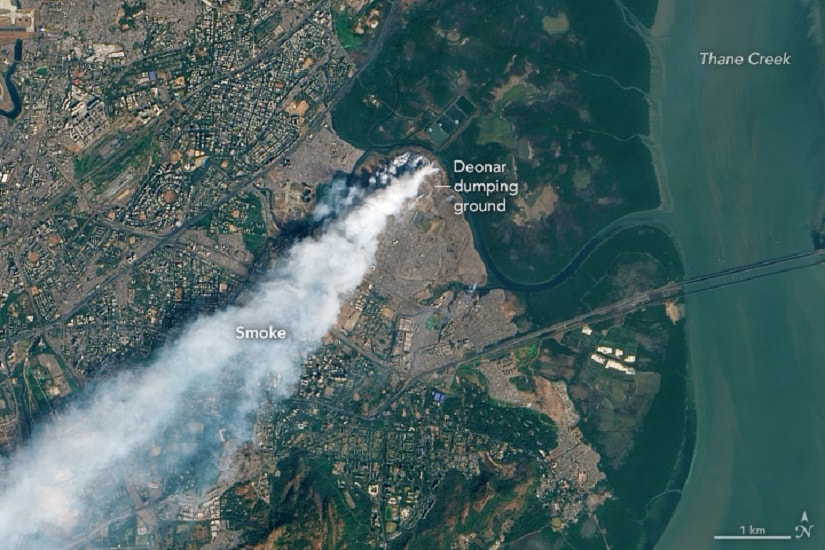 An aerial picture of a fire that broke out in the Deonar dumping ground. Image from Wikimedia Commons/ NASA[/caption]Trivedi's learning from her research is that we are yet to develop a culture of showing concern about "slow killers", like the Deonar dumping ground. "Millions of tons of methane under the dump is a thriving, toxic bomb. We react only when there is a fire that can be seen and smelled. Hence, educating citizens and the administration that this is a problem worse than a localised terror attack, for instance, is a big challenge," she explains.Speaking about possible solutions to the problem of unending waste collection in Deonar, Trivedi suggests — begin at every door, segregate waste, and start measuring the amount of waste you throw. "Compel the BMC to justify its rich coffers to have separate waste collection vehicles for dry and wet waste. Ensure that they do not continue to be trapped in a long-drawn, corruption-ridden process to appoint contractors to treat the century-old accumulated waste at the dump."She also stresses on the need to set goals for one's own household to minimise the weight of waste that one sends out the door. Making changes in your life can help to reduce your contribution to this cycle of waste, she opines. Segregating waste, avoiding plastic, drinking filtered water in offices, stop providing mineral water bottles to office guests, not buying fruits and vegetables which are wrapped in plastic and thermocol packets are some of the suggestions she makes. "Write to corporations like Amazon to reconsider their excessive use of plastic in packaging, educate your kids about responsible waste management. If this continues, we may have to earmark an entire city to accommodate the waste that we generate as a country," she warns.Watch Vandana Trivedi's TedxGateway talk here:
First Published:Jun 02, 2017, 14:31:38 IST
Advertisement
Advertisement

Here's why you crave sweets after every meal: This one thing can fix it
It's common to crave something sweet after meals. However, what's often dismissed as "having a sweet tooth," is mostly nutritional deficiency
1 min read
India's most beloved national parks for wildlife lovers
India holds some of the world’s most wonderful wilderness spaces. Forests and jungles where myth, beauty and survival exist side by side. From mangroves that swallow rivers to grasslands shaped by centuries of migration, the country’s national parks offer more than sightings. They offer moments of stillness, surprise, and reverence.
1 min read
Even the Beckhams break: The rise of family estrangement
People are choosing to cut off contact with their families, prioritising mental health.
4 min read
European Council Chief has an OCI card: What is it?
The OCI Scheme, introduced in 2005, grants foreign nationals of Indian origin a life-long visa for India, but no political rights.
1 min read
The 90s show Friends, and why we misread modern friendships
We’ve all heard about the loneliness epidemic at this point. It isn’t even particularly shocking — it seems like the result on the obvious — people consistently glued to their phones, seeking intimacy and even sex through phone screens, consistent comparison to other peoples’ partners, and what their relationships look like, to how far everyone has come in their jobs — there is much to feel diminished about.
5 min read
Advertisement
Advertisement