
Advertisement


Sections
Words Count 2019: Ideas, debate take centre stage at first edition of festival curated by Advaita Kala
At Words Count: The Festival of Words 2019, curated by noted author and screenwriter Advaita Kala, two pertinent issues — politics and religion — were at the forefront of the seven panel discussions organised on 3 February in Pune.

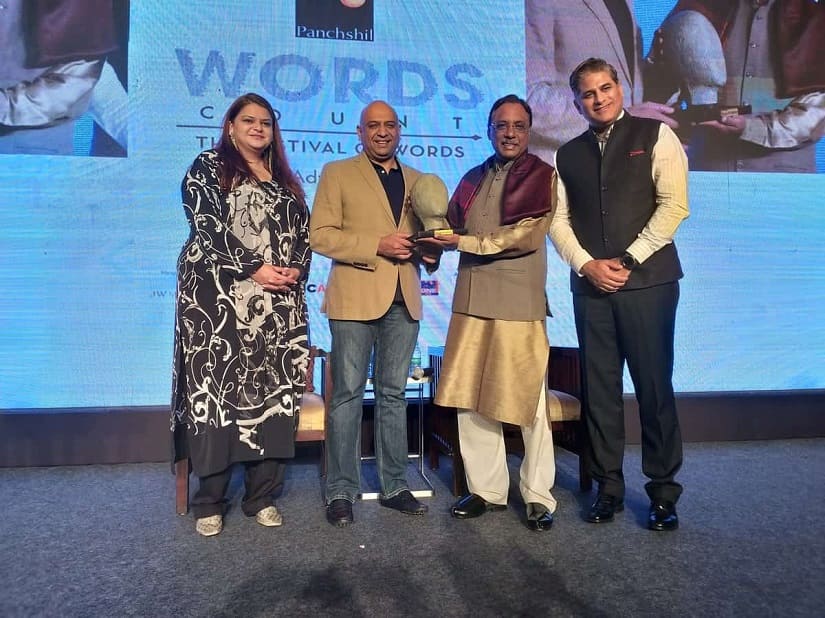 Pavan Varma (second from right) is honoured with the Words Smith Award at Words Count 2019. Image via Twitter/@WordsCount2019[/caption]The country comes first and then everything else, Ambekar stated through the course of the talk, speaking about ABVP as an organisation that worked at the grassroots level, that was made up of students who spread its message among their peers.Ambekar opined that ABVP’s focus had always been on nation-building; to Joshi’s questions about ABVP’s perceived anti-women and exclusionist policies, Ambekar responded with a mention of the organisation’s ‘Mission Sahasi’ initiative that focused on women's empowerment.In the next discussion, the editor of the Observer Prafulla Ketkar, and MP and president of the All India Majlis-e-Ittehadul Muslimeen (AIMIM) party Asaduddin Owaisi dove into a scathing debate on the idea of secularism in the country.In response to multiple questions from Ketkar on Owaisi’s understanding of secularism and politics, the latter pointed out that within the Constitution of India, Articles 15, 25-28 — and not just the 42nd amendment — together shaped secularism. Owaisi suggested that the country ‘cannot have uniformity by destroying diversity’. He raised the viewpoint that the Sabarimala row had become an issue of faith while triple talaq became an issue of gender justice in the country. He also questioned why people weren’t voting for Muslim candidates and asked why India reported fewer number of Muslim graduates, higher drop-out rates and more incarcerated Muslims.
The afternoon session opened with a panel discussion on the 'Journey of a Writer', with a group of authors working in multiple genres (including horror, mythology and non-fiction) sharing what compelled them to write stories. Saiswaroopa Iyer talked about her novel Abhaya (centred on the Narakasura Vadh from the Bhagavata Purana) and how a platform like Kindle Direct Publishing came to her aid while she was starting out as a writer. Mayuresh Didolkar, in a similar vein, noted how “digital publishing had created a market for all kinds of readers,” pointing out that his short stories were received exceedingly well online. Moderated by VK Karthika, the panel stressed on the importance of regional language literature with Shefali Vaidya stating that “there was much more freshness and robustness now to regional languages” than ever before.Kavita Kane, the author of mythological works like Sita’s Sister and Lanka's Princess, revolving around characters such as Urmila and Surpanakha from the epics, said more than anything else, “it was important for a book to be read”.The panel also spoke extensively about translation and the need for good translators not only from English to regional languages (and vice versa) but also from one Indian language to others (Tamil to Telugu and Marathi, for instance).
'Fake News Is Now Breaking News', was the discussion that followed this session; it was moderated by Kala and dwelt on grave aspects of the issue such as “the fact is that there is fake news every day, every hour…” as pointed out by journalist Bhupendra Chaubey. His fellow panelist Kanchan Gupta questioned the quality of the truth even if a news report was factually correct.For her part, Congress spokesperson Shama Mohammed vociferously stated that there was no mention of fake news until 2014 while Madhav Nalapat opined that we all lived within echo chambers that ignored the voices of those we didn’t agree with.Taking the conversation from a political to a philosophical plane were Gupta and former MP and author Pavan Varma. The latter was honoured with the Wordsmith Award 2019, and shared with the audience his views on spirituality and the philosophy of politics.
The diplomat-turned-author dwelt on the idea that “civilisation is a legacy to which you and I are heir” and said that he was merely bringing to the fore philosophies such as Chanakya’s ideas on statecraft (that existed, according to him, much before Machiavelli’s discourse).The session that followed was one filled with lyric and melody as Prasoon Joshi engaged the audiences in a poetic experience even as he discussed the grave idea that as a nation, “We brush under the carpet, what doesn’t suit us, because it doesn’t suit the politics, the people”.
Words Count 2019 concluded with a discussion between Kala and the Minister of Textiles Smriti Irani; the duo talked about Irani's journey from being an ‘ambitious, stubborn and even belligerent child’ to being at the top of her game as an actor, and her subsequent foray into regional and national politics.“I did not wait for life to happen to me, I just attacked it myself,” Irani said.
On questions related to the involvement of women in Indian politics, Irani stated that women have now become central to Indian politics, drawing on Prime Minister Narendra Modi’s idea of ‘women-led development.’ “I’d rather women be celebrated for the talent they bring to the table than the nomenclature they carry,” she added.
First Published:Feb 04, 2019, 17:50:29 IST
Advertisement
Advertisement

Here's why you crave sweets after every meal: This one thing can fix it
It's common to crave something sweet after meals. However, what's often dismissed as "having a sweet tooth," is mostly nutritional deficiency
1 min read
India's most beloved national parks for wildlife lovers
India holds some of the world’s most wonderful wilderness spaces. Forests and jungles where myth, beauty and survival exist side by side. From mangroves that swallow rivers to grasslands shaped by centuries of migration, the country’s national parks offer more than sightings. They offer moments of stillness, surprise, and reverence.
1 min read
Even the Beckhams break: The rise of family estrangement
People are choosing to cut off contact with their families, prioritising mental health.
4 min read
European Council Chief has an OCI card: What is it?
The OCI Scheme, introduced in 2005, grants foreign nationals of Indian origin a life-long visa for India, but no political rights.
1 min read
The 90s show Friends, and why we misread modern friendships
We’ve all heard about the loneliness epidemic at this point. It isn’t even particularly shocking — it seems like the result on the obvious — people consistently glued to their phones, seeking intimacy and even sex through phone screens, consistent comparison to other peoples’ partners, and what their relationships look like, to how far everyone has come in their jobs — there is much to feel diminished about.
5 min read
Advertisement
Advertisement