


Whenever you are tempted to buy wool, remember the cruelty that has gone into its production
Wool users support butchery by subsidising the production cost of lamb and mutton joints — even though they may not consume them.

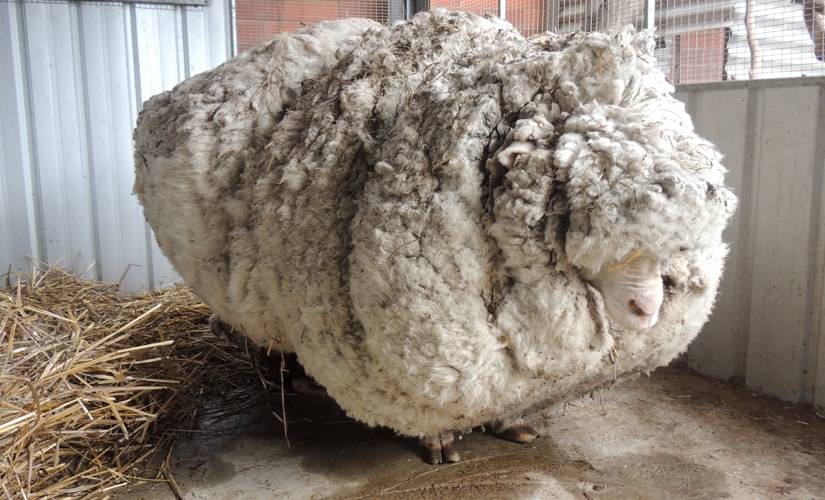
The overgrown sheep found in Australian scrubland is prepared to be shorn in Canberra. AP[/caption]You probably think that, because they are so valuable as wool producers, sheep must warrant proper handling and treatment. Here is the truth: all over the world, and especially in Australia from where we import a lot of wool, they are appallingly treated. When you see a sheep shearing demonstration on television, you are not aware that these are "demonstration experts" who handle the animal well and do the job neatly and quickly without causing obvious distress. But these are not the run-of-the-mill shearers. There are a lot of unskilled farmhands who work in a hurry and leave bloody gashes on the sheep whenever their scissors cut too close. Every shearing operation has one boy standing by, called a "blood stauncher", whose job it is to put tar on the wounds to stop the bleeding.In Australia, as anywhere else in the world, it is not necessary to use anaesthetics for operations performed on farm-bred animals, so mulesing, tail-docking, ear-clipping and castration of sheep can be performed by unskilled farmhands. The methods of castration are still quite barbaric: a rubber ring may be used to cut off the blood supply to the testicles, causing them and the scrotum to wither; or the testicles may even be bitten off by farmers, who refer to them as "oysters of the bush"! Still more suffering is caused by foot-rot and other harrowing complaints to which these poor creatures are subject to. There are photographs of animals literally trying to walk on their knees because their feet are so painful.Now there is a special breed of sheep which will never see the outdoors, but is bred intensively, like chickens, in sunless, concrete coops, to produce a "super wool" called "Sharlea". Also, a new drug, cyclophosphamide, is being injected into sheep because it has been found to have a hair-loosening effect. Instead of shearing, sheep can now have their hair pulled out in handfuls! Of course, the drug has the aftereffect of making sheep blind. But then, who wants a seeing wool-machine anyway.What will happen to the absolutely naked sheep after the hair has been pulled out? Since they are very sensitive to weather, one of the options is to spray the sheep with a waterproof chemical. What happens when the farmer feels that sheep are wearing out? Obviously, they are ready for the slaughterhouse. Some are transported vast distances in unsuitable trucks and trains. Crowded in layers for a three or four-day journey to the slaughterhouse, they receive neither food nor water and must stand all the way. The sick or clumsy ones who may fall are trampled by their frightened fellow creatures.Of course, some are dead on arrival. Those that can still stand are hurled or harried down the gangplank by men and electrocuted. The dead and the dying are dragged off and thrown into heaps. Some may also suffer the greater cruelty of being exported live to the Middle East. They are herded on to ships (upto 1,20 ,000 per ship) where they are forced to stand in their own urine and faeces in dark holds. Amidst the stench, sheep lie dying as their fellows try to survive on powdery pellet food and urine-contaminated water.Further horrors await the sheep in the Middle East.Witnesses have seen a sheep's throat cut with a knife in the street where it slowly chokes to death on its own blood, or is then blinded and bundled into the boot of a car to be quartered at home later.Journalists have reported the intense suffering of badly handled sheep during transport. In one instance, we are told of 12 wagons loaded with 800 ewes who had been shorn the day before, and had spent a bitterly cold night in the open, leaving Dover on a cargo ship. Two hours after they arrived at Dunkirk, they were re-loaded, 80 to a truck, bound for Marseilles. On arrival there, 25 were lame and one so weak that she could not stand. This ewe, along with the others, was taken further to Algiers where she was dragged off the ship to die on the dockside. At Algiers, the ewes, which had neither been fed nor watered since leaving Marseilles, found a bundle of hay on the dockside and fought each other to reach it. A lorry driver, trying to get through, drove straight at them, sending a few flying and breaking their legs. Even these were loaded onto the slaughterhouse trucks. All this cruelty abroad is duplicated a million times on sheep in India.Nevertheless, you may say, wool is necessary since it keeps us warm in winter. But wait, that is true only if you are a sheep. Wool is not the ideal fabric for humans. Our skin eliminates wastes all the time. The best clothing allows these wastes to pass through them so that the body is not infected with its own excretions. As we say, the skin needs to breathe. Clothing that holds perspiration, and other body wastes, against the skin limits its cleansing activity by obstructing the free access of fresh air and sunlight, thereby laying the ground for all sorts of skin diseases. Woollen fabrics make the worst clothing in this respect.If we don't use wool, how do we keep warm? There are alternatives which are so much better. Clothes and blankets which wash easily, do not shrink and keep their colours, cost far less and are far superior to wool. In future, whenever you are tempted to buy wool, remember the cruelty that has gone into its production. As always, the buyer has the power to put an end to organised cruelty. Wool users support butchery by subsidising the production cost of lamb and mutton joints — even though they may not consume them. Can one live with the knowledge that one has abetted the callous exploitation of these gentle animals?To join the animal welfare movement contact gandhim@nic.in, www.peopleforanimalsindia.org

Here's why you crave sweets after every meal: This one thing can fix it
India's most beloved national parks for wildlife lovers
Even the Beckhams break: The rise of family estrangement
European Council Chief has an OCI card: What is it?
The 90s show Friends, and why we misread modern friendships