
Advertisement


Sections
This Independence Day, free yourselves from the shackles of outrage and breathe
Outrage, or intolerance (as popularly known in India), has become a way of life. A modern-day pastime, like binge-watching your favourite show.

via GIPHYOutrage, or intolerance (as it's popularly known in India), has become a way of life. A modern-day pastime, like binge-watching your favourite show. And, god knows, its fun. But the question is for how long and at what cost?We, as a nation, lack the capacity of laughing at ourselves. We must get all huffy-puffy and enraged if someone makes fun of our Indian-ness. We must whack the daylights out of the person who makes fun of our food habits or says our Prime Minister's English sucks or that Rahul Gandhi is not that useless.We have too many rules and for nothing. We cannot ignore and move on. We must react. And that has nothing to do with India. It is a very worldwide condition. And it stems from insecurity.Outrage is a high explosive defence. It has the buckshot of righteousness, the large calibre of hurt and the muzzle velocity of evangelism. And we become martyrs to a cause and feel important. It is sufficient to say if public outrage were energy, we would happily give up on fossil fuel overnight.A study done in 2013 from Beihang University in Beijing, of Weibo - a Twitter-like microblogging site, found that anger spreads most easily over social media. Happiness comes in distant second. The study observed:
"We find the correlation of anger among users is significantly higher than that of joy, which indicates that angry emotion could spread more quickly and broadly in the network. While the correlation of sadness is surprisingly low and highly fluctuated. Moreover, there is a stronger sentiment correlation between a pair of users if they share more interactions. And users with larger number of friends posses more significant sentiment influence to their neighborhoods."Experts who study anger have said that even though we are quick to share happiness with close friends and family, joining a stranger at times of rage is way more popular than the former. As the study suggests, outrage is lavishly rewarded on social media, whether through supportive comments, retweets or Facebook likes. Those prone to outraging on the internet are looking for validation. They want to hear that others share their anger and they are less lonely and isolated in their belief. They stand vindicated.There are times when outrage is an appropriate reaction to current events (crimes against women, atrocities against minorities, restrictions by state machinery on lifestyle, etc) — all injustices and valid reasons for momentary rage. Most of the time though, our outrage is excessive and even unwarranted. Other times it is us who counter others outraging by outraging ourselves. It is basically this counter-productive exercise which engulfs us in a vicious cycle of hate and indignation and most often than not, it is for nothing.And the exponentially germinating social media has fanned this phenomena. Today (Independence Day) will be the perfect day for you to see (or maybe even try out a social experiment) that scores of people will get into these inane verbal duels on Facebook and Twitter. People will sit, glued to their keyboards dying to tell the world what they feel on this Independence Day. How India is great or not; how a particular political party or a personality has ruined/resurrected the nation; how we as a nation have fallen/risen - and there will be millions sitting to support or negate these arguments. And not mildly. Because how can you?"India is a great nation. We are bunch of awesome people and you will be lucky to know us.""What B***S***! That's just blindness. How can you say India is great? We still eat cow meat.""Oh please! Get over yourself. America eats cow meat. They have Trump and they are a great country.""What did you just say? Trump and great in the same sentence? Ugh... sociopath! Such a filthy gutter-brained moron!"Do you see the drift? Don't tell me you haven't come across something like this on those many, many backlog of comment sections on Twitter and Facebook. I will rejig your memory with something very recent. Author, columnist Shobhaa De, who happens to have a following of 7.7 million on Twitter, on 8 August tweeted this:There were many who reacted to this "outrageous" comment. Read here, here, here and here. But these are commentators who have watched the space of news very closely and analysed events and then come to a conclusion based on well-argued points. Now, read these reactions.
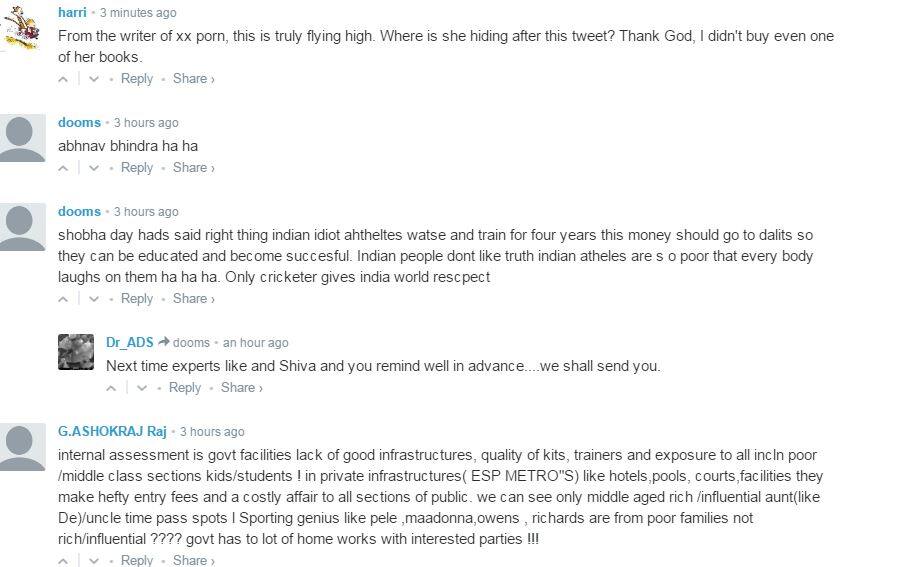 And also sample these:
 Social media and the internet have become breeding grounds for armchair criticism, false discontent, and passive-aggressive disappointment. A place where we, inconsistently, try to precept our building tallest by ridiculing everything else.So, we sit and spew. Without logic, without giving it a second thought and funnily-enough, fooling ourselves to think that we are making this great argument.
via GIPHYBut clearly, oblivious to all the logical thinking of the world, we scroll through the limitless stream, prowling for the next gaffe (or not) just so that we can jump at them with this fake anger. A meaningful discussion is rarely attempted.Humour and the ability to take a joke is a golden attribute. We hardly laugh at ourselves (there are exceptions though) and we take ourselves way too seriously.
via GIPHYHumour in itself, however, is dangerous because it offers a peek into our inner selves and all too often we don’t like what we see. Add to that the rampant ignorance that most of us have of our religion, our language, our culture and history and you can see how we can easily get thin-skinned and super touchy.So here's what we really do: We judge people. We do so because it makes us feel better, fleetingly so, but pretending to be "fed up" with something is much easier than attempting to look into why do people say what they say — introspection is not an easy virtue. It is obnoxious downward spiral and honestly from a third person's point of view - far away from the comments, likes, posts @replies — outraging people look like buffoons. Like I said earlier, enraged people or those with a lot of judgments are insecure people.Line up all things sacred at your convenience and then go for the person who comments on them or questions their legitimacy. How could you? How dare you? Have you no sensitivity to my feelings?
via GIPHYIt is not about being thick-skinned. It is not even about ignoring. It is about reducing the noise. The shrill that has absolutely no causation. Why will you yell when no one really cares? And no, it is not about free speech. This is free speech. Because you don't need to make noise and go batshit crazy when you are making a solid point about a serious issue plaguing the society. When you really care and have something meaningful to say, you say it and not yell it.So. Let it go. Change the channel. Unsubscribe. Unfollow. Unfriend. Block. Mute. Breathe
via GIPHY
First Published:Aug 15, 2016, 07:56:56 IST
Advertisement
Advertisement

Here's why you crave sweets after every meal: This one thing can fix it
It's common to crave something sweet after meals. However, what's often dismissed as "having a sweet tooth," is mostly nutritional deficiency
1 min read
India's most beloved national parks for wildlife lovers
India holds some of the world’s most wonderful wilderness spaces. Forests and jungles where myth, beauty and survival exist side by side. From mangroves that swallow rivers to grasslands shaped by centuries of migration, the country’s national parks offer more than sightings. They offer moments of stillness, surprise, and reverence.
1 min read
Even the Beckhams break: The rise of family estrangement
People are choosing to cut off contact with their families, prioritising mental health.
4 min read
European Council Chief has an OCI card: What is it?
The OCI Scheme, introduced in 2005, grants foreign nationals of Indian origin a life-long visa for India, but no political rights.
1 min read
The 90s show Friends, and why we misread modern friendships
We’ve all heard about the loneliness epidemic at this point. It isn’t even particularly shocking — it seems like the result on the obvious — people consistently glued to their phones, seeking intimacy and even sex through phone screens, consistent comparison to other peoples’ partners, and what their relationships look like, to how far everyone has come in their jobs — there is much to feel diminished about.
5 min read
Advertisement
Advertisement