
Advertisement


Sections
Gora Panju vs kaali Madrasi blog wars: Ethnic stereotypes are so 20th century
All this blather about 'dumb' Punjabis or 'ugly' Tamilians is not just offensive, but also sadly outdated. We now have an urban tribe of professionals who have more in common with each other than with members of their community.

"I'm actually a Delhi girl," I start to say at a dinner party in Bangalore, when the pretty Marathi chick standing next to me interrupts: "Well, you don't look like one! And I should know because I lived there for six years."But what does a Delhi girl look like? Fair, pretty, dumb, shallow, tame and, of course, Punjabi. Or so goes the stereotype, which was summed up recently by the now notorious blogger Shahana Nair Joshi in a string of negatives: [/caption]Dark skin, check. Long hair, check. Kind of mouthy, check. But, but, I am from South Delhi, born and raised.Ok, so I am Tamil by ethnicity. Then again my mother was raised in Mumbai and my father in Mysore. This clearly explains why I'm such a poor excuse of a TamBram. I prefer my rajma to kootu, Pandit Jasraj to MS Subbalakshmi (don't kill me), and my Tamil is, in one word, atrocious. So bad that a friend – Gujju raised in Chennai – begged me to never again desecrate the language. But my three-year old daughter's Tamil is effortlessly fluent. She who is half Haryanvi Jat, born in San Francisco and now being raised in Bangalore.Oh, and I barely scraped through Science and Math in school, as did my brothers. My Jat husband, on the other hand, has a PhD in computer engineering and heads the mobile chip division of a major Silicon Valley company.When reality gets this confusing, no wonder we turn to the most asinine stereotypes.It's easy enough to debunk Nair Joshi's Open Letter to a Delhi Boy which is rife with distasteful and ugly generalisations about North Indians, or more specifically Punjabis. As one Tamil blogger put it, "If you’re playing for the South Indian team, I think you just scored a self goal."But here's the more interesting question: Why do we hold on to these tired old cliches, not just about others, but also our own selves? Nair Joshi, for example, is a product of a inter-community marriage: "part Maharashtrian and part South Indian." And yet she blithely touts the "fact" that all South Indians are dark and not very attractive – or at least, not the men.Part of it is just human nature. Theorists like Henri Taifel suggest that social identity is "that part of individual self-concept that derives from one's knowledge of membership in a social group (or groups), together with the value and emotional significance attached to that membership." And we maintain that identity in relation to other groups who we seek to categorise. In other words, stereotyping is the way we figure out who we are, and deal with the rest of the world. Everyone does it, be it in terms of race, ethnicity, nationality or even gender.Fair enough. And let's be frank, stereotypes can be pretty darn funny. Some of the best jokes are based on ethnicity, but usually when they're directed at one's self. Sikhs will happily share the latest Sardarji joke, and Bongs will riff at amusing length on their various eccentricities (Read: anything written by Firstpost's Sandip Roy). Humour always include a kernel of truth – many of us do indeed remain true to type in some way – but it works best when pointing to reality with self-awareness and affection. The punchlines, however, sound a whole lot meaner when they're used as a weapon.What is sad about Nair Joshi is that much as she believes that she is scoring one over the Punjabis, she seems to have fully internalised all the cruel jokes about "kaali kalooti Madrasis". The irony is that if she did indeed pay attention to that issue of Vogue favoured by dumb Panju babes, she'd find plenty of long-haired kaali kalootis inside. For all our obsession with fairness creams, Indian concepts of beauty are morphing, more so in the upwardly mobile class she belongs to.The real problem with her so-called letter is not that it's offensive but that it's outdated. A futile gesture toward a worldview that has already passed many of us by.Two decades of liberalisation has created a national urban tribe of professionals who have more in common with each other than with members of their community. We move around way too much – as we bounce from school to college, graduate school, and our various jobs – to hold on to age-old stereotypes. Our own social identity has been reduced to series of cultural conventions that we each follow at will and to varying degree. We are far more likely to bond over a common sensibility, life experience, and lifestyle. A reason why inter-community dating and marriage is almost the norm. It's also why books like Chetan Bhagat's Two States or those tired North-meets-South Bollywood melodramas seem trite today.Our world – small and rarefied as it may be – has indeed moved on. And that's a good thing.Growing up Tamil in Delhi back in the 80s was hardly a cakewalk. I still remember the five-year-old me, standing in line for assembly, when my best friend Brinda told another girl, "Your lips are so pink.""So are mine," I added, only to have her firmly disagree, "No they're not. You're a darkie."Ouch!Fast forward 30-plus years later, my cherub-faced daughter tells me, in a heavy Tamil accent, no less, "Mama, I am white. You are brown." To which I just shrug and reply: "Sure, sweetie, like chocolate. And you're a barfi. Both of us, yummy, yummy."Life's funny that way – funnier than any tired old joke about Panjus or Madrasis, Malyalis or Sardars.Follow Firstpost on Facebook, Twitter and Google+ for breaking news and views.
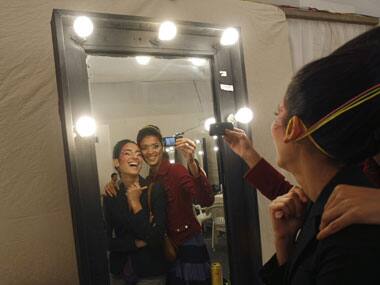
But let me remind you that I am from SOUTH INDIA and not SOUTH DELHI, so no, I am not scrawny, I am not fair, I don’t have straight hair and my topics of conversation go beyond the Fendi I saw in last month’s Vogue. I am olive-skinned, have lower–back-length lustrous cascading tresses that sometimes make me look like I fell out Jim Morrison's tour bus. Got a problem with that? Well just suck it up coz I was born into a society where a woman can whoop your Punjabi patoutie to pulp.[caption id="attachment_85731" align="alignleft" width="380" caption="Two decades of liberalisation has created a national urban tribe of professionals who have more in common with each other than with members of their community. Reuters"]
 [/caption]Dark skin, check. Long hair, check. Kind of mouthy, check. But, but, I am from South Delhi, born and raised.Ok, so I am Tamil by ethnicity. Then again my mother was raised in Mumbai and my father in Mysore. This clearly explains why I'm such a poor excuse of a TamBram. I prefer my rajma to kootu, Pandit Jasraj to MS Subbalakshmi (don't kill me), and my Tamil is, in one word, atrocious. So bad that a friend – Gujju raised in Chennai – begged me to never again desecrate the language. But my three-year old daughter's Tamil is effortlessly fluent. She who is half Haryanvi Jat, born in San Francisco and now being raised in Bangalore.Oh, and I barely scraped through Science and Math in school, as did my brothers. My Jat husband, on the other hand, has a PhD in computer engineering and heads the mobile chip division of a major Silicon Valley company.When reality gets this confusing, no wonder we turn to the most asinine stereotypes.It's easy enough to debunk Nair Joshi's Open Letter to a Delhi Boy which is rife with distasteful and ugly generalisations about North Indians, or more specifically Punjabis. As one Tamil blogger put it, "If you’re playing for the South Indian team, I think you just scored a self goal."But here's the more interesting question: Why do we hold on to these tired old cliches, not just about others, but also our own selves? Nair Joshi, for example, is a product of a inter-community marriage: "part Maharashtrian and part South Indian." And yet she blithely touts the "fact" that all South Indians are dark and not very attractive – or at least, not the men.Part of it is just human nature. Theorists like Henri Taifel suggest that social identity is "that part of individual self-concept that derives from one's knowledge of membership in a social group (or groups), together with the value and emotional significance attached to that membership." And we maintain that identity in relation to other groups who we seek to categorise. In other words, stereotyping is the way we figure out who we are, and deal with the rest of the world. Everyone does it, be it in terms of race, ethnicity, nationality or even gender.Fair enough. And let's be frank, stereotypes can be pretty darn funny. Some of the best jokes are based on ethnicity, but usually when they're directed at one's self. Sikhs will happily share the latest Sardarji joke, and Bongs will riff at amusing length on their various eccentricities (Read: anything written by Firstpost's Sandip Roy). Humour always include a kernel of truth – many of us do indeed remain true to type in some way – but it works best when pointing to reality with self-awareness and affection. The punchlines, however, sound a whole lot meaner when they're used as a weapon.What is sad about Nair Joshi is that much as she believes that she is scoring one over the Punjabis, she seems to have fully internalised all the cruel jokes about "kaali kalooti Madrasis". The irony is that if she did indeed pay attention to that issue of Vogue favoured by dumb Panju babes, she'd find plenty of long-haired kaali kalootis inside. For all our obsession with fairness creams, Indian concepts of beauty are morphing, more so in the upwardly mobile class she belongs to.The real problem with her so-called letter is not that it's offensive but that it's outdated. A futile gesture toward a worldview that has already passed many of us by.Two decades of liberalisation has created a national urban tribe of professionals who have more in common with each other than with members of their community. We move around way too much – as we bounce from school to college, graduate school, and our various jobs – to hold on to age-old stereotypes. Our own social identity has been reduced to series of cultural conventions that we each follow at will and to varying degree. We are far more likely to bond over a common sensibility, life experience, and lifestyle. A reason why inter-community dating and marriage is almost the norm. It's also why books like Chetan Bhagat's Two States or those tired North-meets-South Bollywood melodramas seem trite today.Our world – small and rarefied as it may be – has indeed moved on. And that's a good thing.Growing up Tamil in Delhi back in the 80s was hardly a cakewalk. I still remember the five-year-old me, standing in line for assembly, when my best friend Brinda told another girl, "Your lips are so pink.""So are mine," I added, only to have her firmly disagree, "No they're not. You're a darkie."Ouch!Fast forward 30-plus years later, my cherub-faced daughter tells me, in a heavy Tamil accent, no less, "Mama, I am white. You are brown." To which I just shrug and reply: "Sure, sweetie, like chocolate. And you're a barfi. Both of us, yummy, yummy."Life's funny that way – funnier than any tired old joke about Panjus or Madrasis, Malyalis or Sardars.Follow Firstpost on Facebook, Twitter and Google+ for breaking news and views.
First Published:Sep 16, 2011, 15:37:14 IST
Advertisement
Advertisement

Here's why you crave sweets after every meal: This one thing can fix it
It's common to crave something sweet after meals. However, what's often dismissed as "having a sweet tooth," is mostly nutritional deficiency
1 min read
India's most beloved national parks for wildlife lovers
India holds some of the world’s most wonderful wilderness spaces. Forests and jungles where myth, beauty and survival exist side by side. From mangroves that swallow rivers to grasslands shaped by centuries of migration, the country’s national parks offer more than sightings. They offer moments of stillness, surprise, and reverence.
1 min read
Even the Beckhams break: The rise of family estrangement
People are choosing to cut off contact with their families, prioritising mental health.
4 min read
European Council Chief has an OCI card: What is it?
The OCI Scheme, introduced in 2005, grants foreign nationals of Indian origin a life-long visa for India, but no political rights.
1 min read
The 90s show Friends, and why we misread modern friendships
We’ve all heard about the loneliness epidemic at this point. It isn’t even particularly shocking — it seems like the result on the obvious — people consistently glued to their phones, seeking intimacy and even sex through phone screens, consistent comparison to other peoples’ partners, and what their relationships look like, to how far everyone has come in their jobs — there is much to feel diminished about.
5 min read
Advertisement
Advertisement