


Taste of bygone Surat: rassawala khaman dhokla
Modern versions of the khaman dhokla bear little relation to the traditional street eat that is almost impossible to find.

Kajal TejsinghaniEditor’s note: Food is history. A shared heritage that traces our roots, as a family, community, and nation. The dizzying pace of urban change and of our 21st century lifestyles is transforming not just the way we eat, but what we eat. Age-old family recipes cooked by our mothers and grandmothers, passed down from one generation to the other in the intimacy of the family kitchen, are getting lost in this fast-paced shuffle.A new generation of Indians may remember their favourite childhood treat but don’t possess the knowledge to recreate it. These ‘endangered eats’ are neither available in the restaurant or at home -- and may well be lost to the mists of time if we don’t record this cherished oral inheritance. This Firstpost series is a modest attempt to do the same, and we urge you, dear reader, to contribute your family recipes to this worthy cause. We invite you to share with us the stuff of your memories of ghar ka khana bygone, either in the comments section or in an email to feedback@firstpost.com [caption id="attachment_5956" align="alignleft" width="380" caption="Jai Jalaram's khaman dhokla stall in Surat. Image courtesy: Bhavna Jardosh"]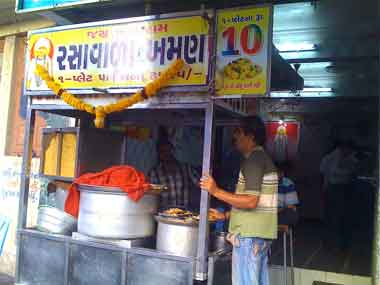 [/caption]Forty years ago, in 1969, in the old city of Surat (Gujarat), on Balaji road, two young sisters, Radhika and Bhavna Jardosh aged 8 and 6, waited patiently for that one day in the week when they could eat their most favourite snack.In the narrow, muddy lane outside the Balaji Girls' School sat three street vendors, temptingly positioned right at the gate. One hawked boiled black channa; the other, peppermint sweets; and the last, a very special treat: the rassawalla khaman dhokla.On that one day when they got their precious weekly allowance of 8 annas, the girls would dash out of the gates the minute lunch break rang out. The slightest delay would mean waiting in a long queue to buy the much-loved ‘khaman’. A delicious, tangy treat that cost a mere two annas, less than 25 paisa today. When Radhika and Bhavna remininsce about those days, they chime together, "modha ma pani ave evu tasty hatu, ketlu chatpatu ane thiku !” [ Our mouths used to water, so tasty it was, so tantalising and spicy].Dhoklas are a staple Gujarati snack, and khaman is a specialty of the Surthis (natives of Surat in southern Gujarat). The traditional khaman dhokla bears little resemblance to its present-day incarnation. It is airy, syrup-soaked and sometimes sandwiched with layers of chutney, ketchup and paneer -- a poor imitation of an age-old culinary delicacy that can only be found in old-fashioned homes or in villages where the authentic khaman endures.In big cities, this dish is nearly extinct, rarely available and barely known to the new generation of urban Gujaratis. As for that street vendor in Surat, he is not around anymore. But Jai Jalaram serves a modern variation of the khaman. It’s not quite the same recipe but close enough. And for Rs 10, it's not a bad deal at all !To eat the real rassawala khaman dhokla, you will just have to cook it at home. Unlike its common cousin, it is not made of fermented batter of rice and urad dal, but ground channa dal. Pan fry the dhokla, pour on a generous helping of a tangy dal-like gravy, and top with chopped tomatoes, onions and sev. Nostalgia is served!For the khaman:400 gm of channa dal½ tsp haldi (turmetic)6-7 spicy green chillis chopped finely1 tbsp ginger pastePinch of sugarPinch of hing (asafetida)1 tbsp peanut oil1 tbsp of Eno (or 1 tsp of soda bicarb)Salt to taste2 tbsp peanut oil2 tsp rai (mustard seeds)1 tbsp shredded fresh coconut1 tbsp chopped corrianderMethod:Soak the channa dal for 4 to 5 hours. Coarsely grind the dal and keep it covered for another 4 to 5 hours for it to ferment. When ready, take the ground dal in a mixing bowl and add all the other ingredients. Stir vigorously. The Eno salt will make the mixture rise.Prepare the steamer and grease the tin with little oil. Pour the dhokla batter into the dish and steam for about 20-25 minutes. To check if it’s done, insert a knife in the middle. Once ready, pull the dhoklas out and cut them into diamond shapes.In another small kadai, take 2 tbsp of oil, and when smoking hot, add mustard seeds. As they splutter, pour the oil over the khaman. Sprinkle with shredded coconut and coriander.These dhoklas can be enjoyed by themselves, but for the rassawalla khaman, add the toppings and gravy below.For the ‘rassa’ (gravy):100 gm urad dal100 gm chana dal100 gm tuwar dal6-7 tomatoes chopped2-3 pods cardamom2-3 cloves4-5 black pepper2-3 green chillis (ground)3-4 pieces of dried tamarind soaked in waterSalt to taste2 chopped tomatoes1 chopped onion1 cup fine yellow sev2 tbsp chopped coriander2 tbsp shredded fresh coconutSoak the dals for 2 hours and boil. In another pot, boil some water to cook the tomatoes. Meanwhile, dry grind the cardamoms, cloves and black pepper seeds to a fine powder.Now mash the dals and add to the tomato/water mixture. Add green chilli paste, spices and salt. Let the mixture boil for some time about 10 minutes or till its begins to come together. Add tamarind pulp at the very end. The gravy should be thick, not thin like soup.To serve, pan fry the khaman dhokla in oil. Put the pieces in a deep-dish plate. Pour the dal over the khaman and top it up with chopped tomatoes, onions corriander, shredded coconut and sev.The author writes food columns for the New Indian Express and putting to use her photography skills and moonlighting as a wedding movie maker.

Here's why you crave sweets after every meal: This one thing can fix it
India's most beloved national parks for wildlife lovers
Even the Beckhams break: The rise of family estrangement
European Council Chief has an OCI card: What is it?
The 90s show Friends, and why we misread modern friendships