
Advertisement


Sections
Remembering Sunderlal Bahuguna: How the activist's life and Satyagraha for nature founded India's ecology movement
The Satyagraha for the forest came from a deep love for the forest. Chipko and Sunderlal Bahuguna received the Alternative Nobel Prize in 1987. In 2009, he was honoured with the Padma Vibhushan.

On Friday, 21 May 2021, Sunderlal Bahuguna breathed his last. Bahuguna has been my inspiration for nearly half a century. His inspiration will continue for generations to come.I met him first at his Ashram in Silyara where I had made a commitment to volunteer for the Chipko Movement. I first heard of “Chipko” from a roadside chaiwala near Chamba in Garhwal.I was born and grew up in the Himalayan forests where my father was a forest officer. Chamba and the hills between Chamba and Mussoorie had a dense oak forest. Right below the forest rest-house flowed a stream.In the early 1970s, I was leaving for Canada to do my PhD in the foundations of quantum theory. Before leaving, I wanted to do a small trek and visit a favourite forest in the Himalayas, so I could carry that memory with me. But the oak forest was gone, and the stream that had its source in it was a trickle. I felt as if I had physically lost a part of me. The forests and streams of the Himalayas had shaped me and made me who I was.While waiting for a bus to get back to Delhi at a dhaba, I started talking to the chaiwala about my sadness and pain seeing the forests disappear. He responded: “Now there is hope. Chipko has started.” I heard about women stopping logging in Reni and other places. I heard about Sunderlal Bahuguna. While I had to catch my flight to join my university in Canada, I took a pledge to return, find Chipko, and volunteer in it during my summer and winter vacations.The first time I came home, we went to the Silyara Ashram which had been started by Sunderlal Bahuguna and his wife Vimla Bahuguna. Since that day in the early 1970s, Sunderlal ji has taught our generation that nature’s economy is the real economy that supports all economies, including the market economy.Every vacation, when I came home to volunteer for Chipko — first while doing my PhD in Canada, and later while working in Indian Institute of Science (IISc) and the Indian Institute of Management (IIM) in Bangalore — Sunderlal ji would ask us to undertake padyatras. From the mid-1970s to 1981, under Sunderlal and Vimla Bahuguna’s guidance, we undertook padayatras and documented the movement while learning from women.We went to Advani and Badyargad, to Gangi and Phata, and other important locations of Forest Satyagrahas. Through Chipko, I learnt the practice of Satyagraha — of acting from the truth and refusing to obey unjust law or follow an unjust policy that was based on violence against nature and people. Because of his tireless efforts, green felling was stopped in the central Himalayas in 1981.![illustration by Mahafuj Ali.]() Illustration by Mahafuj Ali.[/caption]Sunderlal Bahuguna and his wife Vimla are my teachers in Gandhian philosophy, which tells you that ecology is a permanent economy, and that simple living in service of others is central to making a shift from egocentric thinking and living to ecocentric thinking and living. Egocentrism leads to greed, consumerism, taking other's share of things. Ecocentrism leads to caring, sharing and not taking other's share.The three Gandhian principles that I have learnt from Sunderlal and Vimla Bahuguna are:
Illustration by Mahafuj Ali.[/caption]Sunderlal Bahuguna and his wife Vimla are my teachers in Gandhian philosophy, which tells you that ecology is a permanent economy, and that simple living in service of others is central to making a shift from egocentric thinking and living to ecocentric thinking and living. Egocentrism leads to greed, consumerism, taking other's share of things. Ecocentrism leads to caring, sharing and not taking other's share.The three Gandhian principles that I have learnt from Sunderlal and Vimla Bahuguna are:
Sunderlal ji was the continuity between our freedom movement and today’s ecology movement.He was inspired by Sri Dev Suman, who worked with Vinoba Bhave and Gandhi’s disciples Mira Behn and Sarla Behn. I have been blessed to learn Gandhi’s principles first from my mother and father, and later from Sunderlal and Vimla Bahuguna. These are the principles that have seeped into my thinking and work.[caption id="attachment_9647121" align="alignnone" width="640"]
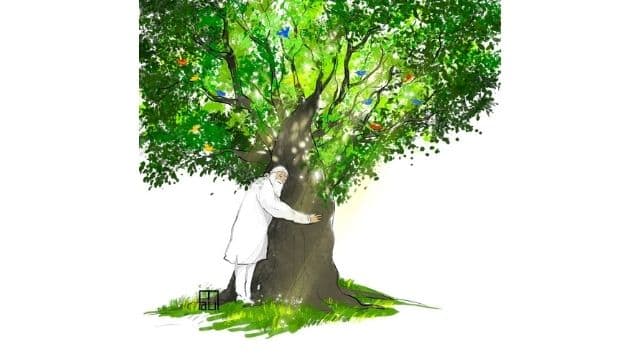 Illustration by Mahafuj Ali.[/caption]Sunderlal Bahuguna and his wife Vimla are my teachers in Gandhian philosophy, which tells you that ecology is a permanent economy, and that simple living in service of others is central to making a shift from egocentric thinking and living to ecocentric thinking and living. Egocentrism leads to greed, consumerism, taking other's share of things. Ecocentrism leads to caring, sharing and not taking other's share.The three Gandhian principles that I have learnt from Sunderlal and Vimla Bahuguna are:
- Swaraj: self-rule and self-organisation.
- Swadeshi: self-reliance, local economy
- Satyagraha: the force of truth and the obligation to not cooperate with unjust brute law.
Whether it was protecting the integrity of the Himalayan forests of oak and rhododendron in the 1970s through the Chipko Movement, spreading Chipko as Appiko in the Western Ghats, or defending the integrity of Mother Ganga through his Ganga Satyagraha at the Tehri Dam, Sunderlal ji was the voice of nature, the voice of the Himalaya, and the voice of the Ganga.His inspiration was not limited to India. He marched to protect the forests in Nairobi. I remember a journey with him to Mexico in the mid-1980s at the invitation of Ivan Illich and Gustavo Esteva. Richard Barbe Baker also known as 'Man of the Trees' wrote of Sundarlal Bahuguna:“As far as I know, in the entire world, Sundarlal is the only person who has gone on a fast unto death for trees. Sundarlal is my guru. And the Chipko Movement is the leading movement for protecting our forests”The Satyagraha for the forest came from a deep love for the forest. Chipko and Sunderlal Bahuguna received the Alternative Nobel Prize in 1987. In 2009, he was honoured with the Padma Vibhushan. In spite of his awards and recognition, Sunderlal ji and Vimla ji lived a life of simplicity and grace.He would frequently come with Vimla ji to teach at the Earth University in Navdanya, on courses on Gandhi and globalisation, and on ecology. Whenever we had the opportunity, we would visit him and Vimla ji.His life embodied the teachings of Gandhi: "The Earth has enough for everyone’s needs but not for a few people’s greed." Through his life, his teachings, his courageous activism, and his creative ideas, he taught me that to protect nature, we need to listen to her and to love her. Listening to the mountains and the rivers has become a survival imperative for us in India, and for humanity across the world.To listen to nature we need to listen to Sunderlal Bahuguna, follow his teachings, and the path he has walked. Speaking to the future generations, Sunderlal asked:“Politicians have loudspeakers.But who will speak for the tree that will be cut?Who will come forward for the dying river?Who will protect the mountains?It is now time to hear the voice of the tree being cut, the voice of the river, the scream of the mountain that is sliding."— Himalaya Me Mahatma Gandhi ke Sipahi, Sundarlal Bahuguna, by KS Valdiya (2017)Sunderlal ji had spoken as the voice of nature. He lived for nature and her protection. His life was a continuous satyagraha for life and freedom. His legacy shows the way for the future of humanity, mandating living with respect for, and in harmony with nature.***(Based on the author’s forthcoming memoir of Sunderlal Bahuguna to be published by Niyogi Books)Vandana Shiva is an environmental activist and commentator.
First Published:May 23, 2021, 10:31:35 IST
Advertisement
Advertisement

Here's why you crave sweets after every meal: This one thing can fix it
It's common to crave something sweet after meals. However, what's often dismissed as "having a sweet tooth," is mostly nutritional deficiency
1 min read
India's most beloved national parks for wildlife lovers
India holds some of the world’s most wonderful wilderness spaces. Forests and jungles where myth, beauty and survival exist side by side. From mangroves that swallow rivers to grasslands shaped by centuries of migration, the country’s national parks offer more than sightings. They offer moments of stillness, surprise, and reverence.
1 min read
Even the Beckhams break: The rise of family estrangement
People are choosing to cut off contact with their families, prioritising mental health.
4 min read
European Council Chief has an OCI card: What is it?
The OCI Scheme, introduced in 2005, grants foreign nationals of Indian origin a life-long visa for India, but no political rights.
1 min read
The 90s show Friends, and why we misread modern friendships
We’ve all heard about the loneliness epidemic at this point. It isn’t even particularly shocking — it seems like the result on the obvious — people consistently glued to their phones, seeking intimacy and even sex through phone screens, consistent comparison to other peoples’ partners, and what their relationships look like, to how far everyone has come in their jobs — there is much to feel diminished about.
5 min read
Advertisement
Advertisement