


Rediscovering America: After long slump, Indian students in US schools up 6 percent
Applications to American colleges from international students has reached an all-time high, reaffirming the strength of US institutions in an increasingly competitive market for tuition paying foreign students.

New York: Applications to American colleges from international students has reached an all-time high, reaffirming the strength of US institutions in an increasingly competitive market for tuition paying foreign students. An upsurge of Chinese and Indian students pushed the number of international students studying at US universities to a record high of nearly 900,000 during the 2013-14 school year, up 8 percent from the previous year, according to an annual survey released on Monday by the Institute of International Education (IIE).India sends a significant number of students to study in the United States, second only to China. Students from China, India and South Korea now represent about half of all international students in the US, with the number from China and India on the uptick and the numbers from South Korea on the decline.China sends the most students of any country — nearly 275,000 in the latest school year, up 17 percent from the year before. The number of students from India also increased, but by a modest 6 percent to 102,673 students after a three-year decline, the report found.As The Times of India reports:"The modest reversal in the Indian student inflow into the US belies earlier reports that there has been a 26 per cent spike in their numbers. In fact, after peaking at nearly 105,000 in 2009-2010 academic year, Indian student population in the US dropped to 96,754 in 2012/2013 as other destinations such as UK, Canada, Australia, and Europe hawked their educational wares before the continuing US allure kicked in this year."[caption id="attachment_1807957" align="alignleft" width="380"]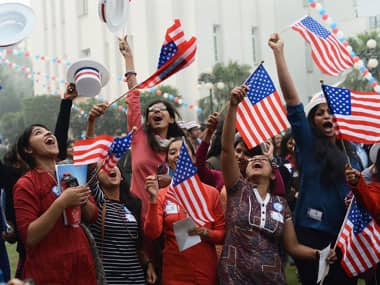 Image used for representational purposes only. AFP.[/caption]Last year, a report by the American Council of Graduate Schools had claimed that the the total number of Indian graduate students had jumped 26 percent to 54,245 students. Indian students regard a US degree as a badge of honor. But for many Indian parents, who partly or wholly fund the exercise, expense is the operative word. The weak Indian rupee has made it difficult for some Indian students to pursue their dreams."The Indian currency had become severely devalued against the dollar and many Indian students were hard hit by that," said Rajika Bhandari, report co-author and deputy vice president of research and evaluation at IIE."Closer to 2014 we saw the rupee stabilize a bit against the dollar," she added. Although the rupee is not expected to slump back to its record low of 68.80 per dollar in August 2013, it is likely to struggle to gain any more over the next 12 months as a US dollar rally gathers pace on hopes of a strong economic recovery. Most analysts expect a trading range of 60 to 62 (per dollar) for the rupee in the near term.The average American college tuition and fees of $48,870 for upperclassmen is expensive for middle class Indian families. On broadly the same lines as the “Open Doors” report, real time SEVIS data from October 2014 showed that the number of Indian students had ticked up to a total of 134,292 students. India has more students studying in the United States than any of other region whether it is Canada, Europe, South America or Australia.“Students from India comprise more than 26 percent of the STEM student population in the United States,” said a report mining Student and Exchange Visitor Program (SEVIS) data released by US immigration authorities.- Thirty-seven percent of students from India study at schools in California, Texas and New York.- Seventy-nine percent of students from India study in STEM fields.- Students from India flock to engineering and computer and information sciences and support services programs.- Twenty-seven percent of all STEM students studying engineering are from India.But as TOI notes, these numbers remain modest in comparison to the flood of Chinese students into the United States over the past 15 years:"In 2000, China and India were not too far apart in terms of student traffic into the US, each having close to 45,000 students in the world's most favored destination. At one point in the 1990s, there were more students in the US from India than from China. China has since pulled away. There are now five times as many Chinese students on US campuses as were reported in Open Doors 2000; but only two times as many Indian students."The “Open Doors” report corroborated that within the US, 41 states saw increases in international students, with California, New York and Texas attracting the highest numbers. Among colleges, New York University became the leading host university for international students, surpassing University of Southern California, which had been the leader for 12 years, according to the report. For the first time, NYU and three other universities enrolled more than 10,000 students. The others included University of Southern California, University of Illinois—Urbana-Champaign and Columbia University.International student spending added more than $27 billion to the U.S. economy in 2013, according to the US Department of Commerce. Most students – about 64 percent – paid for their education with personal or family funds. U.S. universities are looking to other countries for students who pay the full sticker price to attend. On an average, foreign and out of state students wind up paying an extra $23,000 a year and help US colleges plug the budget gaps caused by reductions in state funding.There was a 43 jump in students from Kuwait, a 22 percent increase among students from Brazil and a 21 percent increase of those from Saudi Arabia. All three countries offer national scholarships for students who want to study abroad, according to IIE.

Here's why you crave sweets after every meal: This one thing can fix it
India's most beloved national parks for wildlife lovers
Even the Beckhams break: The rise of family estrangement
European Council Chief has an OCI card: What is it?
The 90s show Friends, and why we misread modern friendships