


Isro launches IRNSS 1C, India a step away from its own navigation satellite system
India on Thursday moved closer towards having its own satellite navigation system as it successfully launched the IRNSS 1c satellite.

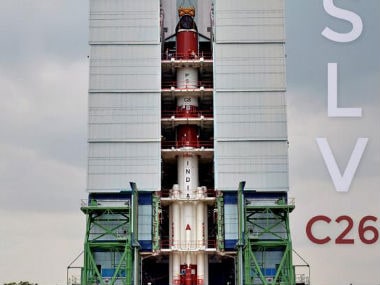
PSLV C26 with the IRNSS 1C system ahead of the launch. Image ISRO Twitter.[/caption]The ranging payload consists of C-band transponder which facilitates accurate determination of he range of the satellite. The satellite control was taken over by the Mission Control Facility(MCF) at Hassan in Karnataka. The MCF will manage the satellite's orbit raising operations firing the on-board motors till it is placed in final orbit.The satellite with a life span of around 10 years is the third of the seven satellites constituting the IRNSS. The first satellite IRNSS-1A was launched in July 2013 and the second IRNSS-1B in April 2014. Both have already started functioning from their designated orbital slots.The navigational system, developed by India, is designed to provide accurate position information service to users within the country and up to 1,500 km from the nation's boundary line.The system, expected to provide a position accuracy of better than 20 metres in the primary service area, is similar to the global positioning system of the US, Glonass of Russia, Galileo of Europe, China's Beidou or the Japanese Quasi Zenith Satellite System.The system will be used for terrestrial, aerial and marine navigation, disaster management, vehicle tracking and fleet management, integration with mobile phones, mapping and geodetic data capture, visual and voice navigation for drivers and others.While the ISRO is silent on the navigation system's strategic application, it is clear that the IRNSS will be used for defence purposes as well. By adding more satellites, the service area can be expanded, an ISRO official said.Radhakrishnan had earlier said though IRNSS is a seven-satellite system, it could be made operational with four satellites. He had said each satellite will cost around Rs.150 crore and there will be a total of nine (seven in the space and two as stand-by on ground). The PSLV XL version used to put the satellites in orbit costs around Rs.130 crore. The seven rockets would involve an outlay of around Rs.910 crore.In addition there will be investments made in setting up a chain of ground stations which will be around Rs.1,000 crore, Radhakrishnan had said. Once the regional navigation system is in place, India need not be dependent on others.The IRNSS will provide two types of services -- standard positioning service and restricted service. The former is provided to all users and the later is an encrypted service for authorised users. The IRNSS system comprises of two segments-the space and the ground. The space segment consists of seven satellites of which three will be in geostationary orbit and four in inclined geosynchronous orbit.The ground segment consists of infrastructure for controlling, tracking and other facilities.IANS

Here's why you crave sweets after every meal: This one thing can fix it
India's most beloved national parks for wildlife lovers
Even the Beckhams break: The rise of family estrangement
European Council Chief has an OCI card: What is it?
The 90s show Friends, and why we misread modern friendships