


How Maya Angelou's poetry taught me the importance of imagination, sass and identity
On Maya Angelou's birthday, give yourself the gift of her poetry.

Maya Angelou probably gave lectures to unassuming people at a coffee shop about using the word "presstitute" — and you would take her seriously because she'd been a sex worker.I've had vivid dreams of her (sometimes Malcolm X makes an appearance) parading across town (can't remember which) in masks, painting impactful words of graffiti against the black of the night.These are a complete figment of my imagination, but that's what Angelou's work inspires in you; it allows you to whirlpool in your thoughts and teaches you the importance of imagination.**
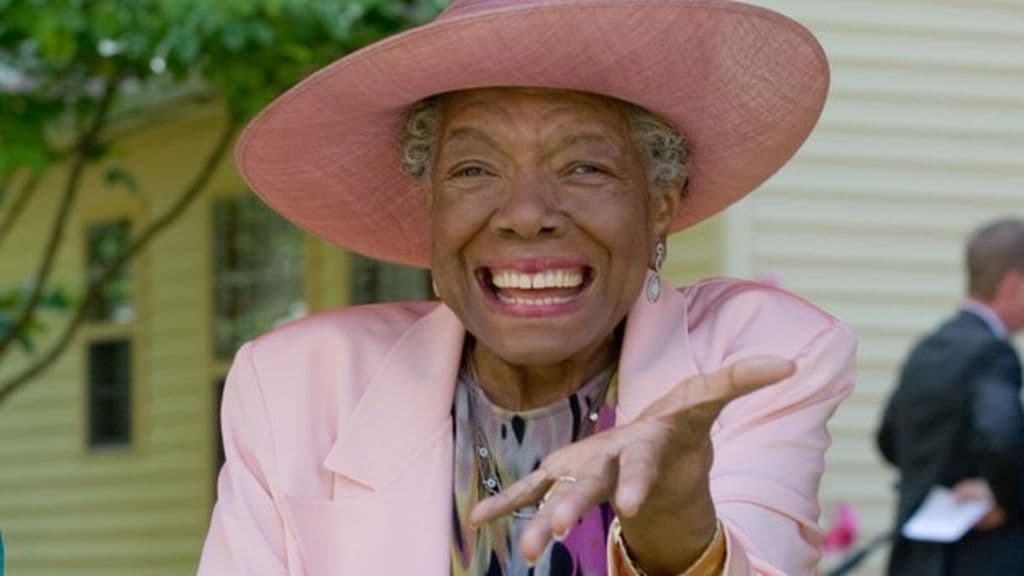
A quick Google search will tell you that for every piece of writing, she would check into a hotel in the morning near her residence, remove all the photographs from the wall, and with a bottle of sherry, a thesaurus and a Bible by her side, she would write a couple of pages on notepads while lying on a bed and wrap up her creative endeavours by afternoon.
**
I started writing for myself by the time I was in college, when we were studying Angelou's works as part of post-colonial literature. It took me a long time to be okay with this categorisation. As a 20 year old, I was convinced she was so much more than her (powerful) writings on racism. Even though Angelou's most popular works were her seven autobiographies that graphed her identity as a black feminist woman, I identified with her personal writings much more, because I wrote personal stuff, with unsharpened pencils on the back of telephone directories.
 More from Living
I wasn't ready to commit to her lineage, to her worldly passions.
It was her short poem, Passing Time, that planted the seed of being a writer in my head.Your skin like dawnMine like muskOne paints the beginning of a certain endThe other, the end of a sure beginning

Angelou used poetry to emerge out of rape trauma. In her first autobiography I Know Why The Caged Bird Sings she describes how poetry helped her finally speak out loud, after she was raped by her mother's boyfriend. The trauma rendered her mute for a very long time, until a schoolteacher encouraged her to recite poetry.
**
All writers go through a Pablo Neruda phase. You probably have a story where you've used one of his lines to woo a crush, or to be your whiskey companion on a rough, lonely night. But it's Angelou Variations To The Word Love that really struck a chord, during my first real heartbreak.
It didn't offer me a mature perspective (your mind can be quite stubborn when it wants to), but it allowed me to understand the complexities of unrequited love. It allowed me to seek solace in the fact that love can't be drawn out with boundaries; that love isn't a (written) concept, it's a feeling.
It's not love we don't wishto fall into, but that fear.this word is not enough but it willhave to do. It's a singlevowel in this metallicsilence, a mouth that saysO again and again in wonderand pain, a breath, a fingergrip on a cliffside. You canhold on or let go.
**
Angelou's second autobiography, Gather Together In My Name, was gifted to me by an older colleague when I was at the brink of a major life change (major enough that I lost the copy while moving cities, and regret it to date. Once you've lost a dear piece of writing, your heart doesn't allow you to replace it with a newer copy that smells of a departmental store). A small note she'd written on the on the first page read: 'Don't stop your frivolity'.
In Gather Together in My Name, Angelou describes her life between 17 and 19, when as a single mother, she is swamped in a world of poverty and crime. Only when I read the note in tandem with the autobiography, did I put two and two together.
**While talking about being sex worker, Angelou wrote,"I never did anything wrong. Who, Moi? – never I. I have no skeletons in my closet. In fact, I have no closet."
Still I Rise continues to be Angelou's most inspiring and famous poem to date (for good reason). It's considered a sassy, obdurate promise to be yourself no matter what the odds.
However, in my humble opinion, two of her more unknown poems pose a colourful alternative. In 1994, Angelou wrote a poem titled Momma Welfare Roll, an eye-opening take on being a middle-aged mother, struggling to make ends meet. You can feel the sass — hidden not by words but by her mother's sacrifice — wafting out.
Too fat to whore,Too mad to work,Searches her dreams for theLucky sign and walks bare-handedinto a den of bureaucrats forHer portion.'They don't give me welfare.I take it.'
She takes it one step further in a 2008 interview to The Atlantic called 'Why Maya Angelou disliked modesty', the gist of which was how she feels women in her culture don't value themselves enough. She spoke about wage gap, the hostility around being a homemaker and how women should genuinely enjoy sex.
"You see, I have no patience with modesty. Modesty is a learned adaptation. It’s stuck on like decals. As soon as life slams a modest person against the wall, that modesty will fall off faster than a G-string will fall off a stripper… Whenever I’m around some who is modest, I think, ‘run like hell and all of fire. You don’t want modesty, you want humility. Humility comes from inside out. It says someone was here before me and I’m here because I’ve been paid for. I have something to do and I will do that because I’m paying for someone else who has yet to come."
**
On Maya Angelou's birthday (she would have been 90 on 4 April, 2017), if there is one gift I can give to aspiring writers, creative professionals and fellow human beings, it has to be her poem Lesson, which is truly a lesson on how to live, not like Angelou herself, but to your fullest. It's merely five lines long, but encapsulates within it the only real life advice you need: to keep breathing, moving, doing, learning.

**
It seems a like lifetime ago when Angelou's words first inspired me. I'm no longer a wandering teenager using her words as an appeasement to my fluctuating self esteem, and I no longer have to luxury of sending hand-written notes to my friend with her poems, as a sort of pick me up after her breakup.
Happy Birthday, my muse.Getting lost in her writings has given me perspective, often when I feel disillusioned or invisible. She makes me believe that drops do make an ocean, and rising is not an option, it should be a life skill.
(all poems have been sourced from a personal copy of 'The Complete Collected Poems of Maya Angelou')

Here's why you crave sweets after every meal: This one thing can fix it
India's most beloved national parks for wildlife lovers
Even the Beckhams break: The rise of family estrangement
European Council Chief has an OCI card: What is it?
The 90s show Friends, and why we misread modern friendships