


How Gujarat courts failed the 14-year-old rape survivor who had to turn to SC for abortion
The tenth standard student, daughter of a bicycle mechanic in Sabarkantha district of Gujarat, was allegedly sedated and then raped by a doctor who was supposed to treat her for typhoid.

It took a panel formed by the Supreme Court of India for a 14-year-old girl to be allowed to abort a foetus conceived out of rape. The tenth standard student, daughter of a bicycle mechanic in Sabarkantha district of Gujarat, was allegedly sedated and then raped by a doctor who was supposed to treat her for typhoid. The girl informed her parents when she was over 16 weeks pregnant and by the family got around to initiate the process of abortion, she was already 20 weeks pregnant. Then the courts had to be involved.The facts of the case suggest two things very clearly. Firstly, it was a case of unwanted pregnancy. Secondly, the pregnant girl, physically, emotionally and economically, is incapable of bringing up a child. That's the reason why several government radio and television ads talk about avoiding teenage pregnancy while campaigning against child marriage.Yet, since the Medical Termination of Pregnancy Act (1971) disallows abortion after twenty weeks of pregnancy, the fourteen-year-old rape survivor was denied the right to abort her foetus by a Gujarat lower court first, then the Gujarat High Court. The prevailing law says that a pregnancy beyond 20 weeks can be terminated if it poses great threat to the mother's life.[caption id="attachment_2374396" align="alignleft" width="380" class=" "]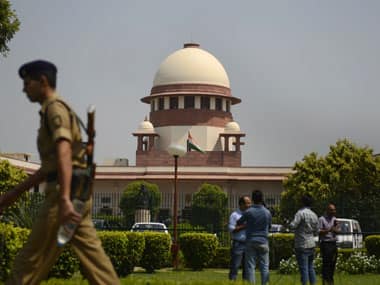 AFP image.[/caption]The family had to then approach the Supreme Court, which formed a medical team that decided that the girl was not only too physically weak to deliver a child, but also 'psychologically devastated'. That was always amply clear. The fact that she reported the pregnancy after 16 weeks had passed indicates that she was either completely unaware of her own condition, or terrified of the implications of it. Even a layperson can tell that is both emotionally unprepared and unwilling to bear the child conceived through rape.What's more shocking is that Justice Abhilasha Kumari of the Gujarat High Court had asked the district collector to take care of her medical expenses and education and asked the government to pay her a compensation of Rs 1 lakh as if that would go very far at all in covering the expenses of this 14-year-old and her baby.It is disturbing that the highest court in the state couldn't figure out that a meagre financial assistance would do nothing to allay her trauma or her fears about her future. More so, the court, while playing by the rule book completely failed to consider the reality of the society the girl has to live in as an unwed teenaged mother. In an ideal world, no girl would have had to face social stigma for having a child without being married. But we do not live in such a world and this is not a case where someone has thought about it and resolved to be a single mother after weighing all the consequences.Basically, telling her to have a baby she doesn't want, while dealing with the trauma of rape, is tantamount to pushing a 14-year-old over the edge.The Gujarat High Court order, in that regard, read more like a clueless motivational speech rather than any well-thought decision to aid the girl's well-being. The order said, "She, too, deserves to be educated, dream her dreams, and, in times to come, have a home and family of her own, just like any other young girl. Humanity and society should assist, her and others like her, in this regard."Asking "humanity" and "society" to take care of this teenaged pregnant rape survivor is possibly as reliable as asking 'God' to take care of her. This was hardly the best test case for society to shed its prejudices about single mothers.It was the girl's parents' conviction that sent them knocking to the door of the Supreme Court. Many others would probably not have the means or courage to do so. In special cases like these, when the court refuses to look beyond the letter of the law, it jeopardises the lives of many. For example, The Indian Express, reports that the Gujarat High Court had turned down the abortion plea of another rape victim earlier this year. The woman had to give birth to the baby in April.Had the teen's parents not doggedly pursued the issue, the fourteen-year-old, up for her first board examination would have suffered the same fate. The tragedy is that they had to go all the way to the Supreme Court in a situation where the clock was ticking against her.

Here's why you crave sweets after every meal: This one thing can fix it
India's most beloved national parks for wildlife lovers
Even the Beckhams break: The rise of family estrangement
European Council Chief has an OCI card: What is it?
The 90s show Friends, and why we misread modern friendships