


From carefully crafted panels to artist guilds: Tracing the Dutch and Flemish paintings of the 16th and 17th century
The process of making 16th and 17th century Dutch and Flemish panel paintings was an elaborate affair that required multiple artists, each equipped with different skills

A lecture series at the Chhatrapati Shivaji Maharaj Vastu Sangrahalaya (CSMVS) in Mumbai on Dutch and Flemish panel paintings comprised a delightful panel of experts that provided insight into the works of the 16th and 17th-century artists and craftsmen who laboriously toiled to produce some of the finest artwork during this period.Dutch and Flemish panel paintings through history have often found their way to India. The lecture series, organised under the aegis of ConservArte: Citi-CSMVS Art Conservation Project, saw art historian Bernard Vermet deliver the first talk — an overview of artworks based on the collection on display at the CSMVS.[caption id="attachment_5511721" align="alignnone" width="825"]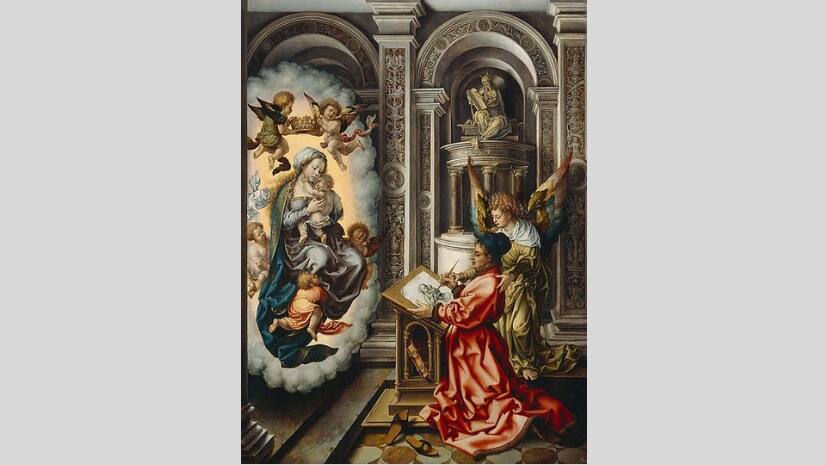 St. Luke Painting the Madonna. Image via Wikimedia Commons[/caption]“A panel painting is layered. It’s like a cake, when sliced one can see all the different layers,” explained Kate Seymour who spoke on: Tracing the Making Process: How Dutch and Flemish 16th and 17th century Panel Paintings Were Made.Seymour, the Head of Education at the Stichting Restauratie Atelier Limburg (SRAL) in the Netherlands teaches how to conserve paintings at the school and maintains that knowledge of the technique employed for making the painting enables a conservator to perceive the object as a whole and determine best-practice treatment options.She says that while there was a time when the image alone was considered paramount, there has been a slow shift towards the beginning of the 20th century that emphasises on non-invasive techniques. Where previously the original panel support (wood), might have been considered sacrificial, today the stress is on understanding the making process in its entirety to estimate the degradation and construct a history of the object before making decisions regarding its conservation.Making panel paintings in the sixteenth and seventeenth century was an activity that required multiple members of a studio, each equipped with different skills. “The person who made the panels is different from the person who painted the image,” explained Seymour who started out at SRAL as a painting conservator nearly two decades ago.Dutch history, over the course of those two centuries, was plunged in conflicts such as the Eighteen Years’ War and witnessed massive uprisings. Subsequently, no longer under the Spanish regime, the northern parts became independent and autonomous. The region divided itself into Catholics and Protestants, economic powers also shifted and then emerged a class of merchants who could afford to commission artwork for their households or even buy directly from the budding art market. Antwerp was an important art centre at the time, home to masters such as Peter Paul Rubens.Seymour says that the style of painting changed during this time expressly because the religious subject matter was replaced with small pieces for the household that showcased the wealth of the merchants.Lia Gorter, Director of The Foundation for Cultural Inventory (SCI), has undertaken an initiative to document many such Dutch and Flemish panel paintings scattered around the world. According to Seymour, the images depicted in these works had changed over time, but the technique stayed the same.Advances in technology made certain tasks easier, such as the invention of the wind-powered sawmill that speeded up the process of cutting wood of the oak trees that were used for making panels. Seymour also explained through her presentation how woodcut with sawmills had more refined edges than the cuts made by a regular hand saw. This helped conservators to estimate when a particular painting might have been made.The GuildsIn her talk, Seymour spoke about the guilds for panel painters, which functioned similar to the unions. The Guild of St Luke was one such association for panel painters. Each artist had to pay a yearly fee that in turn paid for the resources of the union. Guilds nurtured and protected their artists such that a widow of an artist who paid all his dues would get help and resources after his demise.[caption id="attachment_5511711" align="alignnone" width="825"]
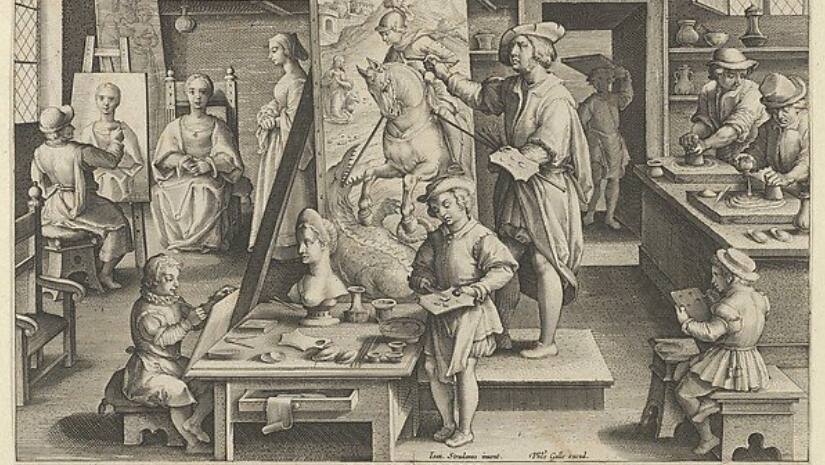 An Artist's Studio. (Nova Reperta, plate 14 engraved by Jan Collaert I.) Image via Facebook[/caption]The guilds also ensured that the markets for their members stayed protected. “There was a sanction against people selling and making artwork who were not members of the guild. So if you were caught, you were fined,” she said.Seymour also pointed out that quality checks were a regular thing and each guild would have its own distinct stamp that marked its product. Since panel painters worked largely on commissions, good quality groundwork and a smooth panel surface for the artists to paint was crucial.Wood and pigmentsA lot of the panel paintings used oak wood for support. Wood would be very absorbent of the binding media of the paint so they made an intermediate or a ground layer. One panel painting would have nearly seven to eight layers below the actual image which were bound using animal oil, glue, and chalk among other materials.Artists used oil paint for the images with the pigments ground in linseed oil. These colours, Seymour adds, were a “mixture of mineral pigments, some of those directly taken from the earth like iron oxides, umbers, sienna, to brightly coloured stones that are crushed and prepared by alchemists.”Sourcing these pigments was a process in itself. The pigment trade was an elaborate affair with same materials procured by artists Europe-wide for different painting styles. Pigments were brought in by pharmacists and alchemists from as far as China and Spain.For instance, Seymour suggested, the lapis lazuli, a highly expensive stone from Afghanistan was imported widely by artists. When crushed, it makes for a very bright blue, known also as ultra-marine.Seymour says, “It may be quite fascinating to see a painting unpacked so that you understand the crafts and the skill and the knowledge that has gone into making it.”For art enthusiasts curious about the creations of the masters, these lectures could be an engaging reading into the panel paintings of the time.And for conservators, it’s simply an exchange of knowledge. As Seymour suggested, “Sometimes we want to preserve what has happened in the past. Sometimes the history is as paramount as the image.”

Here's why you crave sweets after every meal: This one thing can fix it
India's most beloved national parks for wildlife lovers
Even the Beckhams break: The rise of family estrangement
European Council Chief has an OCI card: What is it?
The 90s show Friends, and why we misread modern friendships