


Biologists create bacteria with expanded DNA code
In a breakthrough, scientists have for the first time engineered a bacterium whose genetic material includes three pairs of DNA 'letters' or bases instead of the two found in nature.

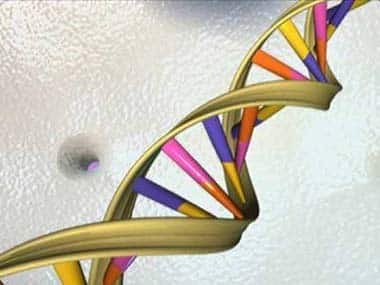
Representative image of DNA. Agencies[/caption]In the new study, the team synthesised a stretch of circular DNA known as a plasmid and inserted it into cells of the common bacterium E coli.The plasmid DNA contained natural T-A (adenine-thymine) and C-G (cytosine-guanine) base pairs along with the best-performing unnatural base pair Romesberg's laboratory had discovered, two molecules known as d5SICS and dNaM.The goal was to get the E coli cells to replicate this semi-synthetic DNA as normally as possible.The greatest hurdle may be reassuring to those who fear the uncontrolled release of a new life form: the molecular building blocks for d5SICS and dNaM are not naturally in cells, researchers said.Thus, to get the E coli to replicate the DNA containing these unnatural bases, the researchers had to supply the molecular building blocks artificially, by adding them to the fluid solution outside the cell.Then, to get the building blocks, known as nucleoside triphosphates, into the cells, they had to find special triphosphate transporter molecules that would do the job.The researchers eventually were able to find a triphosphate transporter, made by a species of microalgae, that was good enough at importing the unnatural triphosphates."That was a big breakthrough for us - an enabling breakthrough," said Malyshev.The team found, somewhat to their surprise, that the semi-synthetic plasmid replicated with reasonable speed and accuracy, did not greatly hamper the growth of the E coli cells, and showed no sign of losing its unnatural base pairs to DNA repair mechanisms.The study was reported in the journal Nature.PTI

Here's why you crave sweets after every meal: This one thing can fix it
India's most beloved national parks for wildlife lovers
Even the Beckhams break: The rise of family estrangement
European Council Chief has an OCI card: What is it?
The 90s show Friends, and why we misread modern friendships