


World watches, from a distance
India and Pakistan have been told to calm things down but nobody is getting too worked up about the situation

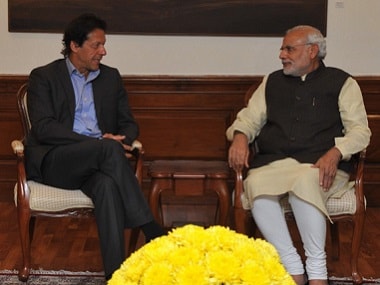
File image of Imran Khan and Narendra Modi. Twitter @MEAIndia[/caption]The US suggested nothing to facilitate either measure. Inhalation.The European Union’s foreign policy chief Federica Mogherini warned the crisis "has the potential to lead to serious and dangerous consequences for the two countries and the wider region" and both India and Pakistan should take "urgent measures". Exhalation.Mogherini didn’t elaborate. Inhalation.British Prime Minister Theresa May expressed deep concern, called for restraint and said “We are in regular contact with both countries urging dialogue and diplomatic solutions to ensure regional stability”. Her foreign secretary Jeremy Hunt said the situation “is going to take really critical restraint in the days ahead”. Exhalation.The UK offered no ideas for the way forward. Inhalation.Australia and France were perhaps the only ones to take a deep breath and speak clearly. In a strong statement, Australia’s foreign minister Marise Payne demanded that Pakistan take “urgent and meaningful action” against terrorist groups in its territory, including Jaish-e-Mohammed and Lashkar-e Taiba. "Pakistan must do everything possible to implement its own proscription of Jaish-e-Mohammed. It can no longer allow extremist groups the legal and physical space to operate from its territory," she said.France's ministry of Europe and foreign affairs said Paris “recognises India's legitimacy to ensure its security against cross-border terrorism and asks Pakistan to put an end to the operations of terrorist groups established on its territory". The spokesperson added, "France, which stands by India in the fight against terrorism in all its forms, is fully engaged in mobilising the international community to sanction terrorists responsible for this attack (Pulwama) and freezing their financing networks.”Pursed-lip breathing is often recommended during asthma attacks because it helps slow down breathing and induces calm. It’s probably just as effective when foreign observers are confronted with bad-tempered exchanges between faraway nuclear-armed neighbours. What else can they usefully do but exhale and inhale in a measured way?That said, when much of the western world woke up on Tuesday to news of an Indian airstrike on Pakistani soil – the first such transgression since the 1970s – pursed-lip breathing suddenly became a geopolitical signalling mechanism.The Europeans urged de-escalation but did not condemn India. Trump’s national security adviser John Bolton had already tweeted support for “India’s right to self-defence” after the Pulwama attack. Few governments rushed to Islamabad’s defence. Strategic breathing – with long periods of silence – suddenly seemed to have become a viable policy option.To be fair, world attention has been somewhat distracted this week, with Season 2 of the Trump-Kim show in Vietnam and Trump’s former lawyer, Michael Cohen, assailing the president’s character before the US Congress.It has, therefore, been left to experts in Western universities and think tanks and other talking heads to fill the gap. Many have drawn parallels between the India-Pakistan military escalation and the essential purpose of Trump’s second summit with Kim Jong Un in Hanoi.As India and Pakistan tried to manage rising tensions – retaliatory strikes, a captured pilot, public bellicosity – North Korean denuclearisation became an even more urgent issue for the wider world. The uncertainties of the situation in South Asia, experts said, illustrate the perils of accepting North Korea as a de facto nuclear weapons state, as happened with India and Pakistan.Joseph DeTrani, a former US intelligence official who engaged in talks with Pyongyang in 2017, recounted the North Korean argument for a Pakistan solution to the denuclearisation issue. “They said it very clearly. Accept us as a nuclear-weapons state and we will be a good friend of the United States. You’ve done it with Pakistan.”George Perkovich of the Carnegie Endowment for International Peace recalled the North Koreans asking for the India option a decade before DeTrani’s discussions. “What North Korean officials said to me is ‘We’re going to keep our nuclear weapons, and you’re going to end the sanctions and normalise relations and make a peace treaty with us’.”But neither nuclear-capable India nor Pakistan offer a good template for North Korea, argued the authoritative Atlantic magazine. “New Delhi and Islamabad see the possession of nuclear weapons not only as cementing their rightful place in the world as powerful nations, but also as providing a credible deterrent against threats, real and perceived,” the magazine said. “That, in effect, is the underlying reason few believe Kim will ever give up nuclear weapons. So while the military escalation in South Asia has sparked little public discussion in Hanoi, its implications have nevertheless been felt there.”Pursed-lip breathing clearly has its limits.The author is an international affairs columnist based in London

India rejects Pakistan's 'baseless' claims at Asean, says Indus Waters Treaty to remain on hold
India successfully tests long-range 'Kusha' air defence missile system
Indian trucker arrested in US over alleged theft of $3 million worth of tungsten powder
China has dominated Myanmar’s rare earth mines — now India eyes deal to harness country’s critical minerals
CJP protest in Delhi: New videos of stone pelting, violence emerge as police, agitators trade charges