


Why is the onus only on Hindus to accept Muslims and not the other way round?
Hindus feel victimised in a Hindu-majority country and in turn, some demonise Muslims, most of whom are descendants of victims of the conquerors and forced converts.

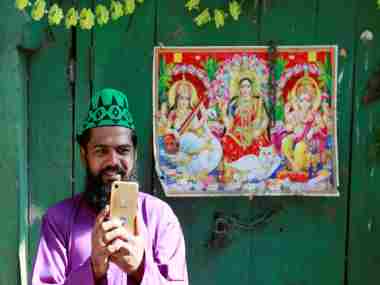
Representational image. Reuters[/caption]Moreover, the word "should" indicates what is desirable, even obligatory. Should, in that sense, any religion be a necessary or required part of the Indian identity? If such questions are open-ended, so would the answers be.Now to the third question: what is the legitimacy of the claim that Muslims should be a part of the Indian milieu? This query, one would imagine, is subsumed in the previous two. There is only one added angle, that of legitimacy. But who will determine legitimacy?If we go by the Constitution, then all religions must be treated equally, despite faith-specific personal laws. Our experience, however, is that all religions are not equal. Some are more equal than others. Majorities do matter, especially when they are effectively mobilised, sending their representatives to power. On the other hand, the so-called minorities also have all kinds of protections, if not privileges and advantages.Of course, Muslims should be—are—a part of the Indian milieu. Who can doubt it, especially these days when every other Muslim asserts identity with a skullcap, a burqa or a headscarf?That is why the questions obscure rather than uncover what the real problem is: Hindu-Muslim relations in India and the subcontinent. This is the elephant in the room. Why don’t we want to talk about it? Why is the "secular" and "Left-Liberal" intelligentsia and media obscuring it?Why must we not speak of the Islamic conquest of the subcontinent, often violent and savagely destructive? Why must we downplay, if not deny, this history?It is this "denialism" that has resulted in a backlash, bordering on rage or worse, counter-narratives of "victimology" or "demonology."Hindus, to put it bluntly, feel victimised in a Hindu-majority country. Some even want to turn India into a "Hindu Rashtra." In turn, some demonise Muslims, most of whom are descendants of victims of the conquerors and forced converts.But history cannot be undone or set right by revenge narratives. Then what is the way out? How can Hindus and Muslims live in peace?To my mind, that is the question. That is what we should be discussing.The Left-Libs believe Hindus should take responsibility for this amity by papering-over the past or pampering Muslim sentiments today. However, such efforts do not work. They may even lead to Partition as an endless rather than a one-off event. There are, some would point out, many "mini- Pakistans" cropping up in India, no-go zones for others. When the percentage of Muslims in any area exceeds 30%, it is argued, a definite and discernable process of Islamisation ensues, with a covert or overt imposition of Sharia. Such claims may be exaggerated but can’t be totally dismissed.That is why a realistic understanding of Islamic history, polity and society is essential for a lasting covenant between the two communities. The old contract, following the Partition, failed. Soon after the Partition, Pakistan tried to take over Kashmir, a conflict that rages on.But, it is also true is that both, the state and idea of Pakistan, have failed. That is the opening for us in India to propose a new bond between the two communities. Indian Muslims may well happily agree to be a part of the Indian, Hindu-dominated story rather than the subcontinental or global Islamic one. For this, they need to be guaranteed safety, security and respect.We need an Indian, perhaps subcontinental, truth and reconciliation process. Muslims would acknowledge and disassociate themselves from the bloody and horrific history of the conquest of India. Hindus, in turn, would let go of their hurt and pain that can turn into retaliatory rage.So, is Hinduism a part of heritage and identity of contemporary Indian Muslims? Why is the question never framed in this manner? Why is the onus only on Hindus to accept Muslims and not the other way round? (The writer is the Director of the Indian Institute of Advanced Study, Shimla)

Naresh Pal Gangwar appointed higher education secretary, Vineet Joshi moved to Panchayati Raj ministry
India rejects Pakistan's 'baseless' claims at Asean, says Indus Waters Treaty to remain on hold
India successfully tests long-range 'Kusha' air defence missile system
Indian trucker arrested in US over alleged theft of $3 million worth of tungsten powder
China has dominated Myanmar’s rare earth mines — now India eyes deal to harness country’s critical minerals