


Why India's rooftop solar installation initiative is yet to see the light of success
India aimed to install 40GW of rooftop solar (RTS) power by 2022. However, the nation has installed just 6GW till the end of October 2021

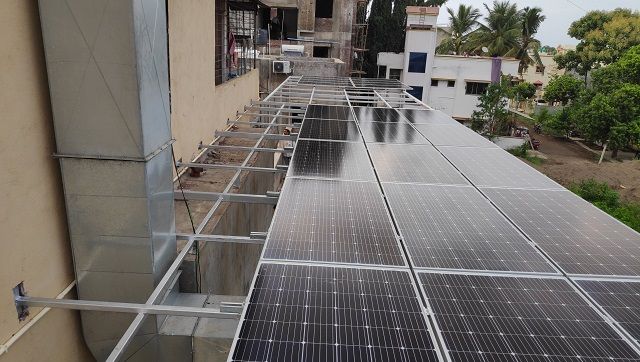
Rooftop solar system installed at a private institution. Image courtesy: Ajinkya Machale[/caption]Net metering was limited to 1 MW until December 2020, when the Power Ministry of India cut it to 10 KW. After much criticism, it amended the Electricity Rules 2020 in April 2021. Now net metering for RTS systems is allowed till 500 KW. It must be gross metering above that."Policy uncertainty is one of the major issues why India has minuscule RTS installation till now. All states have different rules when it comes to gross and net metering. DISCOMs are generally unwilling to avail gross or net metering as they don't want to lose premium high-paying consumers like commercial and industries (C and I) to solar," says Samrat Sengupta, programme director, Climate Change and Energy, at the New Delhi-based think tank Centre for Science and Environment (CSE).In 2019, MSEDCL decided to opt for gross metering over net metering for commercial rooftops. It had to reverse the decision in 2020 after a seven-day protest by solar manufacturers."Generally, when a prosumer installs RTS, he does not make profit for 4-5 years as he is repaying money of installing RTS. And he makes profit after five years as he does not have to pay electricity bills. But if governments do not have fixed plans, why would consumers invest lakhs of rupees to install RTS?" asks Ajinkya Machale, a solar integrator from Maharashtra.Pradip Kulkarni of MASMA said, "Manufacturers will invest if there are policies for a fixed duration of at least 3-5 years. But both state and Central governments change policies every few months without prior information to us. Policies are made without consulting consumers or us. MSEDCL or all DISCOMs design policies as per their profit, and they are not at all interested in cutting down greenhouse gas (GHG) emissions. We have to approach state or central ministries, protest, demand for every policy they design. Is this how India will achieve its target to install a capacity of 100 GW by 2022?"Financing is a major issue"Commercial, institutions, and residential sectors are keen to install grid-connected RTS by getting bank loans. MNRE has advised banks to give loans for RTS as subsidised rates. However, nationalised banks hardly offer loans to RTS. Thus, many private players have come into the market that offer loans for RTS at higher rates like 10-12 percent. Consumers cannot afford these rates," said Machale.He also pointed out that financing is a major issue for MSME and residential RTS."Commercial and industrial sector easily get bank loans due to their good financial balance. But MSME and the residential sector struggle to get loans for RTS. Under schemes of the World Bank, a few consumers from metros do get loans. But rural areas remain neglected," he added.The solar consumers and manufacturers also point out MSEDCL's apathy to pay tariffs to prosumers on time and also delayed processes."MSEDCL should approve proposals in at least one month but it takes 3-6 months. Not a single time, it pays tariffs on time to prosumers," tells one of the consumers.This story was produced with the support of the Earth Journalism Network.

Naresh Pal Gangwar appointed higher education secretary, Vineet Joshi moved to Panchayati Raj ministry
India rejects Pakistan's 'baseless' claims at Asean, says Indus Waters Treaty to remain on hold
India successfully tests long-range 'Kusha' air defence missile system
Indian trucker arrested in US over alleged theft of $3 million worth of tungsten powder
China has dominated Myanmar’s rare earth mines — now India eyes deal to harness country’s critical minerals