
Advertisement


Sections
While government fails to enforce pollution standards on power plants, India breathes more toxic air
India wants more electricity and needs more power plants to get it, but the government is not enforcing the pollution standards it needs to on these plants.

Source: Lok Sabha/Central Electricity Authority of India“India’s failure to implement emission control standards for coal-fired power plants is leading to severe air pollution levels,” Aishwarya Sudhir, an independent researcher on air quality, told IndiaSpend.Delhi has 13 coal-fired power plants within a 300-kilometre radius operating with no emission controls to regulate SO2 and nitrogen dioxide that contribute to the surge in particulate matter level, Sudhir said.SO2 emission load in Delhi is estimated to be 141 tonne per day, according to this January 2016 report by the Indian Institute of Technology (IIT) Kanpur. Industrial sources account for more than 90 percent of total emission, mostly from power plants.

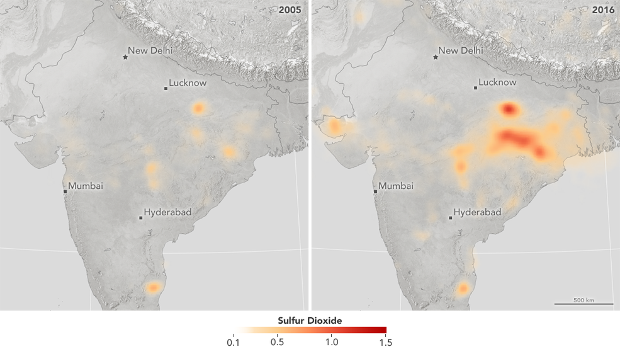
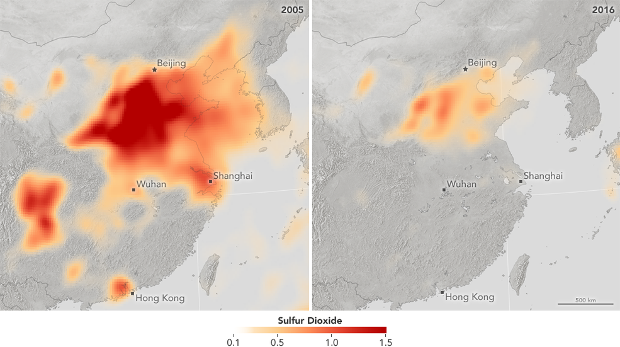 Source: NASA; Credits: NASA’s Earth Observatory/Jesse AllenThe ozone monitoring instrument on NASA’s Aura satellite reflects the change in SO2 concentrations in India and China between 2005 and 2016. Despite the increase in coal consumption by 50% and electricity generation by 100 percent between 2005 and 2016, SO2 levels in China have reduced. The decrease in SO2 levels is attributed to stricter pollution control measures, shift to non coal-based energy sources and the recent slowdown of the Chinese economy.China’s biggest success has been the installation of basic pollution abatement equipment on a majority (95 percent) of thermal power plants compared to only 10 percent of Indian power plants, IndiaSpend reported on November 21, 2016.About 13 million people in India were exposed to >0.5 dobson units (DU) of SO2 in 2013, which more than doubled (154 percent) to 33 million in 2016. In contrast, people exposed to >0.5 DU of SO2 in China declined 78 percent from 457 million in 2013 to 99 million in 2016.
Source: Scientific Reports; University of Maryland and NASA study. Long way off to curb pollution levels in north India with rising power demand“India’s increased sulfur dioxide emissions are not causing as many health or haze problems as they do in China because the largest emission sources are not in the most densely populated area of India,” according to Can Li, an associate research scientist in the University of Maryland’s Earth System Science Interdisciplinary Center and NASA’s Goddard Space Flight Center in Greenbelt, Maryland. “However, as demand for electricity grows in India, the impact may worsen.”India is yet to electrify forty million households that would require additional power of about 28,000 mega-watt and additional energy of about 80,000 million units per annum. About 13% or 2,457 villages of 18,452 unelectrified villages are yet to be electrified as on November 14, 2017, according to government’s real-time GARV dashboard.With over 70 percent of the country’s electricity generation dependent on thermal power and increasing demand, bringing down pollution levels in India’s northern states seem to be a long way off.Power plants or combustion of coal are not the only factors leading to toxic air in Delhi and its surrounding areas.
 The top four contributors to particulate matter (PM) 2.5 emissions in Delhi are road dust (38 percent), vehicles (20 percent), domestic fuel burning (12 percent) and industrial point sources (11 percent) based on annual emissions, according to to the IIT Kanpur study.Reducing burning of straw or stubble and other biomass in neighbouring states of Delhi could improve air quality by 90 percent, IndiaSpend reported on 17 October, 2017.NASA released satellite images of active crop fires in Punjab and surrounding areas, on October 25, 2017, followed by skies covered with thick and smog on 8 November, 2017, indicating rise in pollution levels in north India, IndiaSpend reported on 10 November, 2017.#Breathe air-quality sensors recorded “severe” air quality (>250 µg/m³ or 10 times World Health Organization’s safe levels) in four of eight locations in seven north Indian cities, based on 24-hr average PM 2.5 levels on November 7, 2017, IndiaSpend reported on 10 November, 2017.China has instituted regional air quality regulations to ensure that air pollution is addressed jointly across city and state boundaries, IndiaSpend reported on 21 November, 2016. It has developed a network of 1,500 air quality-monitoring stations in over 900 cities compared to 39 in India covering 23 cities.Over 11 months, Delhi failed to issue 150 air quality alertsAs air quality index continues to worsen in Delhi, the national capital missed 150 alerts over the last 11 months since 12 January, 2017, according to an analysis done by Sudhir based on data from the Graded Response Action Plan (GRAP), the government’s alert system, Air-quality levels crossed “poor” 95 times, “very poor to severe” 49 times and “emergency” six times, the analysis show.Monsoon was the only relief for Delhiites as they could breathe easy in July and August as air quality index recorded safe levels.
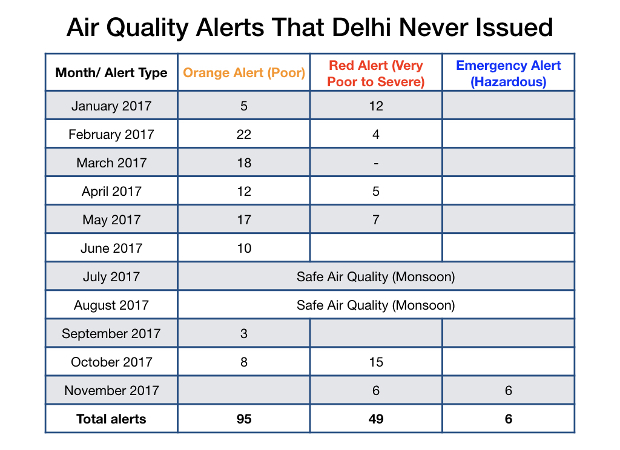 As many as 30 alerts were not issued between October and 8 November, 2017, IndiaSpend reported on 9 November, 2017.“Delhi’s Graded Response Action Plan has clearly failed to make any difference to the severe pollution levels being witnessed by the citizens of Delhi,” Sudhir said.“The government had enough time to implement GRAP and ensure inter-state coordination. Implementing GRAP and addressing pollution at the source are not mutually exclusive. If long-term solutions are not in place, episodic action to mitigate the problem will not help as most agencies continue to pass the buck with no accountability to implement action plans across the region.”(Mallapur is an analyst with IndiaSpend.)
First Published:Nov 15, 2017, 09:10:33 IST
Advertisement
Advertisement

NEET protest: Sonam Wangchuk ends hunger strike after talks with JP Nadda, Jitendra Singh
Sonam Wangchuk ended his hunger strike after meeting Union Ministers J.P. Nadda and Jitendra Singh, even as protests over the NEET paper leak and demands for exam reforms continue.
2 min read
Pakistan-based social media handles active during Op Sindoor spreading rumours amid NEET protest: Police
The police claimed the accounts, allegedly linked to Pakistan, were circulating fake posts, edited videos and misleading content to provoke students during the ongoing NEET protest at Jantar Mantar.
1 min read
PM Modi says stricter action against paper leaks to be announced at Friday's Cabinet meeting
Prime Minister Narendra Modi has announced that the Centre will introduce a fresh set of stringent measures to curb examination paper leaks, with key decisions expected to be taken at the Union Cabinet meeting on Friday.
2 min read
NEET protest: CJP delegation to meet ministers on Friday, sources say
The meeting comes after behind-the-scenes negotiations to resolve the impasse over the NEET paper leak, with protesters demanding Education Minister Dharmendra Pradhan's resignation and sweeping reforms to the examination system.
1 min read
Naresh Pal Gangwar appointed higher education secretary, Vineet Joshi moved to Panchayati Raj ministry
Gangwar is a 1994-batch Indian Administrative Service officer of the Rajasthan cadre. Prior to his new appointment, he was serving as Secretary, Department of Animal Husbandry and Dairying under the Ministry of Fisheries, Animal Husbandry and Dairying.
1 min read
Advertisement
Advertisement