


Wake up Delhi! The BRT is not working
The BRT was supposed to make Delhi’s traffic management ‘world class’. But what South Delhi's commuters have been living for four years now is a traffic nightmare.

When Delhi's Bus Rapid Transit corridor or BRT corridor was first conceptualized, the idea behind it was that people would start shunning private vehicles for buses, that buses would get dedicated lanes, and Delhi’s traffic woes would end.The BRT was supposed to make Delhi’s traffic management ‘world class’. But what South Delhi's commuters have been living for four years now is a traffic nightmare. Vehicles are seen crawling on the 5.8 km stretch between Moolchand and Ambedkar Nagar particularly during rush hours. A wait at the intersection can range anywhere between 10 and 20 minutes. And you are lucky if your vehicle can cross the intersection in two to three signal cycles.Why is the BRT which has been running smoothly in 134 cities worlwide facing a bumpy ride in Delhi?"It was seen as a solution, but the remedy seems to be worse than the disease,” observed the Delhi High Court which has temporarily allowed private vehicles to ply in the lane reserved for buses, hearing a PIL, demanding the scrapping of the project.[caption id="attachment_377071" align="alignleft" width="380"]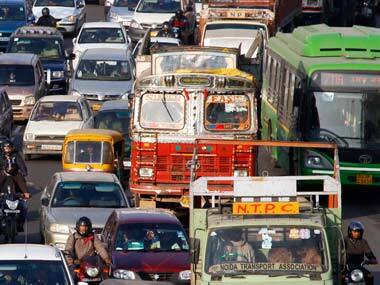 The BRT is not easing Delhi's traffic woes: Reuters[/caption]Following the court orders, the Delhi government appointed the Central Road Research Institute (CRRI) to conduct a study of the corridor. The CRRI’s interim study found that traffic flow was smoother when private vehicles were allowed in the lane marked for buses only.CRRI concluded that speeds on BRT corridor were at least 5 kmh less than the speeds on other similar corridors, indicating congestion.A majority of motorized users told surveyors that they felt the situation was much better without the BRT corridor."It was the government’s lack of vision that made a good concept go awry", said Dr Prof. PK Sarkar, transport expert at the School of Planning and Architecture, Delhi. “The aim was to shift car users to buses. But this cannot be achieved unless we have a good transport policy supporting the same. Merely constructing a corridor will not solve the purpose. Equally important is to conceptualise and implement policies that encourage the use of the corridor,” said he.There are more than 72 lakh registered motor vehicles in the national capital against 32000 buses, according to an RTI response from Delhi government transport department.On average, around 80 buses cross the BRT corridor in an hour. But the number of other motor vehicles which cross the stretch in the same duration is fifty times more. Ideally, four times more space should be allotted to private vehicles than to buses. This is not the case. The corridor has a 14 feet bus lane and while there is just 24 feet for all other motor vehicles. “Such projects are ideal for roads which are at least 60 meters wide. Here, we are implementing it on 27 to 45 meters wide roads,” said Sarkar,He gave another reason why BRT is not feasible in a city like Delhi: the sheer number of private vehicles. "Such projects are meant for cities with low to medium density traffic. Around 1000 private vehicles are added on Delhi's roads daily. In such a scenario,the waiting time on the BRT corridor is going to increase with each passing day," he said.Apart from congestion, one of the petitions against the BRT points out that creating bus stops right in the middle of the road is a safety hazard for commuters. Lt Colonel B. B. Sharan (Retired) who filed a PIL on this basis said, “Traditionally we have bus stops on either side of the roads. By constructing bus stands in the centre of the road has eaten away the carrying capacity of the road, besided has forced the bus traveler to cross the fast moving care lane to reach the centre of the road which is very hazardous and risky. Accidents have caused 30 deaths on this stretch,” said Sharan.Sharan and lakhs of Delhi’s commuters might face worse in the months to come as the state government has expressed intentions of replicating the project in other parts of the city. Why it would not pay heed to the concerns of people is beyond understanding. One reason can be the money involved in the project, said a Delhi transport department official on the condition of anonymity.The corridor is maintained by the Delhi Integrated Multi Modal Transit System limited (DIMITS)- a joint venture between Delhi government and IDFC Foundation. In addition to Rs 2.81 crores incurred on maintenance of the corridor, the company gives 6.63 lakh per month to marshals and another 4.40 lakh per month is spent on sweeping the road, as per the information obtained through an RTI.The crane stationed on the corridor to tow away vehicles, costs Rs 60,000 per month. In total, Rs 4.20 cores per annum is the cost of keeping the 5.8 kms corridor corridor in shape.Why cannot MCD/ PWD staff sweep the road and why private marshals must regulate traffic instead of the Delhi traffic police, is a different story.“Along with money, there is ego issue involved here. Scrapping the project means the government admitting that a project made a cost of Rs 129 crores was a waste,” said the official.

China has dominated Myanmar’s rare earth mines — now India eyes deal to harness country’s critical minerals
CJP protest in Delhi: New videos of stone pelting, violence emerge as police, agitators trade charges
'From make in India to launch from India': Skyroot COO on why Vikram-1 could change India’s space sector
Choke terror funding, keep international shipping lanes safe: Jaishankar at Asean Regional Forum
PM Modi announces fast-track courts for paper leak cases; CJP responds ‘Dharmendra Pradhan must go’