


Violence over Burhan Wani: Jammu and Kashmir govt hasn't learnt from past
The situation in Kashmir has not improved since the killing of Burhan Wani. It seems the state administration has not learnt from the past.

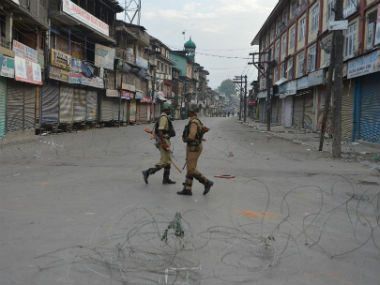
The death toll in Jammu and Kashmir has climbed to 19 due to violence over Burhan Wani's killing. PTI[/caption]On Saturday, the day after Burhan Wani's killing, the security apparatus of the state was apparently similarly unprepared. Once more, curfew disintegrated. Police stations and paramilitary camps across the valley were attacked, attracting tear gas and bullets. Nineteen people have been killed because of the violence so far.If that was horrifying, so was the fact that a mob invaded and took over an entire police station, took the policemen captive and looted the armory. Some of the policemen disappeared. This sort of chaos has not happened since 1990, when the police force had become defunct.In 1990, the forces' inability to efficiently handle the new eruption of insurgency was understandable. After all, the records of the police department probably still hold a note from October 1998 saying, 'one Calcincope rifle also recovered.' Only one of a host of senior officers who knew about a Kalashnikov on a militant's body could identify it. The one who misspelt it became DGP of Jammu and Kashmir Police a couple of years later. Many years later, the one who did identify it became DGP of Punjab.Twenty-eight years later, with the amount of experience, training, equipment and thousands of crores of rupees worth of investment on the police and paramilitary forces operating in Kashmir, this sort of fiasco is unacceptable.It was obvious to anyone who knew the pulse of Kashmir that Burhan's death at the hands of security forces would cause a massive — possibly unprecedented — backlash. I said to a very senior Army officer as he was leaving after a function to mark the 50th anniversary of the 1965 war late last summer that it would be best to catch Burhan alive and not kill him. That advice should have been re-affirmed by the massive and violent turnout from three districts for the funeral of Abu Hamza last December. Hamza, after all, was a Pakistani. Burhan was a young, pleasant-faced local boy.The danger is that, as in 2010, the course of what happens over the next few days and weeks may be set by those 'handlers' who appear to have managed Saturday's series of attacks across Kashmir. In 2010, schedules of protests used to be issued through separatist leader and former Hezbollah commander Masarat Alam. He remained underground for weeks while issuing statements regularly.The state and its vastly funded agencies could do nothing to alter the timeline or the events. It had become impossible to move in the city of Srinagar and most other parts of the Valley that summer, except when Alam ordered that people be allowed to move. When he did, the roads were jammed. It would have been possible to move any amount of arms and militants during those times, for the jams allowed for no security checks.Finally, the police were able to track down and arrest Alam. Syed Ali Shah Geelani's calls for calm led to order thereafter. This time, attempts to restore calm may be more troubled. A new generation of protesters has come up since then, many of them still in their teens. Generally, they do not have much regard for traditional separatist leaders, even such high-profile ones as Geelani.Monday is likely to bring the biggest challenge. It will mark Burhan's Chahrum, when certain rights are observed on the fourth day after a death. It could spark fresh protests. Already, there were stone-pelting demonstrations across many parts of the valley on Sunday. The main highway to Srinagar was among the worst affected and the highway was closed at Baramulla too. Several people had to walk home from the airport when their flights landed in Srinagar.At some places, even journalists were challenged, both by mobs of young protesters and by some paramilitary forces. Naturally, security forces were generally angry and stressed after camps, police stations and bunkers were attacked, some policemen were abducted and one was deliberately drowned.In a nutshell, the situation was at least as bad as one might have expected after security forces killed Kashmir's youth icon, Burhan.
David Devadas is an expert on politics and geopolitics. Formerly a Senior Fellow at the Nehru Memorial Museum and Library, Visiting Professor at Jamia Millia Islamia, and Political Editor of Business Standard, he is currently Distinguished Fellow at the Institute for Social Sciences. He has written books on Kashmir, on youth, and on history. He has been a radio compere, guest faculty at JNU's Academic Staff College, St Stephen's College and Hindu College. He has worked for the Indian Express, The Hindustan Times, India Today, The Economic Times and Gulf News. His most impactful article, on a murder cover-up, prevented a Congress President from becoming prime minister. One led to the closure of an airline, and another created a furore and consequent clean-up in Delhi's health department. Several have correctly predicted election results in key states, and a series of reports from Srinagar made the government aware of how unsettled the situation there was in 1990. He is an alumnus of St Xavier's School, St Stephen's College, and the Indian Institute of Mass Communication. He has lived for extended periods in Geneva and Berlin, and has traveled to almost 50 countries. He enjoys various kinds of music, theatre, design, architecture and art.

India successfully tests long-range 'Kusha' air defence missile system
Indian trucker arrested in US over alleged theft of $3 million worth of tungsten powder
China has dominated Myanmar’s rare earth mines — now India eyes deal to harness country’s critical minerals
CJP protest in Delhi: New videos of stone pelting, violence emerge as police, agitators trade charges
'From make in India to launch from India': Skyroot COO on why Vikram-1 could change India’s space sector