


Unpacking row over IAF strikes in Balakot, satellite data: Unless India releases proof, disbelief will gain momentum
Unless India releases the evidence it has on the casualties in 26 February IAF air strikes in Pakistan, the impression that the attacks were hyped for political gain will only gather momentum. That might seem as a minor sideshow, but it will have serious consequences for the credibility of the country, and its institutions.

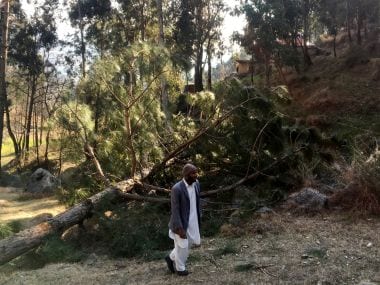
A report by Reuters said that there are no "displaced trees around the madrasa." But eyewitnesses, as claimed in another report by Reuters, described "four bomb craters and some splintered pine trees (as seen in the above photo). Reuters[/caption]Version Two: Damage Not GreatThere are various versions — using satellite imagery, government sources and eyewitness accounts — to suggest that the target was indeed hit, but caused less damage than some of the more hyperbolic media accounts might suggest.In ThePrint, former Indian Army imagery analyst Colonel Vinayak Bhat asserts that the satellite imaging shows "four dark spots on roof, missing tents and burnt earth but walls and buildings intact." He concludes that "the damage to buildings and walls from the air strikes may not have been as extensive as it has been made out by the Modi government and the ruling BJP".Bhat's claims, it is worth noting, are quite different from those of Reuters: He finds some damage; the international wire service finds none.In The Indian Express, Sushant Singh reported that the government has "evidence, in the form of imagery from Synthetic Aperture Radar (SAR), showing that the four buildings, identified as targets, were hit by five S-2000 precision-guided munition (PGM) fired from IAF’s Mirage-2000 fighter jets."Francesca Marino, a journalist and author writing for Firstpost, spoke to eyewitnesses who saw up to 35 bodies being evacuated from the site hours after the attack. Her eyewitnesses — who sought anonymity — said one building, housing twelve fidayeen, had been flattened.The QuestionsFive possibilities arise. First, perhaps Reuters has it wrong. This could be because it's looking in the wrong place or a lesser likely possibility of them misinterpreting the data. For example, the report says there are no "displaced trees around the madrasa." But eyewitnesses, as claimed in another report by Reuters, described "four bomb craters and some splintered pine trees."Secondly, the Indian Air Force might have missed its targets. This happens: remember, the United States claimed to have killed many Islamic State terrorists with the largest non-nuclear bomb in its arsenal, but the BBC later discovered the actual damage was minimal.Third, the targeting data provided to the Indian Air Force by the National Technical Research Organisation (NTRO) and the Research and Analysis Wing (RAW) might have been wrong.Fourth, the Pakistan Army somehow cleaned up all the damage.And, five, India might have meant to only growl and not bite — to demonstrate that it could hit hard, without actually hitting hard, and thus avoid retaliation. If that was the government's intention (and that is a big if), the strategy does seem to have worked, to the extent of coercing Pakistan into banning jihadist groups, at least for now.Unless the Centre releases the evidence it has, the impression that the air strikes were hyped for political gain will only gather momentum. That might seem as a minor sideshow, but it will have serious consequences for the credibility of the country, and its institutions.

NEET protest: CJP delegation to meet ministers on Friday, sources say
Naresh Pal Gangwar appointed higher education secretary, Vineet Joshi moved to Panchayati Raj ministry
India rejects Pakistan's 'baseless' claims at Asean, says Indus Waters Treaty to remain on hold
India successfully tests long-range 'Kusha' air defence missile system
Indian trucker arrested in US over alleged theft of $3 million worth of tungsten powder