
Advertisement


Sections
UIDAI says Aadhaar is not a profiling tool, claims identifiers and biometric data governed by strong laws
UIDAI CEO Ajay Bhushan Pandey said that Aadhaar is based on minimum information and biometrics which is "least intrusive"

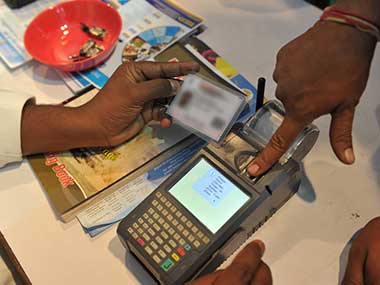
New Delhi: The UIDAI on Sunday sought to allay fears over data protection and privacy issues around the 12 digit biometric identifier, asserting that Aadhaar is an identification tool and not a profiling instrument.[caption id="attachment_4291927" align="alignleft" width="380"]![Representational image. AFP]() Representational image. AFP[/caption]It also stressed that Aadhaar data is governed by strong laws.Fielding questions on Twitter in a live chat, Unique Identification Authority of India (UIDAI) CEO Ajay Bhushan Pandey said that Aadhaar is based on minimum information and biometrics which is "least intrusive".To a specific query on whether UIDAI will go for DNA profiling in future, Pandey said that there were no such plans."We take fingerprint, iris and photo…We have no plans to take something like DNA… photo, fingerprint and iris is good enough for de-duplication, generating Aadhaar and to authenticate any person," he said.The UIDAI chief dismissed concerns that linking of various information with Aadhaar could lead to government monitoring, surveillance or possible misuse. "When you give Aadhaar number in bank... UIDAI doesn’t know about your bank account. Bank gives us your Aadhaar number and fingerprint and UIDAI is a matching service. It says a yes or no, or we send a limited eKYC," he explained. The government does not get any information about the resident from the system, he said.UIDAI further tweeted, "Aadhaar is an identifier not a profiling tool".During the question and answer session that lasted for over 1.5 hours, Pandey took over 20 queries that ranged from privacy concerns around Aadhaar to benefits of the biometric identifier for residents, and from linking of Aadhaar to mobile SIMs (subscriber identity module) to moving the enrolment centres to government offices and banks.To another question, he said bank accounts are "property of citizens" and their linkage with Aadhaar number should not raise fears that government will one day freeze such accounts.Maintaining that introduction of Virtual ID and limited eKYC had nothing to do with data leak stories pertaining to Aadhaar, Pandey said they were conceptualised for strengthening the privacy system.The UIDAI recently announced a new concept of "Virtual ID' which Aadhaar-card holder can generate from its website and give for various purposes, including SIM verification, instead of sharing the actual 12-digit biometric ID. The Virtual ID, a random 16-digit number, will give the users the option of not sharing their Aadhaar number at the time of authentication.During the live chat on Sunday, Pandey said that since some people feared that information residing in multiple places could be linked despite it being prohibited under Aadhaar Act, the latest feature will give people the choice to mask their Aadhaar number."It has nothing to do with data leak story. I have said that in the last seven years, there has been no data leak from UIDAI," he said.Pandey said that Aadhaar was protected by strong laws, and that Aadhaar Act is "based on the premise that privacy is a fundamental right".Citing the various Sections of Aadhaar Act he said that biometric data given to UIDAI cannot be shared without an individual's permission, and that doing so is punishable. "No one can aggregate data and do profiling," he pointed out.
Representational image. AFP[/caption]It also stressed that Aadhaar data is governed by strong laws.Fielding questions on Twitter in a live chat, Unique Identification Authority of India (UIDAI) CEO Ajay Bhushan Pandey said that Aadhaar is based on minimum information and biometrics which is "least intrusive".To a specific query on whether UIDAI will go for DNA profiling in future, Pandey said that there were no such plans."We take fingerprint, iris and photo…We have no plans to take something like DNA… photo, fingerprint and iris is good enough for de-duplication, generating Aadhaar and to authenticate any person," he said.The UIDAI chief dismissed concerns that linking of various information with Aadhaar could lead to government monitoring, surveillance or possible misuse. "When you give Aadhaar number in bank... UIDAI doesn’t know about your bank account. Bank gives us your Aadhaar number and fingerprint and UIDAI is a matching service. It says a yes or no, or we send a limited eKYC," he explained. The government does not get any information about the resident from the system, he said.UIDAI further tweeted, "Aadhaar is an identifier not a profiling tool".During the question and answer session that lasted for over 1.5 hours, Pandey took over 20 queries that ranged from privacy concerns around Aadhaar to benefits of the biometric identifier for residents, and from linking of Aadhaar to mobile SIMs (subscriber identity module) to moving the enrolment centres to government offices and banks.To another question, he said bank accounts are "property of citizens" and their linkage with Aadhaar number should not raise fears that government will one day freeze such accounts.Maintaining that introduction of Virtual ID and limited eKYC had nothing to do with data leak stories pertaining to Aadhaar, Pandey said they were conceptualised for strengthening the privacy system.The UIDAI recently announced a new concept of "Virtual ID' which Aadhaar-card holder can generate from its website and give for various purposes, including SIM verification, instead of sharing the actual 12-digit biometric ID. The Virtual ID, a random 16-digit number, will give the users the option of not sharing their Aadhaar number at the time of authentication.During the live chat on Sunday, Pandey said that since some people feared that information residing in multiple places could be linked despite it being prohibited under Aadhaar Act, the latest feature will give people the choice to mask their Aadhaar number."It has nothing to do with data leak story. I have said that in the last seven years, there has been no data leak from UIDAI," he said.Pandey said that Aadhaar was protected by strong laws, and that Aadhaar Act is "based on the premise that privacy is a fundamental right".Citing the various Sections of Aadhaar Act he said that biometric data given to UIDAI cannot be shared without an individual's permission, and that doing so is punishable. "No one can aggregate data and do profiling," he pointed out.
 Representational image. AFP[/caption]It also stressed that Aadhaar data is governed by strong laws.Fielding questions on Twitter in a live chat, Unique Identification Authority of India (UIDAI) CEO Ajay Bhushan Pandey said that Aadhaar is based on minimum information and biometrics which is "least intrusive".To a specific query on whether UIDAI will go for DNA profiling in future, Pandey said that there were no such plans."We take fingerprint, iris and photo…We have no plans to take something like DNA… photo, fingerprint and iris is good enough for de-duplication, generating Aadhaar and to authenticate any person," he said.The UIDAI chief dismissed concerns that linking of various information with Aadhaar could lead to government monitoring, surveillance or possible misuse. "When you give Aadhaar number in bank... UIDAI doesn’t know about your bank account. Bank gives us your Aadhaar number and fingerprint and UIDAI is a matching service. It says a yes or no, or we send a limited eKYC," he explained. The government does not get any information about the resident from the system, he said.UIDAI further tweeted, "Aadhaar is an identifier not a profiling tool".During the question and answer session that lasted for over 1.5 hours, Pandey took over 20 queries that ranged from privacy concerns around Aadhaar to benefits of the biometric identifier for residents, and from linking of Aadhaar to mobile SIMs (subscriber identity module) to moving the enrolment centres to government offices and banks.To another question, he said bank accounts are "property of citizens" and their linkage with Aadhaar number should not raise fears that government will one day freeze such accounts.Maintaining that introduction of Virtual ID and limited eKYC had nothing to do with data leak stories pertaining to Aadhaar, Pandey said they were conceptualised for strengthening the privacy system.The UIDAI recently announced a new concept of "Virtual ID' which Aadhaar-card holder can generate from its website and give for various purposes, including SIM verification, instead of sharing the actual 12-digit biometric ID. The Virtual ID, a random 16-digit number, will give the users the option of not sharing their Aadhaar number at the time of authentication.During the live chat on Sunday, Pandey said that since some people feared that information residing in multiple places could be linked despite it being prohibited under Aadhaar Act, the latest feature will give people the choice to mask their Aadhaar number."It has nothing to do with data leak story. I have said that in the last seven years, there has been no data leak from UIDAI," he said.Pandey said that Aadhaar was protected by strong laws, and that Aadhaar Act is "based on the premise that privacy is a fundamental right".Citing the various Sections of Aadhaar Act he said that biometric data given to UIDAI cannot be shared without an individual's permission, and that doing so is punishable. "No one can aggregate data and do profiling," he pointed out.
First Published:Jan 28, 2018, 22:38:40 IST
Advertisement
Advertisement

China has dominated Myanmar’s rare earth mines — now India eyes deal to harness country’s critical minerals
India is deepening rare earth cooperation with Myanmar as New Delhi seeks alternative sources of critical minerals dominated by China, including dysprosium and terbium used in EVs, defence systems and clean energy technologies
6 min read
CJP protest in Delhi: New videos of stone pelting, violence emerge as police, agitators trade charges
Fresh videos of violence that broke out during the Cockroach Janta Party's (CJP) protest in Delhi have surfaced, with the police releasing footage showing alleged stone pelting, vandalism and attacks on security personnel
3 min read
'From make in India to launch from India': Skyroot COO on why Vikram-1 could change India’s space sector
Skyroot Aerospace’s successful Vikram-1 mission marks a major milestone for India’s private space sector, as the country seeks to shift from “Make in India” to “Launch from India” and compete in the global commercial satellite launch market
8 min read
Choke terror funding, keep international shipping lanes safe: Jaishankar at Asean Regional Forum
Jaishankar's remarks came against the backdrop of recent terror attacks targeting India and growing threats to commercial shipping amid conflicts in West Asia and Europe
2 min read
PM Modi announces fast-track courts for paper leak cases; CJP responds ‘Dharmendra Pradhan must go’
Amid protests demanding accountability for the leak of medical entrance test Neet and other irregularities in the education system, Prime Minister Narendra Modi has announced that the government has decided to set up fast-track courts to ensure swift and stringent punishment for those involved in paper leaks.
3 min read
Advertisement
Advertisement