


Supreme Court to hear Aadhaar cases today: Look back at how law has developed on the issue
The Aadhaar case will be a look at the legality of the The Aadhaar (Targeted Delivery of Financial and other Subsidies, Benefits and Services) Act, 2016.

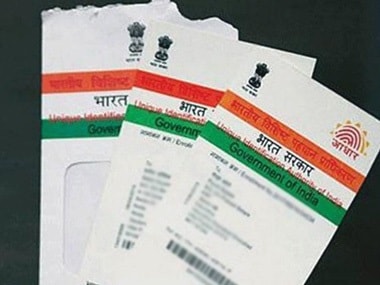
Representational image. News18[/caption]However, the judgment only established the theoretical Right to Privacy. It removed the earlier hurdles of the cases of MP Sharma and Kharak Singh which had held Right to Privacy not to be a Fundamental Right. However, the actual freedoms protected by the Right had to be enshrined into in separate judgments.As far Aadhaar is concerned, the judgment did not invalidate it in any way. However, it did give a boost to anti-Aadhaar arguments which rely on privacy as now the government can no longer say that there is no Right to Privacy.That being said, Soli Sorabjee while talking to The Economic Times said, "You cannot make a blanket and categorical statement that Aaadhaar will be banned or is unconstitutional. No Fundamental Right is absolute. It is always subject to reasonable restrictions." Thus even after recognising Right to Privacy as a Fundamental Right, the court could still save Aadhaar under a reasonable restriction.Meghnad S had told Firstpost that "Aadhaar might slip through the cracks because an arbitrary restriction like national security might be used. It's about a larger question of privacy right now."Finance Minister Arun Jaitley had said he was sure Aadhaar will stand the test of constitutionality. "The legislation has been passed and I'm sure it will stand the test of constitutionality. Even while upholding the idea of privacy as an important constitutional guarantee, the Supreme Court said that it is the question raised just now. (Violation of privacy) could be imposed by law but they have to be obviously reasonable," Jaitley had said.He had said that the Right to Privacy has illustrative restraints like national security and dissemination of social benefits and Aadhaar is being used for the latter. "As some of the illustrative restraints, not exhaustive, are in the larger interest of national security or for the purposes of dissemination of social benefits," he said.Writing for Firstpost, Kriti Trehan had argued that in principle, we are faced with issues of consent. In practice, we struggle with infrastructural deficiencies and an absence of safeguards and accountability. The large-scale centralisation of everything from personal identifiers to financial information, coupled with less than confidence-inspiring security systems to keep the data safe, is probably the greatest concern plaguing those who are sceptical of the Aadhaar process from a privacy perspective. A centralised database that amasses the personal information of the entire citizenry and links it across platforms and services has the potential of being used as a tool for Big Brother-esque policy implementation.Finally, Suhrith Parthasarathy wrote in The Hindu that the government will, no doubt, argue that Aadhaar can bring about many benefits. However any policy, howsoever poorly framed, will likely bring about certain gains. The question is ultimately one of proportionality and justice. Arguing that the government's aim is to create a seamless police state, which will chill our freedom and give the State rampant power he asks whether the Supreme Court will dare to stop this?With inputs from agencies

China has dominated Myanmar’s rare earth mines — now India eyes deal to harness country’s critical minerals
CJP protest in Delhi: New videos of stone pelting, violence emerge as police, agitators trade charges
'From make in India to launch from India': Skyroot COO on why Vikram-1 could change India’s space sector
Choke terror funding, keep international shipping lanes safe: Jaishankar at Asean Regional Forum
PM Modi announces fast-track courts for paper leak cases; CJP responds ‘Dharmendra Pradhan must go’