


Slush around defence deals: Bribe givers are penalised, but bribe takers are seldom convicted
The Government of India needs to set this image right. India desperately needs a comprehensive policy on the way bribes should be dealt with.

Last month, the Government of India announced that it was cancelling the Rs 1,800 crore deal with Whitehead Alenia Sistemi Subacquei (WASS). The reason: WASS is a subsidiary of Finmeccanica, the company which is said to have bribed Indian officials and politicians in order to procure an order for helicopters.This is because Indian laws clearly make a criminal of both the bribe giver and the bribe taker. Since the courts in Italy have established that Finmeccanica has given a bribe, it has been blacklisted. As a corollary, so goes the legal argument, its subsidiary has also been blacklisted. WASS thus lost a business, worth Rs 1,800 crore.

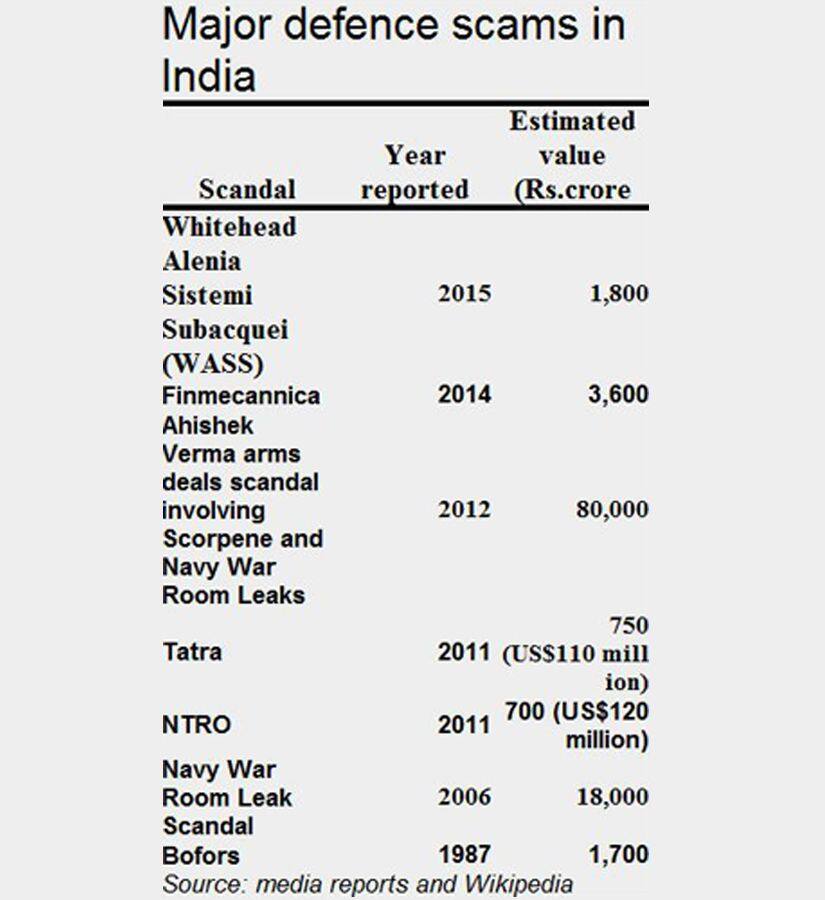 In fact, in none of the major defence scams (see table) has a culprit been nailed. Yes, there has been finger pointing. Yes, cases have been registered. And yes, some have been sent to judicial custody, and even granted bail. But they have not been convicted.Take the Finmeccanica case, as an example. That bribes were indeed paid in the Finmeccanica deal was clearly established by an Italian court in October 2014. Bruno Spagnolini, who served as CEO of AgustaWestland, the helicopter manufacturing division of Finmeccanica, was charged with false bookkeeping (and participation in bribery). The Italian court sentenced him to two years in prison. The court documents pointed to several Indian bribe takers.The middleman for the arms deal was Christian Michel. His lawyer offered to help India with information if it agreed to give Michel approver status and immunity. The offer was shot down. Yes, it did interrogate SP Tyagi, former IAF chief. But then, there is no clinching testimony, which can only come from a court approved whistleblower, or an “approver.”Eventually, only the bribe givers will be penalised. Bribe takers in defence are seldom convicted. Nobody is made approver.In India, this is not merely a case of bribe giving, or bribe taking. By cancelling defence deals which have taken years to prepare, and which are critical to the safety and security of the country, Indian investigators and legislators are actually weakening India. By aborting defence plans – the shells in the Bofors case, and the torpedos in the Finmeccanica case, it is the defence of India that is at stake.India desperately needs a comprehensive policy on the way bribes should be dealt with. The present system stinks.
NEET protest: Sonam Wangchuk ends hunger strike after talks with JP Nadda, Jitendra Singh
Pakistan-based social media handles active during Op Sindoor spreading rumours amid NEET protest: Police
PM Modi says stricter action against paper leaks to be announced at Friday's Cabinet meeting
NEET protest: CJP delegation to meet ministers on Friday, sources say
Naresh Pal Gangwar appointed higher education secretary, Vineet Joshi moved to Panchayati Raj ministry