
Advertisement


Sections
Ramjas College row: Does ideology drive the culture of campus politics, violence?
How campus politics has led to clashes from Hyderabad Central University to Jadavpur University to JNU to Delhi University to Ramjas College now

“We thrashed them, made them do sit ups and go to classes in lungis. It was great fun… Great fun for us, that is,” said the friend, who used be a member of a student union affiliated to a national party 20 years ago. Ask him about his life as a union member, the man — in his 40s now — gets nostalgic about his ‘glory days’.The ‘them’ in discussion were members of other unions or students not affiliated to any organisation. “We were backed by an MLA who was also the president of the students’ wing of his party. It ruled the state then. So muscle power was always at hand and the police looked the other way when we got into action. The party, which is on the decline these days, wanted us to cede no space to rivals and capture all posts in the college elections.”“Looking back, do you feel ashamed of what you did then? Your actions amounted to mindless torture,” you ask, and he turns sheepish. “It was stupid, man... really silly. It was the sheer thrill of it that drove us. One felt very powerful and protected. Dadagiri was our way of showing it off. Party or ideology never mattered. I cannot imagine what other students endured at our hands,” he said.[caption id="attachment_3314550" align="alignnone" width="825"]![File photo of the protests at Ramjas College]() File photo of the protests at Ramjas College[/caption]Is he surprised at the new trend of violence in higher educational institutions? “Not at all. Why do you call it a new trend? Our campuses have always been violent. Look at the history of the Left unions in West Bengal or of the Congress-affiliated NSUI or now, the ABVP. It always had to do with a particular party being in power. The ABVP is in news today because the BJP is in power at the centre and in several states.”This conversation sets one wondering about what drives student politics. Is it ideology or the ephemeral thrill? Over the last 70 years the ideology of the Left or the left of centre has been dominating the politics of the campuses. It helped that such ideology was naturally aligned with the idealistic sprit of the young. They loved the idea of the revolution, the thrill of taking on the establishment and the thought of being branded as rebels. The ideology was fuzzy and disconnected from reality but association with it imbued students with an aura of special-ness.
File photo of the protests at Ramjas College[/caption]Is he surprised at the new trend of violence in higher educational institutions? “Not at all. Why do you call it a new trend? Our campuses have always been violent. Look at the history of the Left unions in West Bengal or of the Congress-affiliated NSUI or now, the ABVP. It always had to do with a particular party being in power. The ABVP is in news today because the BJP is in power at the centre and in several states.”This conversation sets one wondering about what drives student politics. Is it ideology or the ephemeral thrill? Over the last 70 years the ideology of the Left or the left of centre has been dominating the politics of the campuses. It helped that such ideology was naturally aligned with the idealistic sprit of the young. They loved the idea of the revolution, the thrill of taking on the establishment and the thought of being branded as rebels. The ideology was fuzzy and disconnected from reality but association with it imbued students with an aura of special-ness.
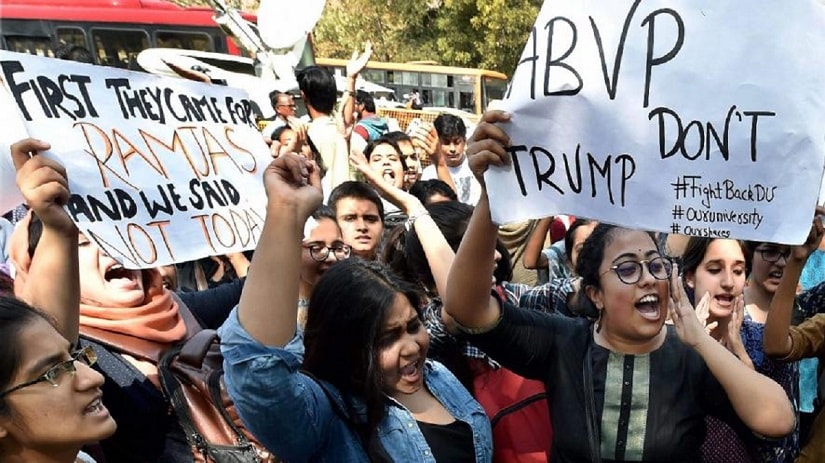 File photo of the protests at Ramjas College[/caption]Is he surprised at the new trend of violence in higher educational institutions? “Not at all. Why do you call it a new trend? Our campuses have always been violent. Look at the history of the Left unions in West Bengal or of the Congress-affiliated NSUI or now, the ABVP. It always had to do with a particular party being in power. The ABVP is in news today because the BJP is in power at the centre and in several states.”This conversation sets one wondering about what drives student politics. Is it ideology or the ephemeral thrill? Over the last 70 years the ideology of the Left or the left of centre has been dominating the politics of the campuses. It helped that such ideology was naturally aligned with the idealistic sprit of the young. They loved the idea of the revolution, the thrill of taking on the establishment and the thought of being branded as rebels. The ideology was fuzzy and disconnected from reality but association with it imbued students with an aura of special-ness.
What drives student politics. Is it ideology or the ephemeral thrill?It’s thus not surprising that all major rebellions against the establishment in the country started from the campuses and were fuelled by the ideas of the Left in all its variations. The history of such movements goes back 150 years but it took an organised form in 1936 with the formation of All India Students Federation. While students were the major driving force behind all movements against the British in the pre-Independence period, the Leftist-Socialist fervour came to influence minds deeply after the Russian revolution of 1917. Post-Independence, while the Left made its presence strongly felt on the student community and campuses, it had to fight a new enemy: the Congress, which according to the Left had started serving the interest of the rich landlords and businesses.While at it, they continued to assert their hegemony inside campuses through methods that were not always subtle or persuasive. While insisting on the primacy of debates and dialogue to settle disputes they often resorted to violence. But the method didn’t raise protests because the ideology of the Left still held its sway over the country. The Congress itself had taken a sharp Left turn under former Prime Minister Indira Gandhi. The romantic idea of the idealistic rebel still enamoured the youth. Not many could connect Karl Marx to the current day reality, some had serious doubts about the idea of revolution but being Left was never out of fashion.The winds of change came in the early '90s. Too many significant developments were taking place in the country at the same time. We had the country’s economy being liberalised and the twin issues of Mandir-Mandal creating new fissures in the pan-Indian socialscape. The student community could not have stayed insulated from these. Liberalisation was opening up a new world for the young. It was not about riches and lifestyle only; it was about possibilities of self-advancement too. This is when young India started finding itself uncomfortable with its socialist obsession.
The issues of Mandir and Mandal broke the cohesion in the student community by drilling into their consciousness social and communal fractures they sought to stay aloof from all these years.The issues of Mandir and Mandal broke the cohesion in the student community by drilling into their consciousness social and communal fractures they sought to stay aloof from all these years. These had similar impact on wider politics too. The Congress started losing its base as did the Left. There were new players on the horizon. The Right began its ascent and regional political players with strong caste affiliation made their presence felt. Campuses were discussing new issues that were at odds with the traditional Leftist discourse. It was a gradual process that brought to scrutiny several matters the Left believed was beyond question, including its right to challenge the state and its instrumentalities.Meanwhile, it was getting weaker due to the rapidly shrinking footprint of the CPI and the CPM in the country. Worse for it, the Congress was getting weaker too. Though it was not out of fashion yet, at least on campuses such as JNU, the challenge to it from the emerging Right was getting stronger. With its moorings in a conservative ideology that ran counter to that of the liberal Left, the conflict was inevitable.The only difference this time is that the Right is much stronger than before. That it is not averse to adopting the muscular approach makes the scope for campus violence greater. So we have campus clashes from Hyderabad Central University to Jadavpur University to JNU to Delhi University to Ramjas College now. The boot is on the other foot. The Left is at the receiving end. And it can get only worse over time.
The only difference this time is that the Right is much stronger than before.However, is campus violence only about ideology? Not necessarily. For many of those involved, like our friend mentioned earlier, it is fun. They love to flaunt power and enjoy the thrills it brings. The social media publicity is an added incentive for them. Perhaps a tough college authority and the police could easily handle it. But they won’t. It suits them to look the other way.At the end of it, they all land in the same pool, don’t they? Hunting for jobs and a good life? You think wryly. The friend has a cushy corporate job now — as a student how he hated big companies! “That was then yaar…carefree days. Ideology can only be a temporary passion. Reality kicks in once you are out of the campus,” he said.One cannot agree more. But there is one thing to ponder: Do our campuses remain cradles of great ideas anymore?
First Published:Mar 04, 2017, 10:58:16 IST
Advertisement
Advertisement

NEET protest: CJP delegation to meet ministers on Friday, sources say
The meeting comes after behind-the-scenes negotiations to resolve the impasse over the NEET paper leak, with protesters demanding Education Minister Dharmendra Pradhan's resignation and sweeping reforms to the examination system.
1 min read
Naresh Pal Gangwar appointed higher education secretary, Vineet Joshi moved to Panchayati Raj ministry
Gangwar is a 1994-batch Indian Administrative Service officer of the Rajasthan cadre. Prior to his new appointment, he was serving as Secretary, Department of Animal Husbandry and Dairying under the Ministry of Fisheries, Animal Husbandry and Dairying.
1 min read
India rejects Pakistan's 'baseless' claims at Asean, says Indus Waters Treaty to remain on hold
India accused Pakistan of misusing the Asean Regional Forum to spread false narratives, reiterating that the Indus Waters Treaty will remain suspended until Islamabad credibly and irrevocably ends cross-border terrorism.
1 min read
India successfully tests long-range 'Kusha' air defence missile system
The DRDO-developed 'Kusha' missile system can engage fighter aircraft, missiles, drones and large enemy aircraft, marking a significant milestone in India's indigenous long-range air defence programme.
1 min read
Indian trucker arrested in US over alleged theft of $3 million worth of tungsten powder
A 39-year-old Indian national living illegally in the US has been arrested in California after authorities alleged he stole a truck carrying nearly $3 million worth of hazardous tungsten powder.
1 min read
Advertisement
Advertisement