


Rafale fighter jets row shouldn't be allowed to shake deep India-France strategic ties, geopolitical convergence
Since launching a strategic partnership in 1998, India and France have built a relationship based on trust and mutual understanding, a shared commitment to liberal values and a clear vision of their converging geopolitical interests

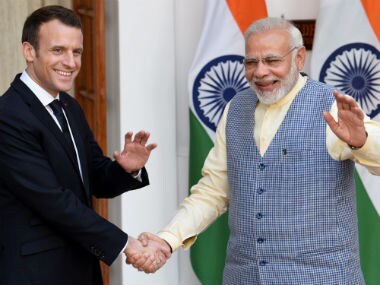
File image of Emmanuel Macron and Narendra Modi. PTI[/caption]The French readiness to support India’s rise to power has also manifested itself in the provision of high-end technology. In the space sector, where there has been long-standing bilateral cooperation, France agreed last month to contribute expertise to the Gaganyaan project.In the field of civilian nuclear power, Nuclear electric power generation company Électricité de France is negotiating with Nuclear Power Corporation of India to expedite the Jaitapur Nuclear Power Project, which involves construction of six high-power reactors.Finally, in the defence sector, France’s main corporations — Dassault Aviation, Thales Group and Naval Group to cite a few — have for long supplied India with complex armament systems such as the Scorpene submarines as well as the Mirage-2000s and Rafale combat aircrafts.Maritime cooperation in the Indian OceanMaritime cooperation has been a major pillar of the bilateral partnership as illustrated by the two decades-and-a-half of Indo-French naval exercises. This long-standing naval cooperation has allowed for a discussion on the security of the Indian Ocean and, eventually, the identification of converging geopolitical interests in the region. With its overseas territories of La Réunion and Mayotte, as well as its military bases in Djibouti and Abu Dhabi, France has a substantial footprint in the Indian Ocean. In its strategic assessment of this vast maritime area, it sees India as an emerging security provider and indispensable partner. As a result, the French rationale has been to develop a close operational partnership with the Indian Navy with a view to conducting joint missions to address non-traditional threats such as piracy, illegal fishing and trafficking.Since 2015 and the launching of a bilateral maritime dialogue, further progress has been made in strengthening maritime cooperation. In March 2018, France and India signed a reciprocal logistics support agreement which will allow the Indian Navy access to French bases in the western Indian Ocean and promote greater interoperability. The two nations have also developed cooperation in the field of maritime domain awareness and intelligence gathering. They have signed a white shipping agreement to share information on maritime traffic, and the Indian Space Research Organisation and the National Centre for Space Studies have concluded a MoU with a view to co-developing a maritime surveillance satellite system focussed on the Indian Ocean and related data fusion mechanisms. Cooperation in hydrography and marine cartography has also been part of the bilateral agenda of cooperation.Finally, it may be argued that, for India, cooperation with France usefully complements its naval partnership with the US. This may be especially true for those in New Delhi who have expressed frustration with the fact that India-US cooperation developed in the framework of the Indo-Pacific Command and centred on the Bay of Bengal.In contrast, India has a partner in France which is more than willing to push cooperation in the Western Indian Ocean. Thus, to a certain extent, Indo-French naval cooperation can fill the vacuum left by the India-US partnership in the Western Indian Ocean. This is especially welcome as China’s growing presence in this part of the world is a matter of concern not only for India, but also for France. Indeed, the French 2017 defence and national security strategic review states, “Rising Chinese military capabilities and their potential consequences in new areas of interaction in Africa (Djibouti) and in the Indian Ocean must be closely monitored.”India as a pillar of French Indo-Pacific strategy?During his various trips across Asia this year, Macron started laying out his government’s strategy for the Indo-Pacific, a notion that has eventually entered the French official narrative. His vision has been informed by the notion that France has to protect its interests in the Indo-Pacific and uphold a multilateral, rule-based order where all stakeholders respect the freedom of navigation and overflight as well as the peaceful settlement of conflicts. As underlined by the French President, this ambition requires that Paris strengthen cooperation with its main partners in the Indo-Pacific, ie Australia and India.Indeed, Macron’s visits to India and Australia in March and May respectively revealed a certain parallelism in his approach. In both countries, he called for a stronger commitment to promoting peace and security in the Indo-Pacific and upholding international norms and law. More to the point, he urged that France’s bilateral cooperation with India and Australia associates other strategic partners thus paving the way for a putative trilateral format between Paris, New Delhi and Canberra.While Macron’s proposal for a ‘Paris-New Delhi-Canberra axis’ seems a long way off, the idea of initiating consultations between the three countries makes sense given their common interest in a stable and rule-based Indian Ocean. However, such discussion should not be conceived of merely as a reaction to China’s presence in the region; it should rather been envisioned as a new initiative adding up to the network of minilaterals that have developed between like-minded countries and that may eventually contribute its share to the emergence of a security architecture in the Indo-Pacific.The writer is an associate research fellow with IFRI, Paris

China has dominated Myanmar’s rare earth mines — now India eyes deal to harness country’s critical minerals
CJP protest in Delhi: New videos of stone pelting, violence emerge as police, agitators trade charges
'From make in India to launch from India': Skyroot COO on why Vikram-1 could change India’s space sector
Choke terror funding, keep international shipping lanes safe: Jaishankar at Asean Regional Forum
PM Modi announces fast-track courts for paper leak cases; CJP responds ‘Dharmendra Pradhan must go’