
Advertisement


Sections
Parliament Logjam Part 4: Strengthening committee system can improve quality of drafted laws, fast-track implementation
India needs greater & effective utilisation of Parliamentary Committees to strengthen Parliament as a deliberative body which can ensure effective oversight.

Editor's note: The recently concluded Budget Session of Parliament was, by all accounts, the least productive in at least a decade, marked by protest, adjournment, and very little constructive debate, let alone passage of bills. Firstpost will examine, by way of a multi-part series spread across a six-week span, the reasons why the Parliamentary process in particular, and the democratic apparatus in general, has failed India's citizens. The clutch of essays, written by experts in the Constitution and constitutional law, will investigate the defects, introduced by design, that have enabled the degeneration of legislative functioning. Series has been curated by Bangalore-based lawyer and tutor of democracy and active citizenship, Malavika Prasad.On 21 December, 2015, the Insolvency and Bankruptcy Code (IBC) was introduced by the finance minister. The 118-page Bill defined the process for dealing with insolvent individuals and companies. The Bill, listed for passage on the following day, saw several objections from the Opposition and was subsequently referred to the Joint Select Committee.[caption id="attachment_4420851" align="alignleft" width="380"]![Parliament. Representational image. PTI]() Representational image. PTI[/caption]The committee deliberated on the Bill for four months and presented a revised version of the legislation in its report tabled during the 2016 Budget Session. The government accepted the recommendations and also took up the committee’s version of the bill for passage. The legislation related to Goods and Services Tax, passed a few months later, also went through a similar process and key recommendations of the Select Committee were accepted in the final bill passed.Parliamentary Committees serve as a forum of deliberation and are the backbone of our parliamentary system. This column highlights the role of parliamentary committees, the issues in the present system and measures that can be taken to strengthen their functioning.The key responsibility of the Parliament is to be a body of oversight over the executive. The executive proposes the formulation of several laws and policies that affect us in various ways. Parliament ensures these are discussed and scrutinised before approval. For this, there are various interventions available for a legislator (question hour, calling attention, etc).Committee-system in IndiaDue to capacity and time constraints, it is not possible for Members of the Parliament to scrutinise all policies and legislation on the floor of the House. It was felt that by forming smaller groups of members to examine the subjects would ensure deeper deliberation and debate.In India, the earliest Parliamentary Committees were the Public Accounts Committee (1921) followed by the Estimates Committee (1950). In 1993, the current system of Department Related Standing Committees (DRSC) was established replacing subject committees and the structure has largely remained the same till date.
Representational image. PTI[/caption]The committee deliberated on the Bill for four months and presented a revised version of the legislation in its report tabled during the 2016 Budget Session. The government accepted the recommendations and also took up the committee’s version of the bill for passage. The legislation related to Goods and Services Tax, passed a few months later, also went through a similar process and key recommendations of the Select Committee were accepted in the final bill passed.Parliamentary Committees serve as a forum of deliberation and are the backbone of our parliamentary system. This column highlights the role of parliamentary committees, the issues in the present system and measures that can be taken to strengthen their functioning.The key responsibility of the Parliament is to be a body of oversight over the executive. The executive proposes the formulation of several laws and policies that affect us in various ways. Parliament ensures these are discussed and scrutinised before approval. For this, there are various interventions available for a legislator (question hour, calling attention, etc).Committee-system in IndiaDue to capacity and time constraints, it is not possible for Members of the Parliament to scrutinise all policies and legislation on the floor of the House. It was felt that by forming smaller groups of members to examine the subjects would ensure deeper deliberation and debate.In India, the earliest Parliamentary Committees were the Public Accounts Committee (1921) followed by the Estimates Committee (1950). In 1993, the current system of Department Related Standing Committees (DRSC) was established replacing subject committees and the structure has largely remained the same till date.![CHART 1]()
![Number of Lok Sabha bills referred to committees. Source: Lok Sabha website; PRS]() The number of Lok Sabha bills referred to committees. Source: Lok Sabha website; PRS[/caption]Fewer bills referred: To strengthen the lawmaking process, it is important that all bills are examined by Standing Committees before passage. This ensures thorough scrutiny of the law. This practice is seen in legislatures of most developed countries.In India, there is no such rule to ensure all bills are referred to committees. As a convention, the ministry piloting the bill recommends the Speaker to refer a bill to the Standing Committee.The 14th and 15th Lok Sabha saw 60 percent and 71 percent of bills referred to committees. This number has dipped sharply to just 27 percent in the 16th Lok Sabha. The attendance of members in committee meetings has been a cause for concern as well, which is about 50 percent since 2014-15.Longer tenure for members: The committee system allows a smaller group of legislators to develop technical expertise on a particular subject and ensure better deliberation. In the present format, the members are nominated to a Standing Committee for one year. However, shifting of committees every year defeats this purpose. The vice-president, as chairman of the Rajya Sabha, recently emphasised on the need to extend the tenure of committee members.Discussion of committee reports: The committees make several recommendations in their reports after thorough analysis and feedback from stakeholders. Since these are recommendatory in nature, the executive may not necessarily accept them. Moreover, the reports of the committees are not taken up for discussion in Parliament except for references in certain debates on bills. Several of committee’s recommendations are neither implemented nor discussed.Research Support: Committees examine issues that are technical in nature. To equip members to gain an in-depth understanding of issues and finally give sound and nuanced recommendations, it is important that quality research is made available to them. Institutional research support will allow committees to serve as expert bodies to examine complex policy issues.The need for referring all bills to committee, longer tenure for members and strengthening committees with adequate research support also find mention in the National Commission to Review the Working of the Constitution, 2002 (NCRWC).Way forwardAnother aspect of committee scrutiny is financial matters like budgets. At present, the Standing Committees analyse the budgets of the respective ministries. The NCRWC argues for trimming the number of Standing Committees and entrusting them with additional responsibilities of financial oversight and doing away with existing finance committees to avoid overlapping of work. It also makes a case for establishing Standing Committee on Economy providing space for deliberations on economic policies and its implementation separately.
The number of Lok Sabha bills referred to committees. Source: Lok Sabha website; PRS[/caption]Fewer bills referred: To strengthen the lawmaking process, it is important that all bills are examined by Standing Committees before passage. This ensures thorough scrutiny of the law. This practice is seen in legislatures of most developed countries.In India, there is no such rule to ensure all bills are referred to committees. As a convention, the ministry piloting the bill recommends the Speaker to refer a bill to the Standing Committee.The 14th and 15th Lok Sabha saw 60 percent and 71 percent of bills referred to committees. This number has dipped sharply to just 27 percent in the 16th Lok Sabha. The attendance of members in committee meetings has been a cause for concern as well, which is about 50 percent since 2014-15.Longer tenure for members: The committee system allows a smaller group of legislators to develop technical expertise on a particular subject and ensure better deliberation. In the present format, the members are nominated to a Standing Committee for one year. However, shifting of committees every year defeats this purpose. The vice-president, as chairman of the Rajya Sabha, recently emphasised on the need to extend the tenure of committee members.Discussion of committee reports: The committees make several recommendations in their reports after thorough analysis and feedback from stakeholders. Since these are recommendatory in nature, the executive may not necessarily accept them. Moreover, the reports of the committees are not taken up for discussion in Parliament except for references in certain debates on bills. Several of committee’s recommendations are neither implemented nor discussed.Research Support: Committees examine issues that are technical in nature. To equip members to gain an in-depth understanding of issues and finally give sound and nuanced recommendations, it is important that quality research is made available to them. Institutional research support will allow committees to serve as expert bodies to examine complex policy issues.The need for referring all bills to committee, longer tenure for members and strengthening committees with adequate research support also find mention in the National Commission to Review the Working of the Constitution, 2002 (NCRWC).Way forwardAnother aspect of committee scrutiny is financial matters like budgets. At present, the Standing Committees analyse the budgets of the respective ministries. The NCRWC argues for trimming the number of Standing Committees and entrusting them with additional responsibilities of financial oversight and doing away with existing finance committees to avoid overlapping of work. It also makes a case for establishing Standing Committee on Economy providing space for deliberations on economic policies and its implementation separately.![PLJ-option1]() There are existing practices in other countries that can contribute to strengthening the committee system in India. For example, in the British House of Commons, the committees interact on certain overlapping subjects. Committees related to defence, foreign affairs, international development, and trade & industry form the Quadripartite Committee which examines government’s arms export licenses.In several countries, the concerned minister appears before the committee to elaborate and defend the policies of the government. In India, ministers don’t appear before the committees but other functionaries do.Strengthening the committee system can go a long way in improving the quality of laws drafted and minimise potential implementation challenges. The need of the hour is for greater and effective utilisation of Parliamentary Committees to strengthen Parliament as a deliberative body which can ensure effective oversight.The author is a Program Officer at PRS Legislative Research and handles engagement with state legislators.Read about the series: Budget Session 2018 washout, worst in over a decade, shows why legislature desperately needs reform agendaRead Part 1: Obsolete system of voice votes needs to be replaced with electronic votingRead Part 2: Examining legislative avenues available to keep govt accountable, exercise necessary oversightRead Part 3: Core problem cannot be fixed till we introduce checks on Speaker's discretionary powersRead Part 5: 'Bye-Partisanship'; What Indian legislature needs to break deadlocks, improve discourseRead Part 6: Waning legislative influence, lack of clear mission flags need to redefine Rajya Sabha's functioningRead Part 7: Political parties must be tamed, their incomes regulated to revive Indian democracyRead Part 8: Anti-Defection Law must be curbed to empower legislature, promote deliberative democracyRead Part 9: Corporate funding of elections continues to bankrupt legislative morality, weaken electoral integrityRead Part 10: Enabling stakeholder consultations in policy-making can deepen democracy, improve transparencyRead Part 11: Time, the unseen yet powerful factor of politics, holds key to controlling legislative discourseRead Part 12: Understanding 'political value' of time and how it is weaponised in democracy
There are existing practices in other countries that can contribute to strengthening the committee system in India. For example, in the British House of Commons, the committees interact on certain overlapping subjects. Committees related to defence, foreign affairs, international development, and trade & industry form the Quadripartite Committee which examines government’s arms export licenses.In several countries, the concerned minister appears before the committee to elaborate and defend the policies of the government. In India, ministers don’t appear before the committees but other functionaries do.Strengthening the committee system can go a long way in improving the quality of laws drafted and minimise potential implementation challenges. The need of the hour is for greater and effective utilisation of Parliamentary Committees to strengthen Parliament as a deliberative body which can ensure effective oversight.The author is a Program Officer at PRS Legislative Research and handles engagement with state legislators.Read about the series: Budget Session 2018 washout, worst in over a decade, shows why legislature desperately needs reform agendaRead Part 1: Obsolete system of voice votes needs to be replaced with electronic votingRead Part 2: Examining legislative avenues available to keep govt accountable, exercise necessary oversightRead Part 3: Core problem cannot be fixed till we introduce checks on Speaker's discretionary powersRead Part 5: 'Bye-Partisanship'; What Indian legislature needs to break deadlocks, improve discourseRead Part 6: Waning legislative influence, lack of clear mission flags need to redefine Rajya Sabha's functioningRead Part 7: Political parties must be tamed, their incomes regulated to revive Indian democracyRead Part 8: Anti-Defection Law must be curbed to empower legislature, promote deliberative democracyRead Part 9: Corporate funding of elections continues to bankrupt legislative morality, weaken electoral integrityRead Part 10: Enabling stakeholder consultations in policy-making can deepen democracy, improve transparencyRead Part 11: Time, the unseen yet powerful factor of politics, holds key to controlling legislative discourseRead Part 12: Understanding 'political value' of time and how it is weaponised in democracy
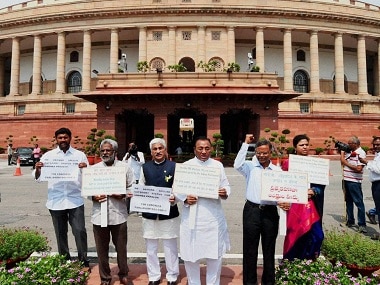 Representational image. PTI[/caption]The committee deliberated on the Bill for four months and presented a revised version of the legislation in its report tabled during the 2016 Budget Session. The government accepted the recommendations and also took up the committee’s version of the bill for passage. The legislation related to Goods and Services Tax, passed a few months later, also went through a similar process and key recommendations of the Select Committee were accepted in the final bill passed.Parliamentary Committees serve as a forum of deliberation and are the backbone of our parliamentary system. This column highlights the role of parliamentary committees, the issues in the present system and measures that can be taken to strengthen their functioning.The key responsibility of the Parliament is to be a body of oversight over the executive. The executive proposes the formulation of several laws and policies that affect us in various ways. Parliament ensures these are discussed and scrutinised before approval. For this, there are various interventions available for a legislator (question hour, calling attention, etc).Committee-system in IndiaDue to capacity and time constraints, it is not possible for Members of the Parliament to scrutinise all policies and legislation on the floor of the House. It was felt that by forming smaller groups of members to examine the subjects would ensure deeper deliberation and debate.In India, the earliest Parliamentary Committees were the Public Accounts Committee (1921) followed by the Estimates Committee (1950). In 1993, the current system of Department Related Standing Committees (DRSC) was established replacing subject committees and the structure has largely remained the same till date.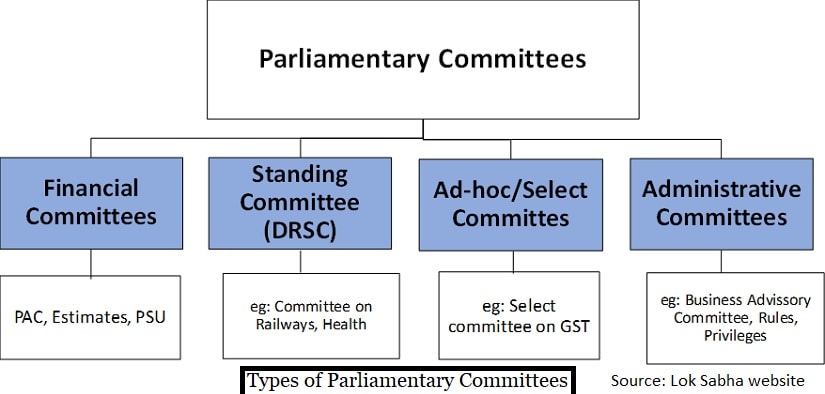
- The Standing Committees (DRSC), aligned with specific ministries examine their performance and budgets apart from bills or subjects related to their respective ministries.
- The Financial Committees are primarily responsible for scrutinising the expenditure priorities of the government, suggest measures to improve efficiency in spending and performance of Public Sector Undertakings.
- The Select Committee is formed for analysing a specific legislation/policy and is disbanded after submission of its reports.
- The Administrative Committees are primarily responsible for ensuring day-to-day activities of the legislature are planned in consultation with the members.
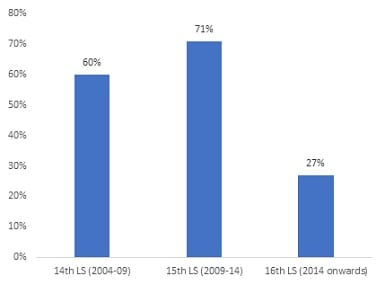 The number of Lok Sabha bills referred to committees. Source: Lok Sabha website; PRS[/caption]Fewer bills referred: To strengthen the lawmaking process, it is important that all bills are examined by Standing Committees before passage. This ensures thorough scrutiny of the law. This practice is seen in legislatures of most developed countries.In India, there is no such rule to ensure all bills are referred to committees. As a convention, the ministry piloting the bill recommends the Speaker to refer a bill to the Standing Committee.The 14th and 15th Lok Sabha saw 60 percent and 71 percent of bills referred to committees. This number has dipped sharply to just 27 percent in the 16th Lok Sabha. The attendance of members in committee meetings has been a cause for concern as well, which is about 50 percent since 2014-15.Longer tenure for members: The committee system allows a smaller group of legislators to develop technical expertise on a particular subject and ensure better deliberation. In the present format, the members are nominated to a Standing Committee for one year. However, shifting of committees every year defeats this purpose. The vice-president, as chairman of the Rajya Sabha, recently emphasised on the need to extend the tenure of committee members.Discussion of committee reports: The committees make several recommendations in their reports after thorough analysis and feedback from stakeholders. Since these are recommendatory in nature, the executive may not necessarily accept them. Moreover, the reports of the committees are not taken up for discussion in Parliament except for references in certain debates on bills. Several of committee’s recommendations are neither implemented nor discussed.Research Support: Committees examine issues that are technical in nature. To equip members to gain an in-depth understanding of issues and finally give sound and nuanced recommendations, it is important that quality research is made available to them. Institutional research support will allow committees to serve as expert bodies to examine complex policy issues.The need for referring all bills to committee, longer tenure for members and strengthening committees with adequate research support also find mention in the National Commission to Review the Working of the Constitution, 2002 (NCRWC).Way forwardAnother aspect of committee scrutiny is financial matters like budgets. At present, the Standing Committees analyse the budgets of the respective ministries. The NCRWC argues for trimming the number of Standing Committees and entrusting them with additional responsibilities of financial oversight and doing away with existing finance committees to avoid overlapping of work. It also makes a case for establishing Standing Committee on Economy providing space for deliberations on economic policies and its implementation separately.
 There are existing practices in other countries that can contribute to strengthening the committee system in India. For example, in the British House of Commons, the committees interact on certain overlapping subjects. Committees related to defence, foreign affairs, international development, and trade & industry form the Quadripartite Committee which examines government’s arms export licenses.In several countries, the concerned minister appears before the committee to elaborate and defend the policies of the government. In India, ministers don’t appear before the committees but other functionaries do.Strengthening the committee system can go a long way in improving the quality of laws drafted and minimise potential implementation challenges. The need of the hour is for greater and effective utilisation of Parliamentary Committees to strengthen Parliament as a deliberative body which can ensure effective oversight.The author is a Program Officer at PRS Legislative Research and handles engagement with state legislators.Read about the series: Budget Session 2018 washout, worst in over a decade, shows why legislature desperately needs reform agendaRead Part 1: Obsolete system of voice votes needs to be replaced with electronic votingRead Part 2: Examining legislative avenues available to keep govt accountable, exercise necessary oversightRead Part 3: Core problem cannot be fixed till we introduce checks on Speaker's discretionary powersRead Part 5: 'Bye-Partisanship'; What Indian legislature needs to break deadlocks, improve discourseRead Part 6: Waning legislative influence, lack of clear mission flags need to redefine Rajya Sabha's functioningRead Part 7: Political parties must be tamed, their incomes regulated to revive Indian democracyRead Part 8: Anti-Defection Law must be curbed to empower legislature, promote deliberative democracyRead Part 9: Corporate funding of elections continues to bankrupt legislative morality, weaken electoral integrityRead Part 10: Enabling stakeholder consultations in policy-making can deepen democracy, improve transparencyRead Part 11: Time, the unseen yet powerful factor of politics, holds key to controlling legislative discourseRead Part 12: Understanding 'political value' of time and how it is weaponised in democracy
First Published:Apr 30, 2018, 13:48:12 IST
Advertisement
Advertisement

NEET protest: CJP delegation to meet ministers on Friday, sources say
The meeting comes after behind-the-scenes negotiations to resolve the impasse over the NEET paper leak, with protesters demanding Education Minister Dharmendra Pradhan's resignation and sweeping reforms to the examination system.
1 min read
Naresh Pal Gangwar appointed higher education secretary, Vineet Joshi moved to Panchayati Raj ministry
Gangwar is a 1994-batch Indian Administrative Service officer of the Rajasthan cadre. Prior to his new appointment, he was serving as Secretary, Department of Animal Husbandry and Dairying under the Ministry of Fisheries, Animal Husbandry and Dairying.
1 min read
India rejects Pakistan's 'baseless' claims at Asean, says Indus Waters Treaty to remain on hold
India accused Pakistan of misusing the Asean Regional Forum to spread false narratives, reiterating that the Indus Waters Treaty will remain suspended until Islamabad credibly and irrevocably ends cross-border terrorism.
1 min read
India successfully tests long-range 'Kusha' air defence missile system
The DRDO-developed 'Kusha' missile system can engage fighter aircraft, missiles, drones and large enemy aircraft, marking a significant milestone in India's indigenous long-range air defence programme.
1 min read
Indian trucker arrested in US over alleged theft of $3 million worth of tungsten powder
A 39-year-old Indian national living illegally in the US has been arrested in California after authorities alleged he stole a truck carrying nearly $3 million worth of hazardous tungsten powder.
1 min read
Advertisement
Advertisement