
Advertisement


Sections
No weekly off, more than 8-hour shifts: What makes India's police force bitter and angry
Police atrocities and bad behaviour with citizens is something rampant in our country, cutting across states. And a new study reveals that their long working hours are to be blamed for this.

Indians have always been quick to dismiss the country's police force, terming them ineffective, and perhaps, sometimes, rightly so.Police atrocities and bad behaviour with citizens is something rampant in our country, cutting across states. And a new study has blamed their long working hours for this.[caption id="attachment_2275210" align="alignleft" width="380"]![Representational image. AFP]() Representational image. AFP[/caption]The Times of India reports, "The study, 'National Requirement of Manpower for 8-hour Shift in Police Stations', carried out by Bureau of Police Research and Development (BPRD) and Administrative Staff College of India (ASCI) has found that 90% of police officers work for more than eight hours a day and 73% don't get a weekly off even once a month and are called for emergency duties from their rare off days as well."It is not just their behaviour that gets affected. The study has also found that long working hours, without any rest or recreation, takes a toll on their health.The study has found:
Representational image. AFP[/caption]The Times of India reports, "The study, 'National Requirement of Manpower for 8-hour Shift in Police Stations', carried out by Bureau of Police Research and Development (BPRD) and Administrative Staff College of India (ASCI) has found that 90% of police officers work for more than eight hours a day and 73% don't get a weekly off even once a month and are called for emergency duties from their rare off days as well."It is not just their behaviour that gets affected. The study has also found that long working hours, without any rest or recreation, takes a toll on their health.The study has found:
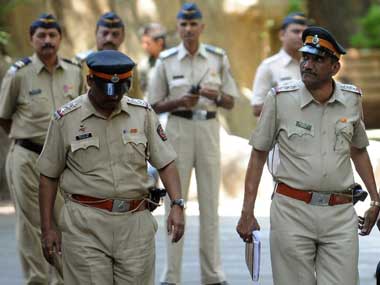 Representational image. AFP[/caption]The Times of India reports, "The study, 'National Requirement of Manpower for 8-hour Shift in Police Stations', carried out by Bureau of Police Research and Development (BPRD) and Administrative Staff College of India (ASCI) has found that 90% of police officers work for more than eight hours a day and 73% don't get a weekly off even once a month and are called for emergency duties from their rare off days as well."It is not just their behaviour that gets affected. The study has also found that long working hours, without any rest or recreation, takes a toll on their health.The study has found:
Nearly three-fourths (74%) of respondents among police station staff reported that the current working hour regime led to various kinds of health problems for them. A large majority (over 76%) of Station House Officers also felt that the current duty hour arrangement was deleterious to health of staff. Most of the specific health problems enumerated by the staff respondents in this regard fall in the domain of occupational hazards and can be directly attributed to long hours on job.Another factor that takes a toll on the motivation of the police force in our country is their almost non-existent social life. The study suggests that cutting across all age-groups, ranks and educational qualifications, the police are 'disenchanted' with their work.The study hence finds that:
The overall frustration manifests itself in the offensive conduct and behavior with the public by many of them, which leads to erosion of societal image of the police and alienation of the public. Since public cooperation is an essential ingredient of effective policing, all this causes an enormous adverse impact on the quality of police service.As steps to solve this problem, the study has found that a shift system and more manpower is required for effective 24/7 policing.Respondents of this research said that that they would prefer 8-hour shifts (with over 96% of police station staff choosing the option). The study found that almost 90% of SHOs and more than 90% of officers in a supervisor rank were of the opinion that a shift system would improve things drastically.However, the study found that to actually follow such a schedule, more manpower is needed in the police force. "This means an addition of 68% to the current sanctioned strength," it says.The study rightly points to this issue saying:
The situation of inordinately long and irregular working hours for police station staff is, thus, quite serious. Long and irregular work hours have multiple negative impacts on efficient policing, since weary, over-worked and over-exhausted personnel cannot be expected to put in their best in their work.The research involved extensive field survey including 12,156 police station staff, 1,003 SHOs and 962 supervisory officers from 319 police districts in the country, spanning 23 States and two Union Territories. These large samples were drawn from nine police station types, namely, metropolitan, urban, urban-rural mixed, rural, crime, traffic, women, tribal and others.Read the whole study here.
First Published:Jun 02, 2015, 16:52:08 IST
Advertisement
Advertisement

China has dominated Myanmar’s rare earth mines — now India eyes deal to harness country’s critical minerals
India is deepening rare earth cooperation with Myanmar as New Delhi seeks alternative sources of critical minerals dominated by China, including dysprosium and terbium used in EVs, defence systems and clean energy technologies
6 min read
CJP protest in Delhi: New videos of stone pelting, violence emerge as police, agitators trade charges
Fresh videos of violence that broke out during the Cockroach Janta Party's (CJP) protest in Delhi have surfaced, with the police releasing footage showing alleged stone pelting, vandalism and attacks on security personnel
3 min read
'From make in India to launch from India': Skyroot COO on why Vikram-1 could change India’s space sector
Skyroot Aerospace’s successful Vikram-1 mission marks a major milestone for India’s private space sector, as the country seeks to shift from “Make in India” to “Launch from India” and compete in the global commercial satellite launch market
8 min read
Choke terror funding, keep international shipping lanes safe: Jaishankar at Asean Regional Forum
Jaishankar's remarks came against the backdrop of recent terror attacks targeting India and growing threats to commercial shipping amid conflicts in West Asia and Europe
2 min read
PM Modi announces fast-track courts for paper leak cases; CJP responds ‘Dharmendra Pradhan must go’
Amid protests demanding accountability for the leak of medical entrance test Neet and other irregularities in the education system, Prime Minister Narendra Modi has announced that the government has decided to set up fast-track courts to ensure swift and stringent punishment for those involved in paper leaks.
3 min read
Advertisement
Advertisement