
Advertisement


Sections
Narendra Modi decides to quit Weibo days after Centre bans 59 Chinese apps; BJP leaders hail 'strong message'
Modi had 115 posts on Weibo, and it was decided to manually delete them and after much effort, all the posts have now been removed, sources told PTI.

Days after India banned 59 Chinese apps, including TikTok and UC Browser, Prime Minister Narendra Modi has decided to quit microblogging site Weibo, which is a Chinese platform similar to Twitter, reports said.PTI quoted government sources as sayig that the prime minister decided to quit Weibo, which he had joined in 2015, as soon as the decision was taken to ban 59 Chinese apps in India. They added that Weibo has a more complex procedure to quit for accounts of important personalities which is why an official process was initiated.For reasons best known to the Chinese, there was a great delay in granting this basic permission, they said.The prime minister had 115 posts on Weibo, and it was decided to manually delete them and after much effort 113 posts were removed, they said.[caption id="attachment_8547371" align="alignnone" width="640"]![File image of Narendra Modi's account on Weibo. Image courtesy: Twitter/@narendramodi]() File image of Narendra Modi's account on Weibo. Image courtesy: Twitter/@narendramodi[/caption]The two posts left were those where Modi had photos with Chinese President Xi Xinping, they noted, adding that it is difficult to remove posts on Weibo in which pictures of Xi feature.All the posts are deleted now, the sources said.According to an article in The Print, after the ban on Chinese apps was announced, many Weibo users had written angry comments in response to Modi's last post on the platform, which was a new year's greeting.Modi had set up an account on Weibo in May 2015, before his first visit to China as prime minister. As of 1 July, 2020, his account had a total of 2,44,000 followers, many of them being Chinese. Among his posts on Weibo were some messages on yoga, and wishes for Jinping on his birthday, an article on Huffpost noted.Weibo is said to be China's most popular microblogging site and is run by the country's largest internet portal, Sina.com. It was introduced in August 2009.The prime minister's decision to quit Weibo comes ten days after at least three official Indian statements – including that of the prime minister – were deleted from the Indian embassy’s official account on the popular social media app, WeChat, a Hindustan Times report said.Several BJP leaders hailed Modi's decision to quit the platform, including IT cell chief Amit Malviya and the party's general secretary (organisation) BL Santhosh.The Centre recently banned 59 Chinese apps, saying that they are "engaged in activities which are prejudicial to sovereignty and integrity of India, defence of India, security of state and public order".The ties between India and China have come under strain due to their military standoff at Ladakh border.With inputs from PTI
File image of Narendra Modi's account on Weibo. Image courtesy: Twitter/@narendramodi[/caption]The two posts left were those where Modi had photos with Chinese President Xi Xinping, they noted, adding that it is difficult to remove posts on Weibo in which pictures of Xi feature.All the posts are deleted now, the sources said.According to an article in The Print, after the ban on Chinese apps was announced, many Weibo users had written angry comments in response to Modi's last post on the platform, which was a new year's greeting.Modi had set up an account on Weibo in May 2015, before his first visit to China as prime minister. As of 1 July, 2020, his account had a total of 2,44,000 followers, many of them being Chinese. Among his posts on Weibo were some messages on yoga, and wishes for Jinping on his birthday, an article on Huffpost noted.Weibo is said to be China's most popular microblogging site and is run by the country's largest internet portal, Sina.com. It was introduced in August 2009.The prime minister's decision to quit Weibo comes ten days after at least three official Indian statements – including that of the prime minister – were deleted from the Indian embassy’s official account on the popular social media app, WeChat, a Hindustan Times report said.Several BJP leaders hailed Modi's decision to quit the platform, including IT cell chief Amit Malviya and the party's general secretary (organisation) BL Santhosh.The Centre recently banned 59 Chinese apps, saying that they are "engaged in activities which are prejudicial to sovereignty and integrity of India, defence of India, security of state and public order".The ties between India and China have come under strain due to their military standoff at Ladakh border.With inputs from PTI
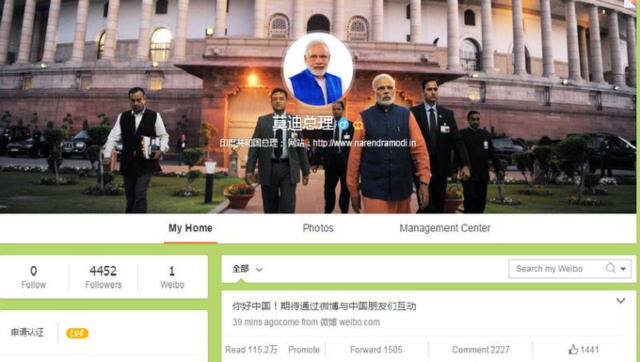 File image of Narendra Modi's account on Weibo. Image courtesy: Twitter/@narendramodi[/caption]The two posts left were those where Modi had photos with Chinese President Xi Xinping, they noted, adding that it is difficult to remove posts on Weibo in which pictures of Xi feature.All the posts are deleted now, the sources said.According to an article in The Print, after the ban on Chinese apps was announced, many Weibo users had written angry comments in response to Modi's last post on the platform, which was a new year's greeting.Modi had set up an account on Weibo in May 2015, before his first visit to China as prime minister. As of 1 July, 2020, his account had a total of 2,44,000 followers, many of them being Chinese. Among his posts on Weibo were some messages on yoga, and wishes for Jinping on his birthday, an article on Huffpost noted.Weibo is said to be China's most popular microblogging site and is run by the country's largest internet portal, Sina.com. It was introduced in August 2009.The prime minister's decision to quit Weibo comes ten days after at least three official Indian statements – including that of the prime minister – were deleted from the Indian embassy’s official account on the popular social media app, WeChat, a Hindustan Times report said.Several BJP leaders hailed Modi's decision to quit the platform, including IT cell chief Amit Malviya and the party's general secretary (organisation) BL Santhosh.The Centre recently banned 59 Chinese apps, saying that they are "engaged in activities which are prejudicial to sovereignty and integrity of India, defence of India, security of state and public order".The ties between India and China have come under strain due to their military standoff at Ladakh border.With inputs from PTI
First Published:Jul 01, 2020, 21:04:41 IST
Advertisement
Advertisement

CJP Protest in Delhi Live Updates: Heavy security deployed in Jantar Mantar ahead of student protests
CJP Protest in Delhi Live Updates: Heavy security has been deployed at the Jantar Mantar in Delhi, where the Cockroach Janta Party (CJP) is continuing its protest demanding the resignation of Union Education Minister Dharmendra Pradhan over the recent paper leaks controversy
1 min read
Bharat Forge, Flying Whales sign pact to develop 60-tonne airships for India’s defence logistics
Bharat Forge has signed an MoU with Flying Whales to jointly develop and manufacture 60-tonne heavy-lift airships in India for defence logistics, strategic mobility and disaster response
3 min read
Air India to cut Delhi-Toronto flight time by 3 hours, resume non-stop services from August 1
Air India will resume non-stop Delhi-Toronto flights from August 1, cutting travel time by nearly three hours and deploying its new Boeing 787-9 Dreamliner on the route
2 min read
J&K cop on Amarnath Yatra duty shot dead in Anantnag terror attack; TRF claims responsibility
The Resistance Front (TRF), a shadow outfit of Lashkar-e-Taiba, claimed responsibility for the attack through a social media post
2 min read
Jaishankar meets Canada's Anita Anand, discusses bilateral cooperation and shared interests
External Affairs Minister S Jaishankar on Wednesday held talks on bilateral ties with his Canadian counterpart Anita Anand, focusing on cooperation and common goals.
1 min read
Advertisement
Advertisement