
Advertisement


Sections
Land reform failures: Only 5% of India’s farmers control 32% farmland
What has largely failed nationwide — with the exception of West Bengal — over 54 years since a land redistribution law was passed, is not likely to improve

Source: 2002, 2007, 2015(*The data for 2006 were sourced from the website of Ministry of Rural Development, Government of India, from the hyperlink titled “Other Land Reform Programmes”, as accessed on 5th February 2016. However, the link was recently removed)
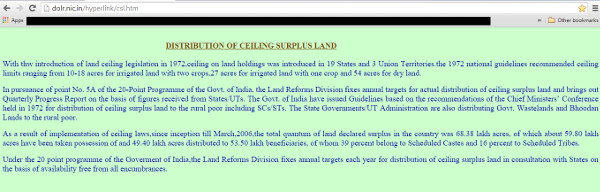 Screenshot from the website of the Ministry of Rural Development, Government of IndiaSimilarly, the land declared surplus has fallen over the years. Between 1973 and 2002, an average of 150,000 acres was declared surplus, and an average of 140,000 acres was distributed every year. In contrast, between 2002 and 2015, the land declared surplus every year was 4,000 acres, while land in government possession and distributed declined by 29,000 acres and 24,000 acres per year, respectivelyThis means that there is less land declared surplus every year over the past 13 years and what was once a growing trend of government possession and distribution has reversed.
 Source: 1973, 2002, 2007, 2015(*The data for 2006 were sourced from the website of Ministry of Rural Development, Government of India, from the hyperlink titled “Other Land Reform Programmes”, as accessed on 5th February 2016. However, the link was recently removed)The slowdown and fluctuations in land distribution data over the years are usually because of disputes over how much is to be taken away; courts restored some land to original owners; and some land was unfit for cultivation, according to this 2009 report from the Centre for Rural Studies, Lal Bahadur Shastri National Academy of Administration (LBSNAA), Mussoorie.The surplus land under litigation increased by 23.4%, from 920,000 acres to 1.14 million acres between 2007 and 2009. Some states, such as Kerala, Andhra Pradesh, Tamil Nadu, Karnataka, Gujarat and Maharashtra, created land tribunals to quickly settle such cases.Irrespective of the fluctuations, the land declared surplus, up to 2015, is 12.9% of 51.9 million acres — almost the size of Gujarat — the land that should be taken away from landlords, the LBSNAA estimated as cited in the report of the Committee on State Agrarian Relations and Unfinished Task of Land Reforms from 2009. The land in government possession and land distributed is 11.7% and 9.8%, respectively of the 51.9 million acres that should be declared surplus.Why land is important to further economic progressAs many as 570 million Indians, or 47.1% (including 6.7% in urban areas), still depend on agriculture, which contributes 15% to Gross Domestic Product (GDP), according to this 2011-12 National Sample Survey Office 2011-12 report and 2011 census data.South Korea and Taiwan — and Japan before them — implemented sweeping land reforms before transforming agriculture and moving their people to manufacturing, Jayati Ghosh, a professor at the Centre for Economic Studies and Planning, Jawaharlal Nehru University, wrote in this 1997 column for the Economic and Political Weekly. As agriculture’s importance diminished, agricultural productivity kept rising.“This was not only because of the institutional changes which released productive energies, but also because of the role of the government in increasing public investment levels in agriculture, providing subsidised fertiliser and pesticide inputs, supporting agricultural research and extension services, assisting in the organisation of co-operatives, and similar measures,” Ghosh wrote.
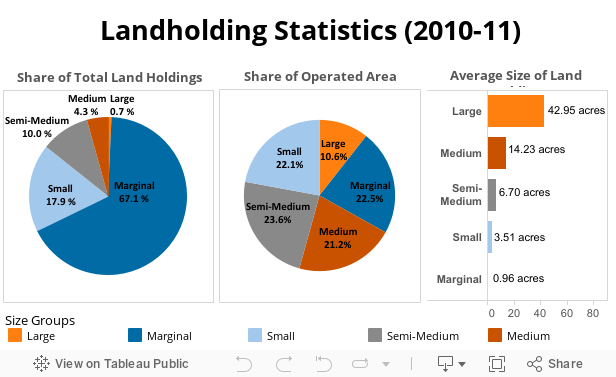 Source: Agriculture Census 2010-11: Phase 1But as India tries to ramp up manufacturing, through programmes such as Make in India, the failure of land reforms may worsen rural poverty.India has 101 million landless, equivalent to populations of Germany and Sri LankaAs many as 95.1% of Indian farmers are called “marginal, small and semi-medium”, meaning they own up to 2.47, 4.94 and 9.88 acres of land, respectively. These farmers own 68.2% of cultivated land, while 4.9% “medium and large” (owning up to 24.71 and 49.42 or more acres, respectively) farmers own 31.8% of cultivated land, according to the 2011-12 agriculture census.A “large” farmer on average has 45 times more land than a “marginal” farmer, as we already said, and 101.4 million people — equivalent to the population of Germany and Sri Lanka combined — or 56.4% of rural households, own no land, according to the socio-economic caste census 2011.A national law that guides the land a farmer can own was passed in 1972. It recommended that farmers should own between 10 and 18 acres of irrigated land with two crops, 27 acres of irrigated land with one crop and 54 acres for dry land.The surplus land was to be taken away by state governments and distributed to the rural landless, identified by village panchayats. Land ceilings varied by state and land quality.West Bengal — land reforms champion — gives rural landless area larger than GoaThe RTI response received by this correspondent reveals that West Bengal has outperformed other states.It has declared the most land “surplus” (1.41 million acres, or nearly one-and-a-half times the area of Goa), and accounts for 21% of such land so declared nationwide.West Bengal has taken possession of 1.32 million acres, 93.6% of land declared surplus statewide, and distributed 1.05 million acres, 79.8% of the land in the state’s possession.West Bengal also accounts for more than half (54.2%) of India’s land-reform beneficiaries. As many as 3.14 million of the rural, landless got free land over 60 years.The Draft National Land Reforms Policy has credited West Bengal, Kerala and Jammu and Kashmir for having performed best in surplus land distribution.Jammu and Kashmir is the worst performer, according to data from the RTI reply, which is also riddled with inaccuracies.For Jharkhand, it says no “surplus” land was declared and taken over — yet it shows 860 acres distributed among 1,316 beneficiaries.For Karnataka, land distributed is more than that declared “surplus” and taken over by the government.For Punjab, land taken over and distributed is more than land declared surplus.These inconsistencies raise concerns over the reporting and verification of surplus land declaration and distribution nationwide.
 The draft National Land Reforms Policy, prepared in 2013, suggests policy correctives:- Stopping land-holding exemptions to religious, educational, charitable, research and industrial organisations beyond 15 acres- Allowing smaller land-holdings in states where the existing limit is more than five to 10 acres for irrigated land and 10 to 15 acres for non-irrigated land- A “single-window” to redistribute surplus land within a specified time- A crackdown on benami (in someone else’s name) land- A database of land inventories available for public scrutiny(The author is an independent journalist and a blogger at opiniontandoor.in)Indiaspend.org is a data-driven, public-interest journalism non-profit
First Published:May 04, 2016, 11:11:25 IST
Advertisement
Advertisement

India rejects Pakistan's 'baseless' claims at Asean, says Indus Waters Treaty to remain on hold
India accused Pakistan of misusing the Asean Regional Forum to spread false narratives, reiterating that the Indus Waters Treaty will remain suspended until Islamabad credibly and irrevocably ends cross-border terrorism.
1 min read
India successfully tests long-range 'Kusha' air defence missile system
The DRDO-developed 'Kusha' missile system can engage fighter aircraft, missiles, drones and large enemy aircraft, marking a significant milestone in India's indigenous long-range air defence programme.
1 min read
Indian trucker arrested in US over alleged theft of $3 million worth of tungsten powder
A 39-year-old Indian national living illegally in the US has been arrested in California after authorities alleged he stole a truck carrying nearly $3 million worth of hazardous tungsten powder.
1 min read
China has dominated Myanmar’s rare earth mines — now India eyes deal to harness country’s critical minerals
India is deepening rare earth cooperation with Myanmar as New Delhi seeks alternative sources of critical minerals dominated by China, including dysprosium and terbium used in EVs, defence systems and clean energy technologies
6 min read
CJP protest in Delhi: New videos of stone pelting, violence emerge as police, agitators trade charges
Fresh videos of violence that broke out during the Cockroach Janta Party's (CJP) protest in Delhi have surfaced, with the police releasing footage showing alleged stone pelting, vandalism and attacks on security personnel
3 min read
Advertisement
Advertisement