


Kathua rape case: How does brutality inflicted on an eight-year-old girl fit into narrative of 'New India'?
An 8-year-old girl from Kathua in Jammu was abducted, tortured, raped repeatedly and murdered, and her body was dumped in a forest.

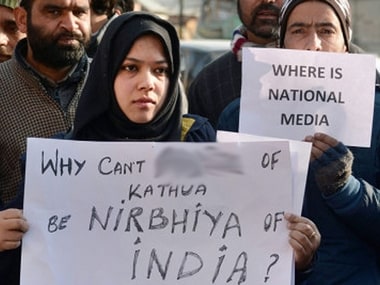
File image of protesters in Jammu. News18[/caption]The Narendra Modi-led NDA government has preferred to remain silent on issues related to intolerance and scathing attacks on religious and sect-based minorities. At the same time, the government at the Centre has made few attempts to project itself as offering an alternative to the Congress narrative with all-inclusive agenda. One such attempt was when the BJP trumpeted the vision of a "New India" — something that appeared palatable for mass consumption. The "New India" narrative seemingly marked a shift from the BJP's ideological fountainhead's narrative of making India a "Hindu Rashtra".The "Hindu Rashtra" narrative not only excludes all religious minorities from the equation, but also poses an existential threat to them. From the representation of minorities in politics and development, the argument takes a new thread — that of security. With the relentless efforts of BJP-affiliated groups to target minorities, Muslims in particular, the first takeaway happens to be security and existence, rather than representation. Put differently, Muslims in India have been forced to lower their demand for rights to that of a peaceful existence. The BJP and RSS have been successful in thwarting any attempt made by Muslims to claim political rights and representation. The manifestation of this has been visible in Uttar Pradesh where the BJP not only denied a ticket to Muslim candidates, but also created an atmosphere where the first concern of Muslims is a peacefuk existence. The trusted lieutenant of the BJP-RSS, Yogi Adityanath who is the chief minister of the state, is following the script religiously. If it has been lynchings over beef consumption and now encounters in UP, it has come down to rape and murder in Jammu and Kashmir.In Jammu and Kashmir, the footprint of the BJP has increased since it entered into an alliance with PDP and formed the government. Like Uttar Pradesh, Jammu and Kashmir has Muslim and Hindu populations living in different pockets. The religious faultline however is a little different in Jammu and Kashmir. The state is divided in three regions — Jammu, Kashmir and Ladakh. The divide is administrative, geographic, ethnic and now political. Kashmir is the largest region with 10 districts and more than 90 percent of population comprising Muslims. Ladakh, after the establishment of Hill Councils, has been politically isolated to some extent. It started with the indoctrination of the idea of a "separate status", preferably Union Territory, in which the BJP played a major role behind the scenes. Jammu, although it has also been divided into 10 smaller districts to maintain the proportion of its counterpart Kashmir, has a mixed population of Muslims and Hindus.While some districts have a predominantly Hindu population, there are also some where the Muslim numbers are strong. Kashmir is out of the league for now, because the region, in an outright mandate, rejected the BJP. As a matter of fact, Kashmir voted against the BJP when in all other states, the party was welcomed. It is in the Jammu region where all troubles are to start. With the right-wing politics of the BJP having registered a thumping victory in Jammu, its character is fast-changing. Jammu today is more like Uttar Pradesh. The BJP’s top leaders meet the people, workers and political leadership to keep them aligned with the party's interests. It has created a feeling among the people of this region that they are directly connected to the Modi government at the Centre.The state government has become meaningless as they perceive it to be powerless. It has been seen on many occasions that the workers and other people take their grievances directly to the Centre. In all likelihood, the BJP core is aware of all the developments and has been responding in ways to further the hold of the party on masses in Jammu. This has led to the development of a sense of impunity among the BJP workers and foot-soldiers in Jammu. As in Uttar Pradesh, the foot-soldiers of the BJP bask in their "untouchable" status. The feeling at times heightens to "Above the Law" euphoria. This is the political backdrop against which the brutal rape and murder in Kathua took place. There is still more to it than meets the eye.Soon after the formation of BJP-PDP state government, a prominent BJP leader, Choudhary Lal Singh, came under the spotlight for harassing and targeting minorities, Gujjar and Bakarwal, in particular. Given the portfolio of ministries of health at first and forests later, Lal Singh has been at the centre of controversies from philandering to stirring communal passions among people. The community Lal Singh and his cohorts have been targeting has at several times come out in public and held demonstrations — nothing has been achieved though.Back to the Kathua rape case, and after the police started its investigation, HEM launched a campaign against the investigation. For days, the group carried out protests in the Kathua region against the arrests made by the police. There were two interesting demands put forth by the HEM: The first was to release the arrested who were accused of being involved in the rape and murder, and the other was the demand to hand the investigation over to the CBI. To add more fuel to the fire, two BJP leaders including Lal Singh offered support to the HEM in their demands. That raised a lot of questions — from politics of hate and fear to the audacity of demanding release of rapists and murderers, to the support of BJP leaders in the brutal crime to the CBI and all the way to the rights and freedoms of minorities, and the narrative of New India. The questions remain unanswered.We asked liberal and secular groups the question: How does the rape and murder of an eight-year-old Muslim girl fit into the new narrative? And as we mentioned earlier, they said "The word 'Muslim' can be omitted". It is here that we differ: If the 8-year-old girl hadn’t been Muslim, she might not have been raped and murdered. The Crime Branch of the Jammu and Kashmir Police has arrested the person who allegedly played the lead role — Sanjhi Ram. He has appeared at HEM protests that had the support of BJP leaders. It wouldn't make any difference to him if the nomads stayed or moved, but it makes a difference to BJP, RSS, their leaders and their politics. Why should only Sanjhi Ram be tried for the crime? Behind all incidents of hate crimes in India today, there are people who have, in a real sense, become untouchables.Footnote: The 2012 Delhi gang rape case shook all of India. Laws were passed, fast-track courts were established. And some people said it was all because of "Congress rule". In 2018, an eight-year-old girl was held in captivity, tortured, raped and murdered. BJP leaders demanded the release of those arrested. Does this shake the "New India"?The authors are oped editors of Rising Kashmir

NEET protest: CJP delegation to meet ministers on Friday, sources say
Naresh Pal Gangwar appointed higher education secretary, Vineet Joshi moved to Panchayati Raj ministry
India rejects Pakistan's 'baseless' claims at Asean, says Indus Waters Treaty to remain on hold
India successfully tests long-range 'Kusha' air defence missile system
Indian trucker arrested in US over alleged theft of $3 million worth of tungsten powder