


Jammu and Kashmir Instrument of Accession explained: Article 370 linked to agreement signed between Hari Singh and India
Under the instrument of accession, Jammu and Kashmir surrendered only three subjects — defense, external affairs and communications — to the Union of India and earned an assurance from India that the people of Jammu and Kashmir through their own constituent Assembly would draft their own constitution

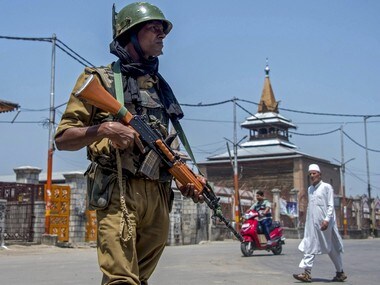
Representational image. PTI[/caption]This led to the signing of the ‘instrument of accession’ between Singh and then prime minister Jawaharlal Nehru on 26 October, 1947. It was accepted by the then Governor General of India Lord Mountbatten on 27 October.This accession was legally valid as the Indian Independence Act of 1947, which was signed by both India and Pakistan, gave sovereignty of the state to Maharaja Hari Singh after the lapse of British paramountcy and Singh could make his sovereign decisions.The US representative Warren Austin seconded this view in the Security Council where he said that with the accession of Jammu and Kashmir to India, this foreign sovereignty went over to India.Under this instrument of accession, Jammu and Kashmir surrendered only three subjects, which was defense, external affairs and communications to the Indian state and earned an assurance from India that the people of Jammu and Kashmir through their own constituent Assembly would draft their own constitution.In this respect an important point as highlighted by DD Basu in his magnum opus Commentary on the Constitution of India was that while allowing the people of Jammu and Kashmir to draft their own constitution it was promised that the nature and the extent of the jurisdiction of the Union of India over the state and until the decision of the constituent Assembly of the state, the Constitution of India could only provide an interim arrangement regarding the state.And from this instrument of accession and in the pursuance of the above-mentioned committeemen Article 370 was incorporated in the Constitution of India.The most important point of the instrument of accession was that its ruler and formal head Singh decided and declared that the state of Jammu and Kashmir accede to the ‘Dominion of India’ with a clear result that from here on "governor-general of India, the dominion legislature, the federal court and any other dominion authority established for the purposes of the dominion" will be legally authorised to carry out any function in respect to the state of Jammu and Kashmir, as vested in them by or under the Government of India Act, 1935.However, to retain its special status it added two important clause which states:"The terms of this my Instrument of Accession shall not be varied by any amendment of the Act or of the Indian Independence Act, 1947, unless such amendment is accepted by me by an Instrument supplementary to this Instrument."Nothing in this Instrument shall empower the Dominion Legislature to make any law for this state authorising the compulsory acquisition of land for any purpose, but I hereby undertake that should the Dominion for the purposes of a Dominion law which applies in this state deem it necessary to acquire any land, I will at their request acquire the land at their expense or if the land belongs to me transfer it to them on such terms as may be agreed, or, in default of agreement, determined by an arbitrator to be appointed by the Chief Justice Of India."

Naresh Pal Gangwar appointed higher education secretary, Vineet Joshi moved to Panchayati Raj ministry
India rejects Pakistan's 'baseless' claims at Asean, says Indus Waters Treaty to remain on hold
India successfully tests long-range 'Kusha' air defence missile system
Indian trucker arrested in US over alleged theft of $3 million worth of tungsten powder
China has dominated Myanmar’s rare earth mines — now India eyes deal to harness country’s critical minerals