


Jallikattu: Even if there is a revocation, Tamil people should ensure sport is strictly regulated
Where did this outpouring of support for jallikattu among Tamil Nadu’s youngsters come from?

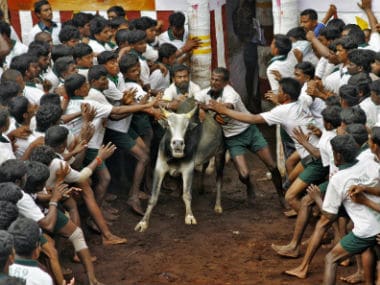
The protests against ban on jallikattu have taken the form of a fight for Tamil pride. Reuters[/caption]Jallikattu, or Yeru Thazhuvuthal (which literally translates to ‘bull embrace’) as it is traditionally known, finds mention in Sangam literature, which dates back to as early as 200 BC. According to legend, an arena, usually the biggest open space in the village, would be designated for the sport to be played, and a makeshift entrance, or Vaadi Vaasal, would be marked out for both the bulls, which were decorated and garlanded like heroes going into battle, and for their owners, who would stand in line with them. The bulls were then released, one by one, into the field, where (willing) young men would grapple in their attempt to tame the beast by grabbing its hump—they either successfully managed to hang on for dear life, or they were simply tossed around like banana peels, bouncing off the bulls’ spines.Traditionally, Jallikattu was played to judge a man’s virility; it was seen as a way to win a woman’s hand in marriage. The men who held on to the bulls which were reared by the object of their affections were adjudged winners. Generations later, the game continues to be about virility, albeit of the bull’s – modern day Jallikattu is played by the agrarian communities in Tamil Nadu to locate and handpick the strongest, most ferocious bulls as sires for their cows and in turn, produce high quality calves. The sport, in its latter form, has remained alive now for thousands of years.As a result, the protestors believe their outrage is only natural, given jallikattu’s long association with Tamil history, and given that the ban, at least in some senses, was initiated by the activism of a foreign organisation, in this case, Peta.Even if only a cross section of protestors have actually witnessed Jallikattu by virtue of being raised in towns where the event was held, all of them feel that the sport forms a strong part of their identity as Tamils – an identity that they’re not willing to give up. Popular Tamil YouTube star Rajmohan, who is part of the channel Put Chutney, released a video a few weeks ago, with an appeal to the youth of the state to rise against the ban, calling the sport the birthright of Tamils. Plenty of memes and posters supporting jallikattu have since surfaced on social media. Jallikattu as an issue that goes beyond mere identity. It is also a sport that is practiced by the farmers of the state, for what they see as their own futures. When a male calf is born, it is usually castrated around adolescence to serve as a draught animal, or for use in bullock carts. Given the industrialisation of farming today, there is no real use for a bullock to plough fields when tractors can do the job with far greater efficiency in half the time. As a result, these days, most male calves are sold, either to the leather industry, or to the meat industry. More and more farmers are taking to artificial insemination, resulting in native breeds slowly being wiped out.Jallikattu, the argument goes, sees native male bulls being raised for the sole purpose of breeding, and therefore works as an effective way to conserve the native breeds of the region. If jallikattu is banned, it will only be a matter of time before the native breeds of cow go extinct. Much has been written and shared about the side effects of A1 milk (produced by Jersey cows) and the benefits of A2 milk (produced by native breeds), with the conspiracy theory that the reason Peta even wanted the ban was to wipe the native breeds off the map and propagate the European and American breeds in India. It must be said though, that the anger against Peta is misplaced, for the organisation has cases pending against all varieties of animal abuse, and not just jallikattu. The Supreme Court, in its judgement banning Jallikattu, goes into great detail about the torture that the bulls are meted out during play – instances of lemons being squeezed into the bulls’ eyes to blind them, chilli powder rubbed on to their genitals, bulls being fed liquor and even cases of the animal having its tail bitten. While there might be more than a kernel of truth in these claims, and while such practices are indeed inhumane and deserving of the greatest condemnation, the argument made by the protestors is that jallikattu, unlike the matador style taming of the bulls (which involves deliberate maiming and killing) wasn’t designed to be cruel. The bulls, for the most part, they say, are considered to be animals of the temple, and are revered and worshipped. Therefore, in their belief, the Supreme Court could have been more measured in its approach, by placing stricter regulations on how the sport ought to he played, as opposed to an outright ban, which, to them, hits at the heart of the state’s cultures and traditions.Today, even as the campaigners march, the chief minister O Paneerselvam is scheduled to meet the Prime Minister, making a request for an ordinance from the central government that would lift the ban on Jalllikattu.It is still unsure as to what the result will be, and whether these protests, which only seem to intensify, will have any fruition. However, if there is a revocation, it is the responsibility of not only the state government but also the Tamil people, to ensure that the sport is strictly regulated to prevent any and all kinds of cruelty to the bulls, and to take up the cause of native breeds independent of this tradition.

Indian trucker arrested in US over alleged theft of $3 million worth of tungsten powder
China has dominated Myanmar’s rare earth mines — now India eyes deal to harness country’s critical minerals
CJP protest in Delhi: New videos of stone pelting, violence emerge as police, agitators trade charges
'From make in India to launch from India': Skyroot COO on why Vikram-1 could change India’s space sector
Choke terror funding, keep international shipping lanes safe: Jaishankar at Asean Regional Forum