
Advertisement


Sections
India successfully flight-tests indigenously-made Man Portable Antitank Guided Missile in Kurnool; all you need to know
DRDO successfully flight tested an indigenously-developed low weight, fire and forget, Man Portable Antitank Guided Missile (MPATGM) from Andhra Pradesh's Kurnool

The Defence Research and Development Organisation (DRDO) successfully flight tested an indigenously-developed low weight, fire and forget, Man Portable Antitank Guided Missile (MPATGM) from Andhra Pradesh's Kurnool, in a major boost to India's indigenous missile development programme on 11 September.This was the third successful test-firing of the 100 percent indigenous ATGM which is being developed for the infantry battalions of the Indian Army who would use them for taking out the enemy tank and other armoured vehicles during war times.Buoyed by the success of the missile test-firing, DRDO chairman G Satheesh Reddy told ANI that it was a major success for the missile project and India has become self-reliant in the field of anti-tank guided missiles."Defence Research and Development Organisation (DRDO) today successfully flight tested indigenously developed low weight, fire and forget MPATGM. The missile was launched from a man-portable tripod launcher and the target was mimicking a functional tank," said defence ministry spokesperson Bharat Bhushan Babu."The missile hit the target in top attack mode and destroyed it with precision. All the mission objectives were met," he added.What is MPATGM?This is third-generation anti-tank guided missile (ATGM), that has been developed indigenously by DRDO in partnership with VEM technologies Ltd.[caption id="attachment_7328381" align="alignleft" width="380"]![India on Wednesday successfully test-fired the man-portable Anti Tank Guided Missile (MP-ATGM) from a firing range in Andhra Pradesh. ANI]() India successfully test-fired the man-portable Anti Tank Guided Missile (MP-ATGM) in Andhra Pradesh. ANI[/caption]It comes with a high-explosive anti-tank (HEAT) warhead. The missile is incorporated with state-of-the-art Infrared Imaging Seeker along with advanced avionics.According to The Financial Express, the strike range of this missile is of 2.5 kilometres and weighs around 14.5 kilograms, a feature that is critical to maintain portability. It has the capability to be fired from shoulder and can be used during the day and night.The missile is expected to be deployed to the infantry and parachute battalions of Indian Army.India had started working on MPATGM back in 2005. The first trial of the MPATGM was conducted on 15 September 2018, and second on 16 September 2018.In 2019, the DRDO test-fired this missile for the first time on 13 March and the second test was conducted on 14 March in the Rajasthan desert, say reports.The test paves the way for the Army to have developed third-generation man-portable ATGM indigenously, the defence ministry spokesperson said.What missile is the army currently using?Currently, the Indian Army uses the imported Milan 2T and Konkurs Russian anti-tank missile in the infantry but they are vintage missiles and the force is looking for a third-generation ATGM.The Army recently had proposed to buy 3,000 Milan 2T ATGMs as a stopgap arrangement.The Indian Army requires around 70,000 ATGMs of various types and around 850 launchers of different types. It is planning to procure third-generation ATGMs with a longer range than that of its existing Milan-2T and Konkurs ATGMs.Army chief General Bipin Rawat has also provided full backing and support to the indigenisation efforts of the force.Last year, the government had decided to scrap a programme to buy the Spike ATGM from Israel keeping in mind the development made by DRDO in this regard.With inputs from ANI
India successfully test-fired the man-portable Anti Tank Guided Missile (MP-ATGM) in Andhra Pradesh. ANI[/caption]It comes with a high-explosive anti-tank (HEAT) warhead. The missile is incorporated with state-of-the-art Infrared Imaging Seeker along with advanced avionics.According to The Financial Express, the strike range of this missile is of 2.5 kilometres and weighs around 14.5 kilograms, a feature that is critical to maintain portability. It has the capability to be fired from shoulder and can be used during the day and night.The missile is expected to be deployed to the infantry and parachute battalions of Indian Army.India had started working on MPATGM back in 2005. The first trial of the MPATGM was conducted on 15 September 2018, and second on 16 September 2018.In 2019, the DRDO test-fired this missile for the first time on 13 March and the second test was conducted on 14 March in the Rajasthan desert, say reports.The test paves the way for the Army to have developed third-generation man-portable ATGM indigenously, the defence ministry spokesperson said.What missile is the army currently using?Currently, the Indian Army uses the imported Milan 2T and Konkurs Russian anti-tank missile in the infantry but they are vintage missiles and the force is looking for a third-generation ATGM.The Army recently had proposed to buy 3,000 Milan 2T ATGMs as a stopgap arrangement.The Indian Army requires around 70,000 ATGMs of various types and around 850 launchers of different types. It is planning to procure third-generation ATGMs with a longer range than that of its existing Milan-2T and Konkurs ATGMs.Army chief General Bipin Rawat has also provided full backing and support to the indigenisation efforts of the force.Last year, the government had decided to scrap a programme to buy the Spike ATGM from Israel keeping in mind the development made by DRDO in this regard.With inputs from ANI
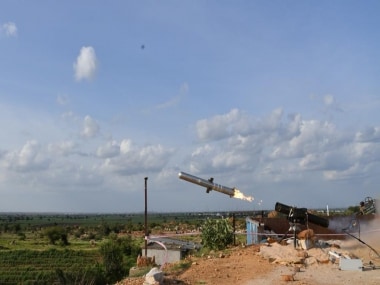 India successfully test-fired the man-portable Anti Tank Guided Missile (MP-ATGM) in Andhra Pradesh. ANI[/caption]It comes with a high-explosive anti-tank (HEAT) warhead. The missile is incorporated with state-of-the-art Infrared Imaging Seeker along with advanced avionics.According to The Financial Express, the strike range of this missile is of 2.5 kilometres and weighs around 14.5 kilograms, a feature that is critical to maintain portability. It has the capability to be fired from shoulder and can be used during the day and night.The missile is expected to be deployed to the infantry and parachute battalions of Indian Army.India had started working on MPATGM back in 2005. The first trial of the MPATGM was conducted on 15 September 2018, and second on 16 September 2018.In 2019, the DRDO test-fired this missile for the first time on 13 March and the second test was conducted on 14 March in the Rajasthan desert, say reports.The test paves the way for the Army to have developed third-generation man-portable ATGM indigenously, the defence ministry spokesperson said.What missile is the army currently using?Currently, the Indian Army uses the imported Milan 2T and Konkurs Russian anti-tank missile in the infantry but they are vintage missiles and the force is looking for a third-generation ATGM.The Army recently had proposed to buy 3,000 Milan 2T ATGMs as a stopgap arrangement.The Indian Army requires around 70,000 ATGMs of various types and around 850 launchers of different types. It is planning to procure third-generation ATGMs with a longer range than that of its existing Milan-2T and Konkurs ATGMs.Army chief General Bipin Rawat has also provided full backing and support to the indigenisation efforts of the force.Last year, the government had decided to scrap a programme to buy the Spike ATGM from Israel keeping in mind the development made by DRDO in this regard.With inputs from ANI
First Published:Sep 12, 2019, 13:13:31 IST
Advertisement
Advertisement

India successfully tests long-range 'Kusha' air defence missile system
The DRDO-developed 'Kusha' missile system can engage fighter aircraft, missiles, drones and large enemy aircraft, marking a significant milestone in India's indigenous long-range air defence programme.
1 min read
Indian trucker arrested in US over alleged theft of $3 million worth of tungsten powder
A 39-year-old Indian national living illegally in the US has been arrested in California after authorities alleged he stole a truck carrying nearly $3 million worth of hazardous tungsten powder.
1 min read
China has dominated Myanmar’s rare earth mines — now India eyes deal to harness country’s critical minerals
India is deepening rare earth cooperation with Myanmar as New Delhi seeks alternative sources of critical minerals dominated by China, including dysprosium and terbium used in EVs, defence systems and clean energy technologies
6 min read
CJP protest in Delhi: New videos of stone pelting, violence emerge as police, agitators trade charges
Fresh videos of violence that broke out during the Cockroach Janta Party's (CJP) protest in Delhi have surfaced, with the police releasing footage showing alleged stone pelting, vandalism and attacks on security personnel
3 min read
'From make in India to launch from India': Skyroot COO on why Vikram-1 could change India’s space sector
Skyroot Aerospace’s successful Vikram-1 mission marks a major milestone for India’s private space sector, as the country seeks to shift from “Make in India” to “Launch from India” and compete in the global commercial satellite launch market
8 min read
Advertisement
Advertisement