


India gets first Lokpal: Whether ombudsman will bring in change or be restricted to optics remains a question
With the appointment of former SC judge Pinaki Chandra Ghose as country’s first Lokpal, it will be interesting to see what tangible changes it can lead to or will it remain good for optics alone

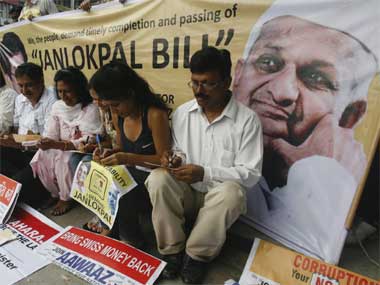
India got its first Lokpal on 19 March, eight years after Anna Hazare launched an anti-corruption movement. Reuters[/caption]It was on 17 January, hearing a contempt petition filed by NGO Common Cause against the government for delaying the appointment of the Lokpal that the Supreme Court asked the search committee on Lokpal to shortlist and recommend by February-end a panel of names for appointing the country’s first Lokpal.The ‘Chequered’ HistoryPolitical establishments cutting across ideologies lacked the will and intent to appoint a constitutional ombudsman, as it took a civil society movement, started in 2011 to compel the government to enact legislation for establishing the office of the Lokpal.The Bill was passed by the Lok Sabha after it agreed to the amendments made by the Rajya Sabha, the Upper House of the parliament, on 18 December, 2013, and got the assent of the President of India on 1 January, 2014, to become an Act. However, it could achieve its desired destination only after five years. President Ram Nath Kovind appointed on Tuesday, former Supreme Court Justice Pinaki Chandra Ghose as country’s first Lokpal and other judicial members of the body, which includes serving Chief Justice of the Chhattisgarh High Court Ajay Kumar Tripathi.The other judicial members are former Chief Justice of the Allahabad High Court, Justice Dilip Bhosale; former Chief Justice of the Jharkhand High Court, Justice PK Mohanty; and former Manipur High Court Chief Justice Abhilasha Kumari.The selection of the Lokpal and members have been done by a Selection Committee led by Prime Minister Narendra Modi and comprising Chief Justice Ranjan Gogoi, Lok Sabha Speaker Sumitra Mahajan and former Attorney General Mukul Rohatgi.The five longs decades that marked the struggle for enacting the Lokpal Bill was marked with numerous corruption cases in the highest echelons of powers, with two cases where the prime minister of the country was directly accused of corruption.While a legal and institutional framework existed to redress citizen grievances in the form of strong laws, commissions, and Lokayuktas in the state, what was lacking was an institution that could make the mightiest accountable.Five years before the first Lokpal bill was introduced in the Lok Sabha for creating the office of Lokpal in 1968 on 3 April 1963, Member of Parliament LM Singhvi while participating in the discussion in the Lok Sabha, stressed the need for setting up of an ombudsman for tackling corruption and redressal of public grievances. According to Compendium on Parliamentary Enactments, the terms Lokpal and Lokayukta were also coined by Singhvi.ARC and NCRWC recommendationsAnother precursor to the first Lokpal bill was the first Administrative Reforms Commission (ARC) of 1966 that too recommended two-tier machinery to redress the grievances of the public – Lokpal and Lokayukta. Apart from the first ARC and the Parliamentary Committees, the second ARC and the National Commission to Review the Working of the Constitution, 2002 (NCRWC) also made strong recommendations regarding the office of Lokpal.Lokpal: The OmbudsmanThe strength of the Lokpal Act lies in the fact that the act brought the Prime Minister of India under the purview of the Lokpal which means that it will have the power to deal with corruption allegations against the serving and former prime minister or a Union minister along with the top brass of civil services and central government employees in Groups A, B, C and D categories.To ensure the independence and autonomy of the Lokpal, it has been provisioned that it will have its own inquiry wing and prosecution wing, and will have the power to supervise investigations by the CBI. The Act has provisions for the establishment of special courts for trying offences. Also, the Lokpal will have the power of superintendence and direction over any investigative agency including CBI for cases referred to them by the ombudsman.Eight years ago, the Anna Hazare-led anti-corruption movement was propelled by a slew of corruption charges against then Congress-led UPA government. The movement made Lokpal a household term. It was touted as the cure of all maladies that was affecting the country’s progress adversely. And now with the appointment of the first Lokpal, it will be interesting to see what tangible changes it can lead to or will it remain good for optics alone.

China has dominated Myanmar’s rare earth mines — now India eyes deal to harness country’s critical minerals
CJP protest in Delhi: New videos of stone pelting, violence emerge as police, agitators trade charges
'From make in India to launch from India': Skyroot COO on why Vikram-1 could change India’s space sector
Choke terror funding, keep international shipping lanes safe: Jaishankar at Asean Regional Forum
PM Modi announces fast-track courts for paper leak cases; CJP responds ‘Dharmendra Pradhan must go’