


India divided over Rohingya crisis but deportation could violate both international and domestic law
As the plight of the Rohingya people goes from bad to worse, opinions in India are divided over how it should treat the refugees.

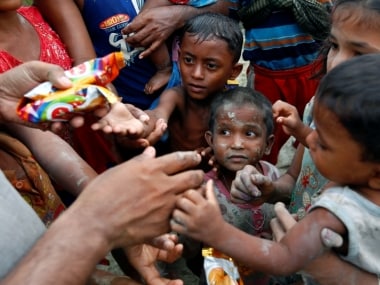
The Rohingyas are fleeing human rights violations in Myanmar. Reuters[/caption]The BBC believes that the reason for government's stand could be to cultivate a good relationship with Myanmar's army officials. It then hopes to enlist their help in acting against militants in India's northeast, many of whom are based in Myanmar's Sagaing jungles.Myanmar is also important to India for other reasons which have been detailed by Firstpost earlier.Many in India support deportationThe State thus seems fairly satisfied with its approach in sending back people to a place where they clearly fear for their lives. But where the government is at least looking to follow due process, there are others who are not quite so civil.Hindutva firebrand leader Sadhvi Prachi for one believes that the Rohingyas are "worse than Islamic State" and the "most fanatical group of people that no country wants", reported The Times of India. She went on to question that why they should be given shelter in India when they could go toShe went on to question why they should be given shelter in India when they could go to any one of dozens of Muslim-majority countries. She advocated strict action against them and opined that they must be "picked up with tongs and thrown out of the country".On the international stage too, India has been wary of condemning the violence against the Rohingyas. On Thursday, it refused to be a part of a declaration which was adopted at the World Parliamentary Forum on Sustainable Development as it had a reference to the violence, said an NDTV report. An Indian parliamentary delegation, led by Lok Sabha speaker Sumitra Mahajan, dissociated itself from the Bali Declaration adopted at the forum as it felt that the reference to the violence in Rakhine state was inappropriate.Rohingyas find support in some pocketsThe Jamiat Ulama-I-Hind (JUH) has urged world powers to take immediate steps to stop the violence, according to The Times of India. In a statement, it urged the United Nations to convene a Security Council meeting to set a deadline for Myanmar to change its attitude. It also urged the Indian government to treat humanely the Rohingyas who have been forced to take asylum in India.The CPM too has expressed a non-deportation stance towards the Rohingyas as it said that they should be treated as refugees and not be pushed back or deported. The party also said that the government should work with Myanmar and Bangladesh to resolve the issue. "The expectations that Prime Minister Narendra Modi during his visit to Myanmar would take up the issue of Rohingyas was belied. Unfortunately, the issue... did not find place in the talks between the Indian prime minister and the Myanmar leaders," it said in a statement.The National Human Rights Commission (NHRC) for its part has issued a notice to the Centre over the deportation plan. The NHRC said that the country has evolved a practical balance between human and humanitarian obligations on the one hand and security and national interest on the other. Stating that "India has been home to refugees, for centuries", the Commission held that from the human rights angle, its "intervention is appropriate" in the matter.The Supreme Court has already agreed to hear a plea challenging the decision to deport illegal Rohingya Muslim immigrants back to Myanmar, on various grounds including that it violated international human rights conventions. The plea was filed by two Rohingya immigrants who that they were facing persecution in Myanmar and that the decision to send them back was in violation of various international conventions. The court has asked the government's stand on the petition who is expected to reiterate its stand favouring eviction of Rohingya settlers.Deportation could mean violation of both international and domestic lawFirstpost had earlier pointed out that India has always welcomed immigrants and refugees. The Syrian Christians who fled persecution found a safe home here. As did the Malabar Jews. A few years later, the Baghdadi Jews followed and so did the Parsis of Iran. Deporting the Rohingyas would be a departure from this humane tradition that the Indian State has followed.Further, there are logistical hurdles too as India will have to figure out where it will deport them. These refugees face a very real risk of violence if they return to Myanmar. India could then risk infringing the principle of non-refoulement which says that States cannot expel, deport, or return refugees to the territories in which a refugee has a well-founded fear of being persecuted; faces a real risk of torture, cruel, inhuman or degrading treatment; or faces other threats to life, physical integrity or liberty.Governing a country is an exercise in balancing the interests of various people. While some of these interests are high on the government's priority list, others can fall by the wayside. In the case of the Rohingyas, the Indian government seems keen to wash its hands of them. In doing so it could very well violate international law as well as potentially the rights given by the Indian Constitution.With inputs from agencies

NEET protest: Sonam Wangchuk ends hunger strike after talks with JP Nadda, Jitendra Singh
Pakistan-based social media handles active during Op Sindoor spreading rumours amid NEET protest: Police
PM Modi says stricter action against paper leaks to be announced at Friday's Cabinet meeting
NEET protest: CJP delegation to meet ministers on Friday, sources say
Naresh Pal Gangwar appointed higher education secretary, Vineet Joshi moved to Panchayati Raj ministry