


Holi 2017: As we celebrate, let's remember its history and acknowledge our sense of community
The earth dons a riot of colours, the mango trees seem to drown under the weight of their tender blossoms, the rabi crop is ready to be harvested, the sounds of the chirping of birds fills the salubrious air…Vasanta Ritu(spring – the king of festivals as per Indian tradition) has graced the land in full glory.

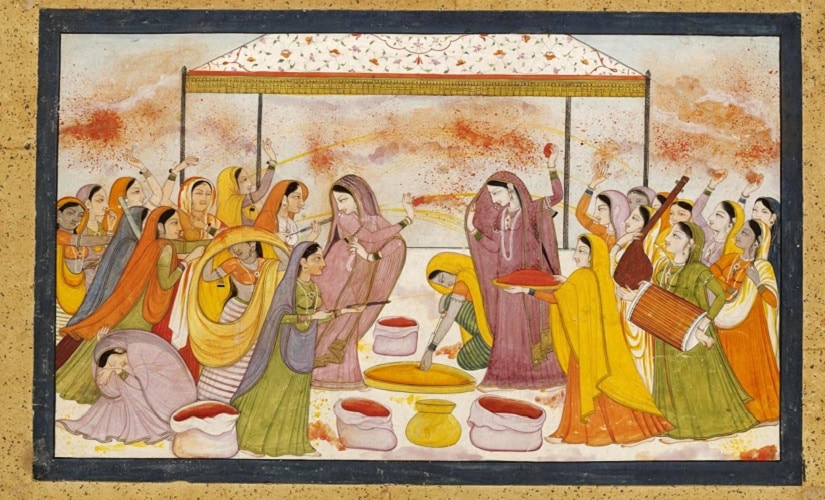
Women Playing Holi – 18th Century, Kangra Image Courtesy: Victoria and Albert Museum[/caption]One of the more popular stories is that Holika Dahan (burning of the Holi fire) is reminiscent of the burning of Holika, the devil, signifying the triumph of good over evil. Holika, at the behest of her brother, Hiranyakashyap, was trying to burn her little nephew Prahlad in a fire that finally consumed her.The story goes thus: Hiranayakashap’s son Prahlad was an ardent devotee of Lord Vishnu and refused to accept his father’s claims that he was more powerful than Vishnu himself. It is also said that astrologers had prophesied that Prahlad would be the cause of his evil father’s death and hence his father wanted to get rid of him.The king told Holika to take Prahlad into her lap and enter the fire. Holika was a powerful demon and would be protected from the fire.However, Lord Vishnu came to the aid of Prahlad and Holika was burnt in the fire. Even today, a small log of wood is removed from the fire before it is lit as a symbol of Prahlad – the good that survived against all odds.We will narrate one more story here on Holi, which has been adapted from the Bhavishyottara Purana and is a beautiful extended metaphor of the festival. It is said that when King Raghu was ruling Ayodhya, a demoness named Dhendha (daughter of Malina – dirty, unclean) infested the city.The people of Ayodhya gathered wood, lumps of dried cow-dung and dried leaves and heaped them in a decorated enclosure. The heap was set on fire and people danced around the fire singing, laughing and abusing Dhendha. Unable to bear the abuse, Dhendha jumped in the fire and perished, thus purifying Ayodhya.Guru Gobind Singhji built on the festival, adding a martial colour to it when he instituted Hola Mahalla at Anandpur Sahib. Hola Mahalla involves mock fights that display martial prowess and bravery, poetry contests, singing kirtans and remembering the Ik Onkar.Since Holi is also an agrarian celebration; in many parts of the country, sugarcane and the tender sprigs of new barley are offered to the fire. The roasted barley is distributed as prasad on the next day (it is referred to as Hola). Holi has a unique local and folk idiom to it.While in parts of popular imagination, Holi is synonymous with Bollywood songs; it is the traditional folk music and songs in India’s innumerable dialects that weave into the rich tapestry of our colourful culture. And it is not just folk songs; Holi is Holi because of the local food (thandai, ghujiyas, the list goes on) and because of our poets and artists who could not stop extolling the festival and the season.And while we extol Holi, it is pertinent to take a few moments to discuss the unholy that is forcefully finding its way into Holi celebrations and the malina (dirty) in a celebration of purity. Holi is inextricably linked to nature and there is absolutely nothing that suggests that healthy trees should be felled to set up Holikas that are bigger or that a Holika needs to be burnt at every nook and corner.The tradition (the extended metaphor quoted above) suggests the opposite. As mentioned earlier, Holi is also linked to love. It is however, not linked to harassment and not linked to the undignified. Holi is not an excuse for crossing the boundaries of propriety and it is incumbent upon us to stop any transgression under the garb of this festival.Holi is a community celebration. As the colours of Holi and the infinite colours of nature come together to form a breathtaking kaleidoscope; different human beings across meaningless distinctions created by us come together to form the kaleidoscope of our nation in specific and the earth in general. And lest we forget, Holi essentially celebrates our dependence on mother nature and her bounty.References:1. Raghavan, V (1979). Festivals, Sports and Pastimes of India. AhmedabadGarima is an independent business consultant, mentors startups and is an Indic Studies enthusiast.
Garima is an independent business and strategy consultant and mentors startups. In her corporate avatar, she spent 15+ years in various leadership roles at Capital18 (Network18), Topperlearning, Citi and TAS (Tata Administrative Services). An Indic Studies enthusiast, she can be reached at garima.c@hotmail.com. LinkedIn page: https://in.linkedin.com/in/garimac

CJP Protest in Delhi Live Updates: Heavy security deployed in Jantar Mantar ahead of student protests
Bharat Forge, Flying Whales sign pact to develop 60-tonne airships for India’s defence logistics
Air India to cut Delhi-Toronto flight time by 3 hours, resume non-stop services from August 1
J&K cop on Amarnath Yatra duty shot dead in Anantnag terror attack; TRF claims responsibility
Jaishankar meets Canada's Anita Anand, discusses bilateral cooperation and shared interests