


Fuelled by new tech, Narendra Modi leads new media charge, as traditional media turns increasingly redundant
Prime Minister Narendra Modi has been using a host of unconventional channels of communication to reach out to the masses and deliver his message

Nostalgia is often nothing more than self-indulgence that provokes grandeurs of delusion. That holds true for the conventional media which had assumed for itself the role of the only channel to conduct the political discourse.That assumption was captured well by Arthur Miller, the great American playwright, when he said a great newspaper is a nation talking to itself — a line that many papers proudly proclaimed over their mastheads. The media called itself the Fourth Estate, the very soul of democracy. Newspaper editors claimed to be holding the second-most important job in the country, imagining that they were shaping and influencing the people’s opinion on the great challenges facing the nation.Suffering from this delusion, the conventional media ignored the warning signals coming from technology, which was rapidly opening up other channels of communication. And around a decade or more into the new era, it continues to bury its head in the sand, blissfully ignorant of its redundancy while the nation prefers to talk to itself through a variety of new mediums and platforms.Nothing illustrates it more clearly than the manner in which Prime Minister Narendra Modi has been using a host of unconventional channels of communication to reach out to the masses and deliver his message. Of late, he has used technology to talk directly with farmers, beneficiaries of the central schemes and upcoming entrepreneurs of Digital India. The ease with which his audiences, largely comprising common people, have been interacting with the country’s top political executive is fascinatingly effective. It is altogether an innovative way of establishing connect between the ruler and the ruled.[caption id="attachment_1504211" align="alignleft" width="380"]
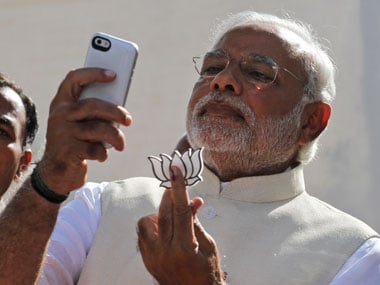
File image of Narendra Modi. AP[/caption]Granted that much of the discussion happens in a controlled environment, but its positives cannot be ignored when an ordinary woman in Raipur gets a chance to speak directly to the prime minister and narrate her entrepreneurial journey. Similarly, farmers sitting in the remotest parts of the country get connected with the prime minister via 50,000-odd common services centres (CSEs) spread across the entire country. In one go, he reaches out to millions through his NaMo app apart from his social media platforms. Meanwhile, the conventional media is yet to wake up to the irony of the fact that it has to go these sources for the news for the day.Modi's lively interactions with hoi polloi do create the impression of a frank and open political dialogue directly with people who matter in electoral terms. Not only commoners, even to talk with la crème de la crème of society, old media is hardly the preferred mode of communication. Take for instance the closed-door meeting the prime minister had with the top chief executive officers (CEOs) of Corporate India in Mumbai in which he explained his government’s economic policies to them and sought their feedback face-to-face — which would ensure no nuances are lost in transmission. He directly communicated with corporate honchos to let them know about the government’s expectations of them and the road ahead. And there is something unique about this changing mode of communication that is adopted by commoners and the ruling elites alike. It paves the way for two-way communication which empowers the less privileged.This has grossly marginalised conventional media that prided itself on having the privilege of exclusive access to corridors of power. The fact that a communicator could create an interactive platform to send and receive messages with the whole nation demonstrates the redundancy of the traditional media that thrived on its supposed connect at least with the elite. That is the precisely the reason most media interviews conducted with the country’s top leaders, irrespective of their domains, mostly conform to PR exercises.Although people still love to watch the irreverent and probing inquisition of Indira Gandhi by a BBC journalist in the post-Emergency phase, that model of journalism is hardly relevant now. People no longer need an intermediary to convey their messages to the top. In the age of social media, a victim of discrimination at the regional passport office (RPO) in Lucknow could get access to Minister of External Affairs Sushma Swaraj and get her grievances addressed. In the process, Swaraj could get trolled by people with an antediluvian mindset and significant weight in numerical terms. That exposes the hideous face of society and a stark reality. This entire exercise is conducted without involvement of a conventional media as a channel of communication, even though it triggered a political debate.Gone are the days when the traditional format of journalism like interviews or TV debates was considered the effective platforms to conduct politics for leaders. If you have any doubt, look at Arun Jaitley who has been using Facebook posts to disseminate his views on political matters. In terms of reach, this is far more efficient way than writing an op-ed or holding a press conference. In any case, the old media has to willy-nilly report his views next day. Even those less visible on social media platforms compared to top leaders find conventional tools of journalism nothing but a means to promote their career till they reach the top. The media's fabled access to newsmakers and its unique position to carry the message from the top are grossly undermined.This development should not surprise anybody when the list of top 10 richest people does not have any old media baron, and instead had as three tech czars at the very top (Jeff Bezos, Bill Gates, Mark Zuckerberg). Bezos' acquisition of The Washington Post should summarise the whole new paradigm.
Modi was ahead of the curve in setting the agenda in the new communication age. His interactions with various social groups through social network platforms emerged as the most powerful medium of communication. Even in his days as Chief Minister of Gujarat, Modi used technological tools and conveyed his messages directly to people, over the heads of the conventional media like print and TV networks.No doubt, his messaging proved to be far more effective than the conventional media's rants. His evaluation of the media's capability can be gauged by the fact that in his new role, he has discontinued the practice of taking journalists along on the prime minister's foreign tours which a select bunch of scribes used to consider their entitlement.Of course, no tears need be shed on this gross marginalisation of the conventional media. As technology bridges the psychological distance between the leaders and the led, the conventional media can no longer hold on to its self-indulgent nostalgia as a mirror for the future. The credit will go to Modi for expediting this course correction. Perhaps a rephrasing of "A quick brown fox…" will be in order to evolve an effective conventional media.

No premium queues, 30-minute target: What changes for Indian passport applicants in UAE
CJP Protest in Delhi Live Updates: Heavy security deployed in Jantar Mantar ahead of student protests
Bharat Forge, Flying Whales sign pact to develop 60-tonne airships for India’s defence logistics
Air India to cut Delhi-Toronto flight time by 3 hours, resume non-stop services from August 1
J&K cop on Amarnath Yatra duty shot dead in Anantnag terror attack; TRF claims responsibility