
Advertisement


Sections
Former Jammu and Kashmir interlocutor vouches for third party intervention in Valley, wants Centre to fulfil aspirations of people forthwith
The government is however prepared for the long haul and would not relax its grip until a peaceful situation prevails, which is unlikely in the foreseeable future owing largely to lack of political engagement with mainstream political parties.

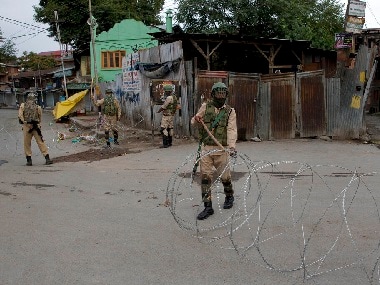
Unilateral revocation of Article 370 of the Constitution of India to withdraw Jammu and Kashmir’s status and its bifurcation into two Union Territories has increased tensions between India and Pakistan. People in the Kashmir Valley feel nearly alienated and it won't be easy for the Centre to win back their confidence as they feel betrayed.The shutdown of the internet and telecommunication network are considered inconsistent with fundamental rights, which is why UN human rights experts have called on the Government of India to end the crackdown on freedom of expression, access to information and peaceful protests prohibited in Kashmir. They have said, "The blackout is a form of collective punishment of people of J&K, without even a pretext of a precipitating offence."[caption id="attachment_7183421" align="alignleft" width="380"]![Paramilitary soldiers prepare to block a road with barbed wires during security lockdown in Srinagar, Kashmir last week. AP]() Paramilitary soldiers prepare to block a road with barbed wires during security lockdown in Srinagar, Kashmir last week. AP[/caption]UN Secretary-General, Antonio Guterres has reiterated his earlier stance suggesting a dialogue between India and Pakistan to resolve all the contentious issues.The government is however prepared for the long haul and would not relax its grip until a peaceful situation prevails, which is unlikely in the foreseeable future owing largely to lack of political engagement with mainstream political parties.Clearly, turmoil in Kashmir and stalemate between the two neighbours will continue, which poses a grave threat to worsening security situation in the region, especially at the time when India’s economy is facing a severe crisis on several fronts, such as export promotion, a slowdown in the manufacturing sector and lack of jobs.At this juncture, the focus of policy planning has to be on reviving domestic economy rather than provoking people in Jammu and Kashmir to be on the warpath for protecting their human rights and dignity. The army and security forces ought not to be engaged in fighting its own people who have willingly accepted the Instrument of Accession to be a part of India. A short term political gain ought not to drive us away from the long term goal of making India an enlightened and prosperous country.In this backdrop, the options that may be exercised to reduce tensions by resolving disputes between India and Pakistan, which may, in turn, ensure restoration of sustainable peace in Jammu and Kashmir. While the imminent threat of extremism and terrorism that are allegedly sponsored by Pakistan would be contained, the policy focus on fixing the domestic economy would yield desirable results.The Centre’s aim of revoking Article 370 is to have direct control over the police, along with paramilitary forces, to strengthen the security grid. But it will not succeed in containing indigenous uprising and militancy, because almost every Kashmiri is willing to pick up arms.The successive generations of Kashmiris they have been deceived in the garb of Article 370, which has been eroded over time and finally revoked. The manner in which it has been done with the massive support of Parliament, any worthwhile relief from the Supreme Court is not expected.Peace Accord with Kashmir: A peace accord with Kashmir is urgently called for by accommodating the wishes and aspirations of people, as per the framework of Insaniyat, Jamhuriat and Kashmiriat, outlined by Atal Bihari Vajpayee.India is the Union of diverse states, which is why the Constitution of India provides for considerable flexibility in accommodating their socio-cultural and ethnic identities. It was precisely for this reason that Jammu and Kashmir, North East and others have been provided constitutional protection for preserving and maintain cultural identities, demographic compositions and ethnicity.Since the decision about the dilution of Article 370 has been taken without ascertaining the wishes of Kashmiris, it may not be possible to win the hearts and minds of people for removing alienation among them. It is important therefore to make a fresh attempt to negotiate with the leaderships of Kashmir and other stakeholders to arrive at acceptable solutions to restore peace in the region.In the past, an understanding has been reached with the federating states like Punjab, Assam, Mizoram, Nagaland and others to evolve framework of political autonomy and for promoting healthy Centre-state relations. The Central government has requisite experience and expertise to accommodate the genuine aspirations of people in different parts of the country.The issue of Line of Control (LoC) could also be settled as International Border, as India did with Bangladesh. As known, India and Bangladesh amicably exchanged the enclaves as per the wishes of the people and finalised the Boarders. A similar exercise is needed to resolve outstanding border issue with Pakistan.Third-Party Mediation: Kashmir dispute has international ramification. The offer of third party mediation by friendly countries or organisations may be considered. Both the countries agreed under the Shimla Agreement:i)That the principles and purposes of the Charter of the United Nations shall govern the relations between the two countries.(ii) That the two countries are resolved to settle their differences by peaceful means through bilateral negotiations or by any other peaceful means mutually agreed upon between them.The option of a third-party mediation is open to both countries. The recent past experience shows on different pretext both the countries are unlikely to mutually engage themselves to arrive at a consensus on an acceptable solution to the Kashmir imbroglio. It is for this reason that, in the past, at least three major issues between the two countries were resolved through the third party mediations.For instance, i) Indus Waters Treaty, 1960 was mediated by the World Bank for sharing the water of the rivers that flow in India and Pakistan. Even during the wars between the two countries, the treaty was duly honoured by the two countries.
Paramilitary soldiers prepare to block a road with barbed wires during security lockdown in Srinagar, Kashmir last week. AP[/caption]UN Secretary-General, Antonio Guterres has reiterated his earlier stance suggesting a dialogue between India and Pakistan to resolve all the contentious issues.The government is however prepared for the long haul and would not relax its grip until a peaceful situation prevails, which is unlikely in the foreseeable future owing largely to lack of political engagement with mainstream political parties.Clearly, turmoil in Kashmir and stalemate between the two neighbours will continue, which poses a grave threat to worsening security situation in the region, especially at the time when India’s economy is facing a severe crisis on several fronts, such as export promotion, a slowdown in the manufacturing sector and lack of jobs.At this juncture, the focus of policy planning has to be on reviving domestic economy rather than provoking people in Jammu and Kashmir to be on the warpath for protecting their human rights and dignity. The army and security forces ought not to be engaged in fighting its own people who have willingly accepted the Instrument of Accession to be a part of India. A short term political gain ought not to drive us away from the long term goal of making India an enlightened and prosperous country.In this backdrop, the options that may be exercised to reduce tensions by resolving disputes between India and Pakistan, which may, in turn, ensure restoration of sustainable peace in Jammu and Kashmir. While the imminent threat of extremism and terrorism that are allegedly sponsored by Pakistan would be contained, the policy focus on fixing the domestic economy would yield desirable results.The Centre’s aim of revoking Article 370 is to have direct control over the police, along with paramilitary forces, to strengthen the security grid. But it will not succeed in containing indigenous uprising and militancy, because almost every Kashmiri is willing to pick up arms.The successive generations of Kashmiris they have been deceived in the garb of Article 370, which has been eroded over time and finally revoked. The manner in which it has been done with the massive support of Parliament, any worthwhile relief from the Supreme Court is not expected.Peace Accord with Kashmir: A peace accord with Kashmir is urgently called for by accommodating the wishes and aspirations of people, as per the framework of Insaniyat, Jamhuriat and Kashmiriat, outlined by Atal Bihari Vajpayee.India is the Union of diverse states, which is why the Constitution of India provides for considerable flexibility in accommodating their socio-cultural and ethnic identities. It was precisely for this reason that Jammu and Kashmir, North East and others have been provided constitutional protection for preserving and maintain cultural identities, demographic compositions and ethnicity.Since the decision about the dilution of Article 370 has been taken without ascertaining the wishes of Kashmiris, it may not be possible to win the hearts and minds of people for removing alienation among them. It is important therefore to make a fresh attempt to negotiate with the leaderships of Kashmir and other stakeholders to arrive at acceptable solutions to restore peace in the region.In the past, an understanding has been reached with the federating states like Punjab, Assam, Mizoram, Nagaland and others to evolve framework of political autonomy and for promoting healthy Centre-state relations. The Central government has requisite experience and expertise to accommodate the genuine aspirations of people in different parts of the country.The issue of Line of Control (LoC) could also be settled as International Border, as India did with Bangladesh. As known, India and Bangladesh amicably exchanged the enclaves as per the wishes of the people and finalised the Boarders. A similar exercise is needed to resolve outstanding border issue with Pakistan.Third-Party Mediation: Kashmir dispute has international ramification. The offer of third party mediation by friendly countries or organisations may be considered. Both the countries agreed under the Shimla Agreement:i)That the principles and purposes of the Charter of the United Nations shall govern the relations between the two countries.(ii) That the two countries are resolved to settle their differences by peaceful means through bilateral negotiations or by any other peaceful means mutually agreed upon between them.The option of a third-party mediation is open to both countries. The recent past experience shows on different pretext both the countries are unlikely to mutually engage themselves to arrive at a consensus on an acceptable solution to the Kashmir imbroglio. It is for this reason that, in the past, at least three major issues between the two countries were resolved through the third party mediations.For instance, i) Indus Waters Treaty, 1960 was mediated by the World Bank for sharing the water of the rivers that flow in India and Pakistan. Even during the wars between the two countries, the treaty was duly honoured by the two countries.
 Paramilitary soldiers prepare to block a road with barbed wires during security lockdown in Srinagar, Kashmir last week. AP[/caption]UN Secretary-General, Antonio Guterres has reiterated his earlier stance suggesting a dialogue between India and Pakistan to resolve all the contentious issues.The government is however prepared for the long haul and would not relax its grip until a peaceful situation prevails, which is unlikely in the foreseeable future owing largely to lack of political engagement with mainstream political parties.Clearly, turmoil in Kashmir and stalemate between the two neighbours will continue, which poses a grave threat to worsening security situation in the region, especially at the time when India’s economy is facing a severe crisis on several fronts, such as export promotion, a slowdown in the manufacturing sector and lack of jobs.At this juncture, the focus of policy planning has to be on reviving domestic economy rather than provoking people in Jammu and Kashmir to be on the warpath for protecting their human rights and dignity. The army and security forces ought not to be engaged in fighting its own people who have willingly accepted the Instrument of Accession to be a part of India. A short term political gain ought not to drive us away from the long term goal of making India an enlightened and prosperous country.In this backdrop, the options that may be exercised to reduce tensions by resolving disputes between India and Pakistan, which may, in turn, ensure restoration of sustainable peace in Jammu and Kashmir. While the imminent threat of extremism and terrorism that are allegedly sponsored by Pakistan would be contained, the policy focus on fixing the domestic economy would yield desirable results.The Centre’s aim of revoking Article 370 is to have direct control over the police, along with paramilitary forces, to strengthen the security grid. But it will not succeed in containing indigenous uprising and militancy, because almost every Kashmiri is willing to pick up arms.The successive generations of Kashmiris they have been deceived in the garb of Article 370, which has been eroded over time and finally revoked. The manner in which it has been done with the massive support of Parliament, any worthwhile relief from the Supreme Court is not expected.Peace Accord with Kashmir: A peace accord with Kashmir is urgently called for by accommodating the wishes and aspirations of people, as per the framework of Insaniyat, Jamhuriat and Kashmiriat, outlined by Atal Bihari Vajpayee.India is the Union of diverse states, which is why the Constitution of India provides for considerable flexibility in accommodating their socio-cultural and ethnic identities. It was precisely for this reason that Jammu and Kashmir, North East and others have been provided constitutional protection for preserving and maintain cultural identities, demographic compositions and ethnicity.Since the decision about the dilution of Article 370 has been taken without ascertaining the wishes of Kashmiris, it may not be possible to win the hearts and minds of people for removing alienation among them. It is important therefore to make a fresh attempt to negotiate with the leaderships of Kashmir and other stakeholders to arrive at acceptable solutions to restore peace in the region.In the past, an understanding has been reached with the federating states like Punjab, Assam, Mizoram, Nagaland and others to evolve framework of political autonomy and for promoting healthy Centre-state relations. The Central government has requisite experience and expertise to accommodate the genuine aspirations of people in different parts of the country.The issue of Line of Control (LoC) could also be settled as International Border, as India did with Bangladesh. As known, India and Bangladesh amicably exchanged the enclaves as per the wishes of the people and finalised the Boarders. A similar exercise is needed to resolve outstanding border issue with Pakistan.Third-Party Mediation: Kashmir dispute has international ramification. The offer of third party mediation by friendly countries or organisations may be considered. Both the countries agreed under the Shimla Agreement:i)That the principles and purposes of the Charter of the United Nations shall govern the relations between the two countries.(ii) That the two countries are resolved to settle their differences by peaceful means through bilateral negotiations or by any other peaceful means mutually agreed upon between them.The option of a third-party mediation is open to both countries. The recent past experience shows on different pretext both the countries are unlikely to mutually engage themselves to arrive at a consensus on an acceptable solution to the Kashmir imbroglio. It is for this reason that, in the past, at least three major issues between the two countries were resolved through the third party mediations.For instance, i) Indus Waters Treaty, 1960 was mediated by the World Bank for sharing the water of the rivers that flow in India and Pakistan. Even during the wars between the two countries, the treaty was duly honoured by the two countries.
- ii) The Tashkent Declaration, 1966 was moderated by the then Soviet premier Alexei Kosygin to give away the captured regions of each other in 1965 war and to return to the 1949 ceasefire line, so as to maintain the sanctity of LoC. This agreement was complied with by both the countries.
First Published:Aug 26, 2019, 12:34:48 IST
Advertisement
Advertisement

CJP Protest in Delhi Live Updates: Heavy security deployed in Jantar Mantar ahead of student protests
CJP Protest in Delhi Live Updates: Heavy security has been deployed at the Jantar Mantar in Delhi, where the Cockroach Janta Party (CJP) is continuing its protest demanding the resignation of Union Education Minister Dharmendra Pradhan over the recent paper leaks controversy
1 min read
Bharat Forge, Flying Whales sign pact to develop 60-tonne airships for India’s defence logistics
Bharat Forge has signed an MoU with Flying Whales to jointly develop and manufacture 60-tonne heavy-lift airships in India for defence logistics, strategic mobility and disaster response
3 min read
Air India to cut Delhi-Toronto flight time by 3 hours, resume non-stop services from August 1
Air India will resume non-stop Delhi-Toronto flights from August 1, cutting travel time by nearly three hours and deploying its new Boeing 787-9 Dreamliner on the route
2 min read
J&K cop on Amarnath Yatra duty shot dead in Anantnag terror attack; TRF claims responsibility
The Resistance Front (TRF), a shadow outfit of Lashkar-e-Taiba, claimed responsibility for the attack through a social media post
2 min read
Jaishankar meets Canada's Anita Anand, discusses bilateral cooperation and shared interests
External Affairs Minister S Jaishankar on Wednesday held talks on bilateral ties with his Canadian counterpart Anita Anand, focusing on cooperation and common goals.
1 min read
Advertisement
Advertisement