
Advertisement


Sections
Erratic monsoon patterns worsening India's water crisis and conflicts, says study; Shimla-like dry spells could recur
Not just Himachal Pradesh, many Indian states are facing acute water shortages due to shifting monsoon patterns of in the country caused by climate change.

As of 17 May, water levels in major Indian reservoirs were 10 percent lower than normal at this time of year, despite a near-normal monsoon in 2017, according to this status report released by the Central Water Commission.Rapid urban growth, increasing population, and a changing climate have made it difficult for many Indian cities to meet the water demands of the ordinary citizen, said Kangkanika Neog, a researcher at the Centre for Energy, Environment and Water (CEEW), a Delhi-based think-tank.Shifting rainfall patterns are causing water distressClimate Trends used secondary data to analyse the impact of climate change in shifting rainfall patterns in India, the repeated droughts and water shortages. Monsoon rain in the country has been below average in five of the last six years to 2018 and pre-monsoon season – from March to May – has seen 11 percent less rainfall in 2018 than the average, for the third consecutive year, the study found.[caption id="attachment_4497721" align="alignleft" width="380"]
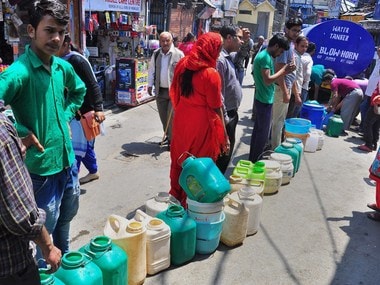 People stand in a queue to collect water from a tanker, as Shimla faces acute shortage of drinking water. PTI[/caption]These shifts are part of long-term changes in where and when rain falls in India, driven by climate change, the fact-sheet said. Some states have seen big changes in annual rainfall. For example, year-round rainfall in Chhattisgarh has fallen nearly 10 percent, while it has increased in coastal Karnataka, Punjab and Haryana, according to the fact-sheet.Monsoon rainfall has been decreasing since 1870, with rainfall outside the monsoon increasing slightly, balancing the annual average.States such as Kerala and Madhya Pradesh received less rainfall during the 2017 monsoon. The poor monsoons of 2014 and 2015 resulted in severe drought and water shortages in much of the country, including parts of Andhra Pradesh, Karnataka, Maharashtra and Telangana, the fact-sheet said.Consequently, water levels in major reservoirs at the end of the monsoon – in early October 2017 – were 11 percent below average, the fact-sheet said.Several states face shortagesLevels in major reservoirs across the country were, as we said, 10 percent below the normal at this time of the year.In Andhra Pradesh, reservoir levels were around half their normal level, and parts of the state, such as Prakasam, are facing a drinking-water crisis. The government is spending Rs 103 crore to provide emergency drinking water. This crisis is linked with water shortages in neighbouring Telangana, the fact-sheet released by Climate Trends said.In some parts of rural Chhattisgarh, wells have dried-up and people are walking many kilometres daily to fetch water.In Tamil Nadu, major reservoirs are 67 percent below normal levels – every major reservoir has below-average levels for this time of year. The state has allocated Rs 200 crore from the Disaster Relief Fund to tackle the crisis. In 2016-17, the state suffered its worst drought in over a century.For a country usually endowed with good monsoons, it's a shame that we are unable to harvest water that is made available to us and end up with a crisis situation, both in managing heavy rainfall and water scarce conditions alike, said Aarti Khosla, director, Climate Trends.Climate change has a multiplier effect and is likely to worsen in the coming years. The increasing and devastating human cost, combined with economic loss across agriculture and industry sectors caused by water shortage, could worsen if we don't manage water resources well and don't act on sharply reducing global greenhouse gas emissions, said Khosla.
 Changes in monsoon patterns would make droughts and floods more common in many parts of India. Droughts are particularly likely to become more frequent in north-western India, Jharkhand, Odisha and Chhattisgarh, according to a 2013 World Bank study.The Ganges, Brahmaputra and Meghna river basin, which serves over 650 million people, is also likely to experience both droughts and floods more often if temperatures continue to rise, according to a 2015 study published in the journal Environmental Science.Water crisis can trigger interstate and international conflictsThe water shortage in many parts of the country can fuel interstate and international conflicts in India, the fact-sheet noted. These conflicts include:
- Cauvery river dispute between Karnataka and Tamil Nadu;
- Krishna river dispute among Andhra Pradesh, Maharashtra, Karnataka and Telangana;
- Narmada river dispute among Gujarat, Madhya Pradesh and Maharashtra;
- Ravi and Beas river dispute among Haryana, Punjab and Rajasthan;
- Disputes between India and China for the water distribution of 10 major rivers originating from Tibet.
First Published:Jun 07, 2018, 11:23:32 IST
Advertisement
Advertisement

China has dominated Myanmar’s rare earth mines — now India eyes deal to harness country’s critical minerals
India is deepening rare earth cooperation with Myanmar as New Delhi seeks alternative sources of critical minerals dominated by China, including dysprosium and terbium used in EVs, defence systems and clean energy technologies
6 min read
CJP protest in Delhi: New videos of stone pelting, violence emerge as police, agitators trade charges
Fresh videos of violence that broke out during the Cockroach Janta Party's (CJP) protest in Delhi have surfaced, with the police releasing footage showing alleged stone pelting, vandalism and attacks on security personnel
3 min read
'From make in India to launch from India': Skyroot COO on why Vikram-1 could change India’s space sector
Skyroot Aerospace’s successful Vikram-1 mission marks a major milestone for India’s private space sector, as the country seeks to shift from “Make in India” to “Launch from India” and compete in the global commercial satellite launch market
8 min read
Choke terror funding, keep international shipping lanes safe: Jaishankar at Asean Regional Forum
Jaishankar's remarks came against the backdrop of recent terror attacks targeting India and growing threats to commercial shipping amid conflicts in West Asia and Europe
2 min read
PM Modi announces fast-track courts for paper leak cases; CJP responds ‘Dharmendra Pradhan must go’
Amid protests demanding accountability for the leak of medical entrance test Neet and other irregularities in the education system, Prime Minister Narendra Modi has announced that the government has decided to set up fast-track courts to ensure swift and stringent punishment for those involved in paper leaks.
3 min read
Advertisement
Advertisement