


Wrong to dismiss 'informal' Narendra Modi-Xi Jinping summit, but economics must now catch up with optics
It is necessary to understand that the 'informal' summit style set in place by Prime Minister Narendra Modi has its own set of connotations

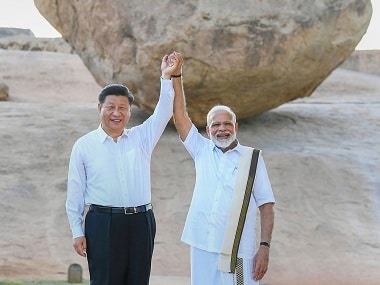
Prime Minister Narendra Modi with Chinese president Xi Jinping in Mamallapuram. PTI[/caption]Recall where that language has been used recently. Minister of External Affairs S Jaishankar in an interaction with a prominent think-tank in Washington, observed "Many of you would have heard in another country the term, a century of humiliation. India actually had two centuries of humiliation by the West…" and went on to outline the 'predatory' forms of exploitation by the West to the tune of some $45 trillion. That puzzled most listeners, since the US was hardly known to have cheered the colonialists, having been a former colony itself. But Jaishankar reference to 'another country' and its humiliation was a nod to Chinese history between 1839 and 1949. That was a signalling of a very high order indeed, with India using the China card to get its own objectives in Washington. This is what countries do, and what India didn't in earlier years. With Jaishankar at the helm, diplomatic nimbleness is now making itself felt.Then comes the core of the matter.No, it's not Pakistan whom China uses and will continue to use variably to gain its various objectives in South Asia, including the deliberate invitation to Imran Khan to visit just before the Chennai summit. Beijing also chooses to ante up the Kashmir issue — all of which are negotiating counters for more important matters. For Modi and his team, the core issue — for the present — is the economy. And with that comes the entire issue of reciprocal trade access, and related to that, the Regional Comprehensive Economic Partnership (RCEP), the mega free trade agreement between the ASEAN countries and six major partner countries including China and India.Even as Modi was waving goodbye to President Xi Jinping, trade negotiators were busy trying to hammer out an agreement in Bangkok. They failed, but will meet again next month. For India, the RCEP is also a domestic issue, with political parties demanding a separate session of Parliament to discuss the possible impact on farmers, dairy producers and a host of other manufacturers who fear an influx of Chinese goods via the RCEP. What the informal summit may have done is probably to iron out an agreement that India, being the main holdout of the RCEP — with some quiet encouragement by some ASEAN countries — will now accede to the agreement along with a bilateral protocol with China that will allay Delhi's concerns. That is the core, and it's well worth a hectoring lecture in history.Does this mean that India and China are now on the road to glorious friendship or even an uneasy peace? Probably not.Consider the joint statement between China and Nepal. Apart from the declarations of mutual esteem and respect, was that "the two sides agreed to intensify implementation of the Memorandum of Understanding on Cooperation under the Belt and Road Initiative to enhance connectivity, encompassing such vital components as ports, roads, railways, aviation and communications within the overarching framework of trans-Himalayan Multi-Dimensional Connectivity Network". Then follow details of the several projects that are already underway.That's not exactly aimed at the 'Chennai connect' objective of considering each other's 'sensitive' issues. And there's not much Delhi can do about it. Therefore, India has been wooing the US in terms of the first tri-service military exercise, the meeting of the Quad ( India, Australia, Japan US) grouping at New York recently and so on. A healthy realism — also absent in the past — has meant that Delhi is beefing up its defences along the border, as well as its capabilities.In sum therefore, the Chennai summit can certainly not to be dismissed as yet another opportunity for optics and hollow outcomes. Anyone who has played the markets will be well aware of how much optics and sentiment that arise out of such events matter. Modi has undoubtedly put India on the world stage by a series of calculated moves. It now remains for the economy to play catch up with the optics.Meanwhile, the dance between the elephant and the dragon has to ensure that neither steps heavily on the other's toes, or breathes fire for no good reason. The elephant at least has other choices.

Pakistan-based social media handles active during Op Sindoor spreading rumours amid NEET protest: Police
PM Modi says stricter action against paper leaks to be announced at Friday's Cabinet meeting
NEET protest: CJP delegation to meet ministers on Friday, sources say
Naresh Pal Gangwar appointed higher education secretary, Vineet Joshi moved to Panchayati Raj ministry
India rejects Pakistan's 'baseless' claims at Asean, says Indus Waters Treaty to remain on hold