


Despite 25,000 child deaths in 40 years, Gorakhpur lacks a comprehensive policy to fight encephalitis
Despite incessant child deaths due to encephalitis in Gorakhpur over the years, no separate comprehensive program has been initiated to fight the menace.

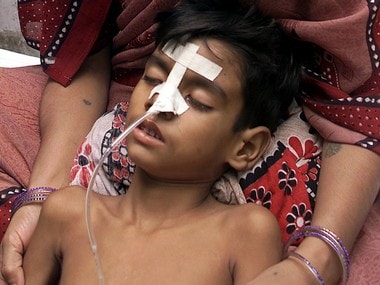
A woman comforts her child who is suffering from encephalitis at a hospital in Gorakhpur. Reuters[/caption]Rajesh Mani, Director of Manav Sewa Sansthan, Gorakhpur, told Firstpost that the efforts to fight the disease has always been curative.“Facilities of treatment were increased, but hardly any effort has been made to prevent it. As a result, the number of people getting infected rose, creating more and more pressure on the existing medical facility,” he said.He further added that past experiences have proved that only curative measures are not enough to fight the menace — a separate effort including preventive and promotive measures are also equally needed.“The earlier state government introduced 100 encephalitis treatmernt centres in Gorakhpur and Basti areas. But these centres never became effective because they failed to earn the trust of the people,” he said. He added that in most cases, the doctors were never present in the centres. In some cases, doctors would rather refer the patients to hospitals than treating themselves, even if they were present.“Many children receive treatment in dying condition. This is the reason of high fatality rates. Encephalitis needs immediate treatment,” he said. Normally, Acute Encephalitis is seen as a vector-borne disease that spreads through mosquito bites.But Dr RN Singh, a health activist in Gorakhpur, told Firstpost that contaminated water is now the main reason behind the spread of the endemic in Gorakhpur.“Earlier, we saw Japanese Encephalitis being spread by mosquito bite. But that has been prevented to a great extent by vaccination. At present, at the most, 9 percent of the encephalitis patients are afflicted with JE virus,” he said.In the years 2005 and 2010, massive vaccination drive against JE was taken was initiated in Gorakhpur, covering around 65 lakh and 75 lakh people. In 2013, the two-dose vaccine strategy was introduced, with a suggestion that the first dose (JE-1) be given between the ages of nine and 12 months, along with measles-containing vaccine (MCV-1) while the second one (JE-2) should be administered between the ages of 16 and 24 months, along with diphtheria/oral polio vaccine booster and MCV-2, reported The Print.The numbers of people affected by encephalitis increases during monsoon as Gorakhpur is also a flood-affected area. But the Uttar Pradesh government is yet to formulate a comprehensive strategy to fight the menace.Singh said that to win this battle, special attention is required for water-borne diseases, which was never present among the policy makers. “In India, we do not have a special programme for water-borne diseases. The program to fight vector-borne disease is also entrusted with the additional responsibility of fighting water-borne diseases,” he said.Encephalitis is the only communicable disease which has a fatality rate as high as 30 percent. Nineteen states in India are affected by this deadly disease.Let alone other states of India, Gorakhpur, which is one of the worst-affected areas in India, did not see a separate program for water borne disease in the last 40 years. Rather, the disease was taken as only as a seasonal affair, said Rajesh Mani.He added that the primary health centres and community health centre are needed to be equipped to an extent that the disease can be diagnosed and treated in its early stage, in the absence of which people travel long distance to BRD Medical College or other medical facilities, wasting the crucial period of treatment in travelling long distances.According to an IndiaSpend study in Uttar Pradesh, the number of public health centres (PHCs), the frontline of the government’s healthcare system, decreased 8 percent over 15 years to 2015, a period when the state’s population increased by more than 25 percent.A source in the hospital said, “The conditions of many of the children brought to the hospital are so severe that even the highest order of health facility is not able to help them survive.”BRD Medical College caters to the medical needs of more than four districts in a radius of 300 kilometres.As this Hindustan Times article suggests,“If the symptoms are not treated within hours of the first few appearing, 30 percent of those affected die.”Experts say that high malnutrition could also be a triggering factor of deaths of children suffering from encephalitis and this issue should also be looked into while chalking out a comprehensive plan to fight the disease.“As per National Family Health Service data, Gorakhpur, almost 1 in 2 children under five is stunted and that it is one of the districts in the state with high levels of wasting, so there is a high chance that the children were also malnourished. It’s important that whenever there are child deaths, the role of under nutrition be ascertained as part of the investigation – it is an underlying cause of close to 45% of child deaths globally,” says Purnima Menon, a nutrition expert with International Food Policy Research Institute.There is no doubt about the fact that the present dispensation in Uttar Pradesh cannot be blamed for the errors of omission committed by earlier governments. But the present deaths should be seen as an imperative to formulate a holistic policy to fight the menace of encephalitis.

No premium queues, 30-minute target: What changes for Indian passport applicants in UAE
CJP Protest in Delhi Live Updates: Heavy security deployed in Jantar Mantar ahead of student protests
Bharat Forge, Flying Whales sign pact to develop 60-tonne airships for India’s defence logistics
Air India to cut Delhi-Toronto flight time by 3 hours, resume non-stop services from August 1
J&K cop on Amarnath Yatra duty shot dead in Anantnag terror attack; TRF claims responsibility