


Delhi HC judge questions SC recommendations: All you need to know about Supreme Court collegium, its functioning
The SC collegium is often in the news, and its decisions are questioned not just by members of the judicial fraternity but also by the government, triggering the need for a longer look into its evolution and functioning.

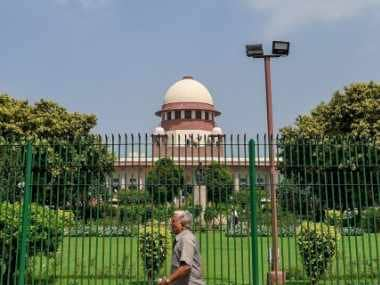
File image of the Supreme Court of India. PTI[/caption]This system of appointment and transfer of judges has evolved through judgments of the Supreme Court, and not by an act of the Parliament or by a provision of the Constitution, says The Indian Express. There is no mention of the collegium in the successive amendments of the Constitution either.If the word of the Constitution is to be followed, then the appointments of judges to the SC and the HCs are made by the President, who is required to meet with sitting judges, or the Chief Justice of India (in case of appointments in the Supreme Court except for the appoint of CJI), and chief justices of high courts (in case of appointments in high courts except for a chief justice of the high court) as per his discretion, before arriving at a decision.Article 124(2) of the Indian Constitution says: "Every Judge of the Supreme Court shall be appointed by the President by warrant under his hand and seal after consultation with such of the Judges of the Supreme Court and of the High Courts in the States as the President may deem necessary for the purpose and shall hold office until he attains the age of sixty-five years. Provided that in the case of appointment of a Judge other than the Chief Justice, the Chief Justice of India shall always be consulted."The other section of the constitution devoted to the appointment of judges is Article 217. It says: "Every Judge of a High Court shall be appointed by the President by warrant under his hand and seal after consultation with the Chief Justice of India, the Governor of the State, and, in the case of appointment of a Judge other than the Chief Justice, the Chief Justice of the High Court."But what actually happens?However, judges of the higher judiciary are appointed only through the collegium system with only a ceremonial participation of the President, says the Times of India. Only after the names of the judges have been finalised by the collegium does the government come in.Here too, the government’s role is limited to asking the Intelligence Bureau to conduct an inquiry into any lawyer who is nominated to be elevated as a judge in a high Court or the Supreme Court. The government can also raise objections regarding the collegium’s choices. However, in such a situation, if the collegium sends back the same names, the government is bound, under Constitution bench judgments, to appoint them as judges.How did the collegium gain acceptance, then?Three judgments, now merged and called the "Three Judges Cases," led to the legitimacy of the collegium. The First Judges Case of 1980 declared that there was no need for the Chief Justice of India to be granted primacy in recommending a candidate to the President.In 1993, a nine-judge bench ruled on what is now called the Second Judges Case. This granted primacy to the Chief Justice of India in appointing the key members of the top judicial brass. For the next five years, confusion reigned on how integral a role the Chief Justice of India would play.This was resolved by the Third Judges Case in 1998, in which, the Supreme Court conclusively asserted the primacy of the Chief Justice of India in the appointments issue. In the same year, then President KR Narayanan issued a presidential reference to the Supreme Court as to what the term "consultation", which the President was required to do with judges before selecting a judge, referred to in the Constitution, reported The Quint.In reply, the Supreme Court laid down nine guidelines for the functioning of the forum which we now know as the collegium.What goes wrong in a collegium?The chief problem with the system that critics have pointed out, is that it does not function out of a rulebook. Because deliberations largely happen behind closed doors, little is known about the selection procedure or the criteria considered for the eligibility of the judges. How and when a collegium meets, and how it takes its decisions are secrets that elude even the lawyers or judges whose names are being considered.Is everyone okay with the idea of the collegium?The NDA government has tried unsuccessfully to replace the system. The Justice MN Venkatachaliah Commission, appointed to recommend on the need for change in the collegium system, said there indeed was. The Commission said a National Judicial Appointments Commission should be formed with the Chief Justice of India, two seniormost judges, the Union law minister, and an eminent person from the public, to be chosen by the President in consultation with the CJI. In 2015, a five-judge Constitution bench declared the move "unconstitutional". However, the 2015 ruling, in the end, also paved the way for a new Memorandum of Procedure to guide the collegium on future appointments.

India rejects Pakistan's 'baseless' claims at Asean, says Indus Waters Treaty to remain on hold
India successfully tests long-range 'Kusha' air defence missile system
Indian trucker arrested in US over alleged theft of $3 million worth of tungsten powder
China has dominated Myanmar’s rare earth mines — now India eyes deal to harness country’s critical minerals
CJP protest in Delhi: New videos of stone pelting, violence emerge as police, agitators trade charges