


Delhi gives its thumbs up to the #OddEvenFormula: But it’s still more odd than even
The Delhi government has reason to be satisfied with people’s response to its odd-even scheme, but environmental experts still believe it’s only a half-measure and a total solution to the air pollution problem needs to go much beyond keeping half the vehicles off the roads on a daily basis

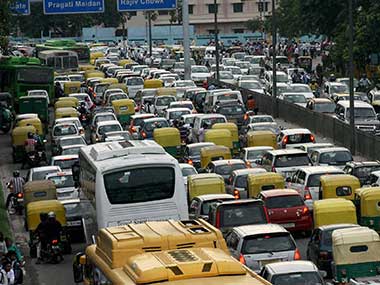
File image of traffic in Delhi. PTI[/caption]The problem with the new announcement, however, is there’s no change in the original format of the scheme. Besides VVIPs, exemption to single women, women drivers (and with kids) and two-wheelers continue to be in place.Ravi Agarwal, director, Toxics Link, remarked, “Creating more road spaces by constructing elevated BRT corridors is a faulty idea. First, it’ll damage the aesthetics of the city plan and second, it’ll lead to multiple-level pollution. The aim should be to have a better public transport system in place, rather than creating more road space and thereby inviting more number of cars on roads. Instead of spending on BRT corridors, investment should be made on expanding public transport system, so that people can voluntarily give up driving cars.”Kejriwal announced that by the end of December, a fleet of 3,000 buses would be added to the existing strength.Anumita Roy Chowdhury, executive director, Centre for Science and Environment (CSE) said, “There should be a clear strategy on the scaling-up of public transport system in Delhi. Only buying buses won’t help. The focus should also be on quality of service, safety for women travelling alone in late hours, wider coverage and last mile connectivity. Elevated corridors are bad news, as they will add to more congestion. In comparison to Mumbai or Kolkata, 23 percent of Delhi’s geographical area has roads.”Delhi has the highest road density of 2,103 kilometres/100 square kilometres in India. According to experts, the Barapulla flyover was constructed to avoid jams (during the Commonwealth Games 2010) and facilitate the smooth movement of athletes, but at present, it witnesses massive traffic congestion.“Delhi has maximum flyovers, yet commuters face severe traffic congestion on these flyovers. Elevated corridors will attract more cars, and people will buy new cars with alternative registration numbers to circumvent odd-even scheme,” she said.The CSE in its earlier reports had expressed a strong concern over extending exemptions to women and two-wheelers.“Continuing with exemption to women and two-wheelers is a major concern. Two-wheelers contribute more than 30 percent of the total pollution caused by the vehicles. It should have also been covered under the odd-even formula. And, should there be class differentiation? Majority of women use public transport in Delhi. Government shouldn’t have continued exemption to women and should have treated them at par. If two-wheelers are brought under the scheme, public buses and auto-rickshaws will get more space on roads to ply on, without facing traffic congestion,” added Roy Chowdhury.According to environmentalists, bikes and scooters emit nearly 32 percent of air pollutants generated by the transport sector in Delhi, whereas private cars are the third biggest polluter—22%, after Diesel-run trucks, which causes nearly 28% of vehicular pollution. In Delhi, there are over 55 lakh two-wheelers including motorbikes and scooters as compared to over 27 lakh private cars.“Exemptions are political considerations. Exempting two-wheelers is a political decision and not scientific. And, what’s the idea of exempting VIPs? Are others less important than a VIP in a democratic system? Unless there’s an efficient public transport system in place, number of cars will go on increasing. It’s a compulsion and not always a luxury,” added Agarwal.

India rejects Pakistan's 'baseless' claims at Asean, says Indus Waters Treaty to remain on hold
India successfully tests long-range 'Kusha' air defence missile system
Indian trucker arrested in US over alleged theft of $3 million worth of tungsten powder
China has dominated Myanmar’s rare earth mines — now India eyes deal to harness country’s critical minerals
CJP protest in Delhi: New videos of stone pelting, violence emerge as police, agitators trade charges