
Advertisement


Sections
Climate change and cities: Green buildings shouldn't be treated as an option anymore
If we need our cities to be sustainable, sustainability would require mainstreaming at every level. It requires stringent and systematic inclusive planning. Green approaches for making cities environment-friendly should not be treated as an option anymore.

The first of the two-part series on climate change and cities delved into the migration, erratic urban flooding, and near-absolute neglect of environmental-friendly measures in policy making process of urban planning. The following second part explains the need and plausible solutions on erecting green buildings in urban landscapes.It’s only a joke to think that cities are being built keeping the environment in mind. Energy-efficient green buildings, at present, account for only five percent of the total stock in India. Surprisingly, of all the cities, which have been selected under the smart city development program, only Bhubaneswar – leading the Smart City list – has shown actual commitment to make its housing infrastructure green. The rest of the cities seem to be ambiguous on this aspect. Moreover, there seem to be no binding on inculcating green building aspects in the construction sector which are presumably most resource-intensive ones. So, what kind of smart cities are we contemplating about?Another important aspect is that of wastage of available resources. A recent report by Knight Frank says that the Mumbai Metropolitan Region has 1.71 lakh unsold apartments which are worth a humungous Rs 1.80 lakh crore. What’s intriguing is – what happens to the unsold inventory and resources like water, sand, electricity, other raw materials which are used to create these spaces?Furthermore, a study conducted by International Water Management Institute deduced that the total water demand in the Business As Usual scenario in India will increase by 22 percent by 2025 and 32 percent by 2050. The per capita water consumption may rise to 200lpcd as against 135lpcd in urban areas. But as per United Nations statistics, only 0.3 percent of fresh water is available in the world. With cities like Delhi, Bengaluru, and Chennai already ferrying water from as far away as 200 km, they will soon have to look for their own fresh water source. So if environmental-friendly factors are considered right from the initial building stage, we may be able to sustain these resources.[caption id="attachment_3078804" align="alignnone" width="825"]![A graphic model of green building. Image courtesy: YouTube @TERI]() A graphic model of green building. Image courtesy: YouTube @TERI[/caption]How will green buildings help?If we go by the definition, green buildings efficiently use basic resources like energy, water, and electricity reducing water wastage and pollution. These buildings are developed considering the building layout for adequate solar orientation and proper ventilation which in turn reduces the heat intake and maximises the glare-free daylight. They are also efficient in treating waste water.However, while discussing urban spaces or built environments at large, what is not often considered is the butterfly effect it can cause. Any given building or a standalone structure is not an independent unit but is tremendously dependent on the resources around. The urban spaces should be crafted considering the present as well as the future state of resources.Mitigating the building sector’s greenhouse gas emissions requires integrated innovative solutions and sustainable technologies. For instance, Building Integrated Photovoltaics (picture below) can reduce the electricity consumption while using the already available building surfaces.[caption id="attachment_3078808" align="alignleft" width="380"]
A graphic model of green building. Image courtesy: YouTube @TERI[/caption]How will green buildings help?If we go by the definition, green buildings efficiently use basic resources like energy, water, and electricity reducing water wastage and pollution. These buildings are developed considering the building layout for adequate solar orientation and proper ventilation which in turn reduces the heat intake and maximises the glare-free daylight. They are also efficient in treating waste water.However, while discussing urban spaces or built environments at large, what is not often considered is the butterfly effect it can cause. Any given building or a standalone structure is not an independent unit but is tremendously dependent on the resources around. The urban spaces should be crafted considering the present as well as the future state of resources.Mitigating the building sector’s greenhouse gas emissions requires integrated innovative solutions and sustainable technologies. For instance, Building Integrated Photovoltaics (picture below) can reduce the electricity consumption while using the already available building surfaces.[caption id="attachment_3078808" align="alignleft" width="380"]![Solar photovoltaic panels. Reuters]() Solar photovoltaic panels. Reuters[/caption]Solar passive design techniques, which can help cut down the need for artificial ventilation, heating, and cooling systems, can significantly contribute to mitigating the urban heat island effect. In the wake of recent Montreal Protocol Amendments, this simple approach can help us leapfrog in the direction we have committed to. If these measures are incorporated at the unit level (considering individual structures), it would make them more responsive to the surroundings. The city corporations should make these climate responsive techniques invariably a part of its bye-laws, to tame the impact of changing climate to a pronounced extent.Green building components should be monitored and regulated irrespective of any rating systems in cities, especially for new construction. The city corporations should retain the ecologically sensitive zones, like salt pans, mangroves, wetlands, lakes especially in the cities like Bangalore, Mumbai, and Delhi, where development is rampant.Needless to say, the youth, citizens and policy makers should be positively made aware of the urgent need of environmental issues on the sustainable development and relevant measures. The city and local governments can play a significant role in mainstreaming the mitigation actions into the developmental process.Cities and built environments are inevitable. However, what needs to be rectified is our approach in creating them. Cities cannot be built overnight. Neither can the world afford to treat them as a mere sporadic response to the rising demands of population and economic growth. If we need our cities to be sustainable, sustainability would require mainstreaming at every level. It requires stringent and systematic inclusive planning. Green approaches for making cities environment-friendly should not be treated as an option anymore.Here's an explainer video on green buildings and how useful they are:The author is an Associate Fellow with Sustainable Habitat Division of The Energy and Resources Institute (TERI), Navi Mumbai
Solar photovoltaic panels. Reuters[/caption]Solar passive design techniques, which can help cut down the need for artificial ventilation, heating, and cooling systems, can significantly contribute to mitigating the urban heat island effect. In the wake of recent Montreal Protocol Amendments, this simple approach can help us leapfrog in the direction we have committed to. If these measures are incorporated at the unit level (considering individual structures), it would make them more responsive to the surroundings. The city corporations should make these climate responsive techniques invariably a part of its bye-laws, to tame the impact of changing climate to a pronounced extent.Green building components should be monitored and regulated irrespective of any rating systems in cities, especially for new construction. The city corporations should retain the ecologically sensitive zones, like salt pans, mangroves, wetlands, lakes especially in the cities like Bangalore, Mumbai, and Delhi, where development is rampant.Needless to say, the youth, citizens and policy makers should be positively made aware of the urgent need of environmental issues on the sustainable development and relevant measures. The city and local governments can play a significant role in mainstreaming the mitigation actions into the developmental process.Cities and built environments are inevitable. However, what needs to be rectified is our approach in creating them. Cities cannot be built overnight. Neither can the world afford to treat them as a mere sporadic response to the rising demands of population and economic growth. If we need our cities to be sustainable, sustainability would require mainstreaming at every level. It requires stringent and systematic inclusive planning. Green approaches for making cities environment-friendly should not be treated as an option anymore.Here's an explainer video on green buildings and how useful they are:The author is an Associate Fellow with Sustainable Habitat Division of The Energy and Resources Institute (TERI), Navi Mumbai
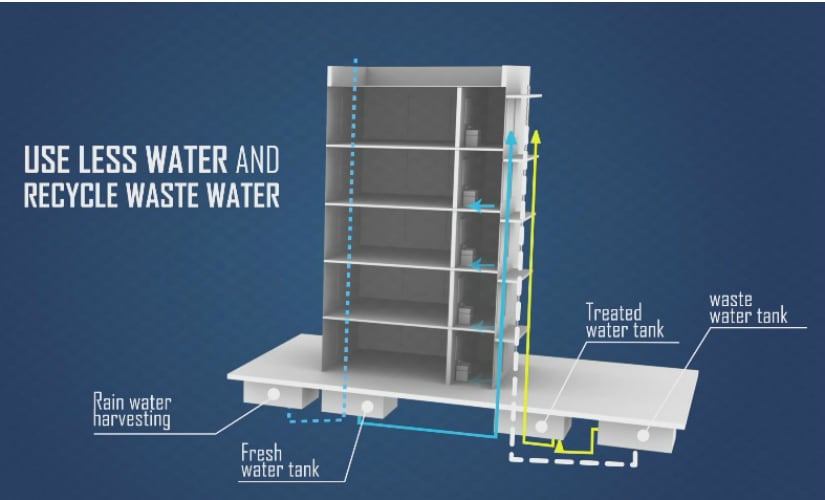 A graphic model of green building. Image courtesy: YouTube @TERI[/caption]How will green buildings help?If we go by the definition, green buildings efficiently use basic resources like energy, water, and electricity reducing water wastage and pollution. These buildings are developed considering the building layout for adequate solar orientation and proper ventilation which in turn reduces the heat intake and maximises the glare-free daylight. They are also efficient in treating waste water.However, while discussing urban spaces or built environments at large, what is not often considered is the butterfly effect it can cause. Any given building or a standalone structure is not an independent unit but is tremendously dependent on the resources around. The urban spaces should be crafted considering the present as well as the future state of resources.Mitigating the building sector’s greenhouse gas emissions requires integrated innovative solutions and sustainable technologies. For instance, Building Integrated Photovoltaics (picture below) can reduce the electricity consumption while using the already available building surfaces.[caption id="attachment_3078808" align="alignleft" width="380"]
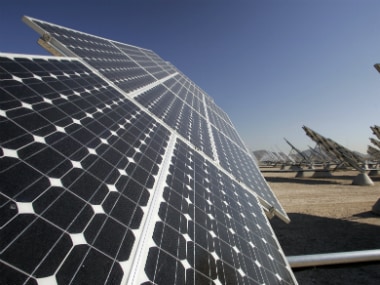 Solar photovoltaic panels. Reuters[/caption]Solar passive design techniques, which can help cut down the need for artificial ventilation, heating, and cooling systems, can significantly contribute to mitigating the urban heat island effect. In the wake of recent Montreal Protocol Amendments, this simple approach can help us leapfrog in the direction we have committed to. If these measures are incorporated at the unit level (considering individual structures), it would make them more responsive to the surroundings. The city corporations should make these climate responsive techniques invariably a part of its bye-laws, to tame the impact of changing climate to a pronounced extent.Green building components should be monitored and regulated irrespective of any rating systems in cities, especially for new construction. The city corporations should retain the ecologically sensitive zones, like salt pans, mangroves, wetlands, lakes especially in the cities like Bangalore, Mumbai, and Delhi, where development is rampant.Needless to say, the youth, citizens and policy makers should be positively made aware of the urgent need of environmental issues on the sustainable development and relevant measures. The city and local governments can play a significant role in mainstreaming the mitigation actions into the developmental process.Cities and built environments are inevitable. However, what needs to be rectified is our approach in creating them. Cities cannot be built overnight. Neither can the world afford to treat them as a mere sporadic response to the rising demands of population and economic growth. If we need our cities to be sustainable, sustainability would require mainstreaming at every level. It requires stringent and systematic inclusive planning. Green approaches for making cities environment-friendly should not be treated as an option anymore.Here's an explainer video on green buildings and how useful they are:
First Published:Oct 30, 2016, 14:43:19 IST
Advertisement
Advertisement

China has dominated Myanmar’s rare earth mines — now India eyes deal to harness country’s critical minerals
India is deepening rare earth cooperation with Myanmar as New Delhi seeks alternative sources of critical minerals dominated by China, including dysprosium and terbium used in EVs, defence systems and clean energy technologies
6 min read
CJP protest in Delhi: New videos of stone pelting, violence emerge as police, agitators trade charges
Fresh videos of violence that broke out during the Cockroach Janta Party's (CJP) protest in Delhi have surfaced, with the police releasing footage showing alleged stone pelting, vandalism and attacks on security personnel
3 min read
'From make in India to launch from India': Skyroot COO on why Vikram-1 could change India’s space sector
Skyroot Aerospace’s successful Vikram-1 mission marks a major milestone for India’s private space sector, as the country seeks to shift from “Make in India” to “Launch from India” and compete in the global commercial satellite launch market
8 min read
Choke terror funding, keep international shipping lanes safe: Jaishankar at Asean Regional Forum
Jaishankar's remarks came against the backdrop of recent terror attacks targeting India and growing threats to commercial shipping amid conflicts in West Asia and Europe
2 min read
PM Modi announces fast-track courts for paper leak cases; CJP responds ‘Dharmendra Pradhan must go’
Amid protests demanding accountability for the leak of medical entrance test Neet and other irregularities in the education system, Prime Minister Narendra Modi has announced that the government has decided to set up fast-track courts to ensure swift and stringent punishment for those involved in paper leaks.
3 min read
Advertisement
Advertisement